For Kathmandu to Pikey Peak, you will first travel to the trek starting point-Dhap Bazaar and Phaplu by road and flight to begin your trek to Pikey peak. The most popular and budget-friendly method is to take a shared public jeep or a private jeep to Dhap, the main starting point for the Pikey Peak trek.
Kathmandu to Pikey Peak Jeeps leave early in the morning at around 5:00 AM from Kathmandu. The drive is long and can take 8 to 10 hours, depending on road conditions and traffic. The roads can be bumpy, especially the final stretch. It costs approximately USD 25 to USD 35 per person.
The Private Jeep journey from Kathmandu to Pikey Peak is faster and more comfortable, typically taking 6 to 7 hours. A private jeep for the round trip can cost between USD 400 to 500 (one way around USD 200-250). It offers greater comfort, flexibility, and a shorter travel time.
Flight and Road Travel finishing point-Phaplu is recommended. You can save significant time on the return journey by flying back to Kathmandu from Phaplu, a nearby airstrip. Kathmandu to Dhap travel by jeep as described above to begin your trek.
Phaplu to Kathmandu by bus/jeep after completing the trek which typically ends in Phaplu or Salleri, you can also take a short flight. The flight takes about 30 minutes. The flights typically cost around USD 180 per person. Flights are not daily, so booking in advance is essential. You can also take a shared or private jeep from Phaplu/Salleri back to Kathmandu that takes 8 to 10 hours.
Kathmandu to Pikey Peak Distance
The driving distance from Kathmandu to the trailhead of the Pikey Peak Trek is approximately 230 to 280 km, taking about 7 to 10 hours by road to reach Dhap or Salleri, the common starting and ending points. The total driving distance for the entire trek, from Kathmandu to Salleri and back, is about 515 to 523 km.
Kathmandu to Pikey Peak trailhead by overland
Kathmandu to Dhap is drive of about 230 km, taking 7 to 9 hours by jeep. This is a common starting point for the trek. Kathmandu to Salleri is a drive of about 270 km, taking 7 to 8 hours. This is often the end point of the trek.
The Total Distance Of The Trip
The total driving distance is approximately 515 km to 523 km, depending on the exact route and starting/ending points. This includes the drive to Dhap and the drive back from Salleri. The total distance of pikey peak trek will vary depending on the specific itinerary and the route chosen for the trek itself, which is approximately 55 km to 60 km. Below is some of our particular pikey peak trek itinerary.
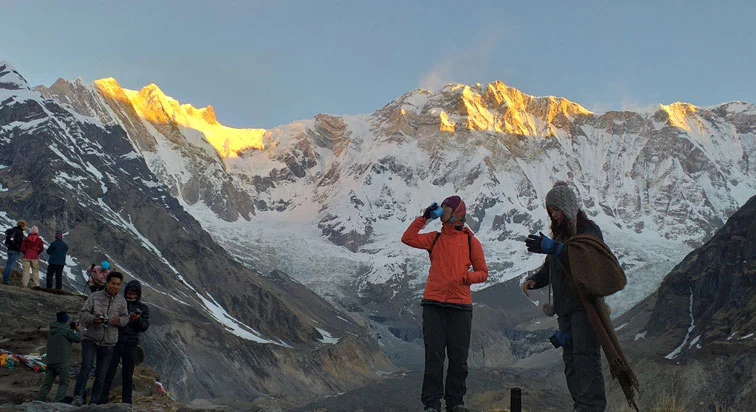
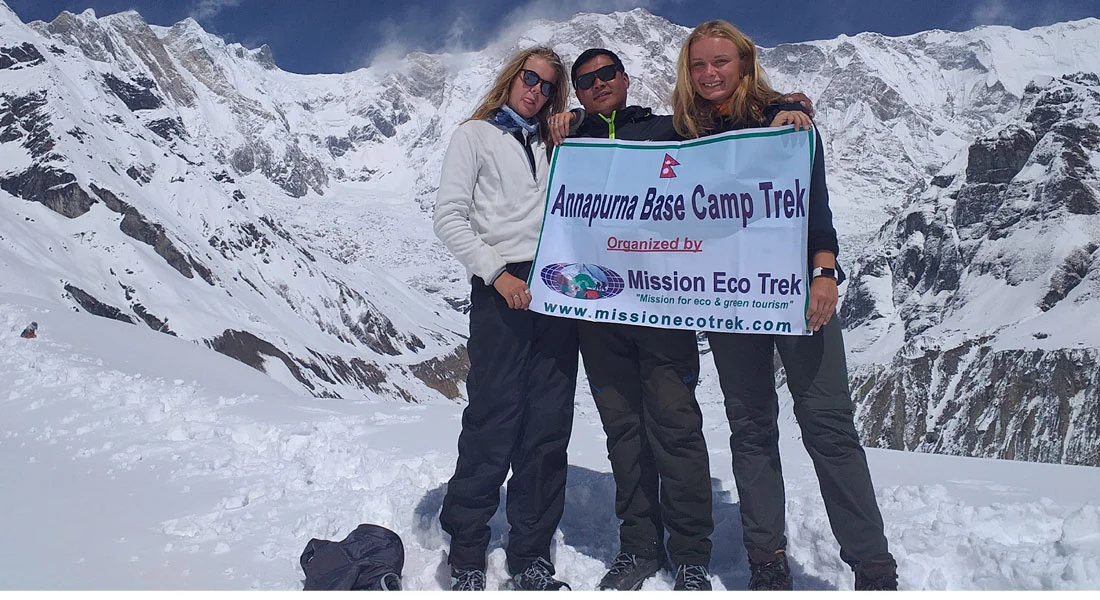
The trek from Pokhara to Annapurna Base Camp (ABC) is a multi-day hike of 7 to 14 days, depending on the route and stops. The journey typically begins with a drive from Pokhara to a starting point like Nayapul, Siwai, Ghandruk or Ulleri followed by trekking through various villages to reach ABC at an altitude of 4,130 meters. The total trek distance is about (115 to 120) km, though this can vary based on your specific path and side trips.
Ghandruk is a beautiful Gurung village offering stunning views of the Annapurna and Machapuchare mountains. Chhomrong is a key village on the main route, offering more spectacular views. Machapuchare Base Camp (MBC) is located at 3,700 meters, this is the last stop before ABC and offers incredible views of the “Fishtail” mountain. Annapurna Base Camp (ABC) at an elevation of 4,130 meters, this is the final destination, where you are surrounded by a magnificent amphitheater of Himalayan peaks.
ABC Trip Distance and Cost for Meals and Accommodation
The Annapurna Base Camp round trip from the starting point near Pokhara to ABC is approximately 70 kilometers, with a total distance of up to 95 kilometers including the journey from Pokhara.
The Annapurna Base Camp route has teahouses that provide accommodation and meals. For food and accommodation, approximately $30 per day is often sufficient, while guides and porters cost extra.
Annapurna Conservation Area Permit (ACAP) is required to enter the Annapurna Conservation Area. TIMS (Trekkers’ Information Management System) card is also required for trekking to Annapurna base camp.
You can trek independently, obtaining your own permits and arranging accommodation. Many choose to hire a guide and porter for a guided tour to ABC. Book a fully organized tour through a local company. A professional guide may cost $30 and more per day, while a porter costs around $25 per day.
The most popular seasons for the ABC trek-Spring (March–May) features clear skies and rhododendron blooms. Autumn (September–November) offers stable weather and excellent mountain views.
The ABC trek is considered moderately difficult. It is accessible to anyone with a moderate level of fitness and the right preparation. The itinerary allows for a gradual ascent, which helps with acclimatization to the high altitude.
Kathmandu to Pokhara Travel Ways
There are three primary ways to travel from Kathmandu to Pokhara by air, tourist bus, and private car. The best option for you depends on your budget, time, and comfort preferences.
Kathmandu to Pokhara by flight
Flying is the fastest and most comfortable option, with flights lasting only 25 to 30 minutes. The major carriers serving this route include Buddha Air and Yeti Airlines.
Flights are significantly more expensive than ground transport. Prices vary depending on demand, but a one-way ticket can start around $100–$140.
Flights offer greater schedule flexibility and save a full day of travel time. However, delays and cancellations are common, especially during the monsoon season, due to adverse weather.
Kathmandu to Pokhara by tourist bus
Taking a tourist bus is a popular and budget-friendly choice, offering a scenic journey along the Prithvi Highway. The trip can take 7 to 10 hours, but significant delays from roadworks, traffic, and accidents can extend the travel time.
The Buses typically depart every morning around 7:00 AM from Kathmandu. While more affordable than a flight, road conditions can be bumpy. For a more comfortable trip, many travelers recommend booking a “luxury” or “deluxe” bus, which features air conditioning and better seats. The standard bus tickets cost around USD 12 to USD 20 per person.
Kathmandu to Pokhara by private car
A private car provides a balance of comfort and flexibility between flying and taking the bus. A private vehicle typically takes 6 to 7 hours, including a stop for lunch. However, delays due to traffic and road conditions are still possible.
This option allows you to stop for breaks and photos along the way and travel at your own pace. A private car is more expensive than the bus but can be cost-effective for a small group. A car ride can cost around $130 for up to four people. The route follows the Prithvi Highway and features scenic drives along rivers like the Trishuli and Marsyangdi.
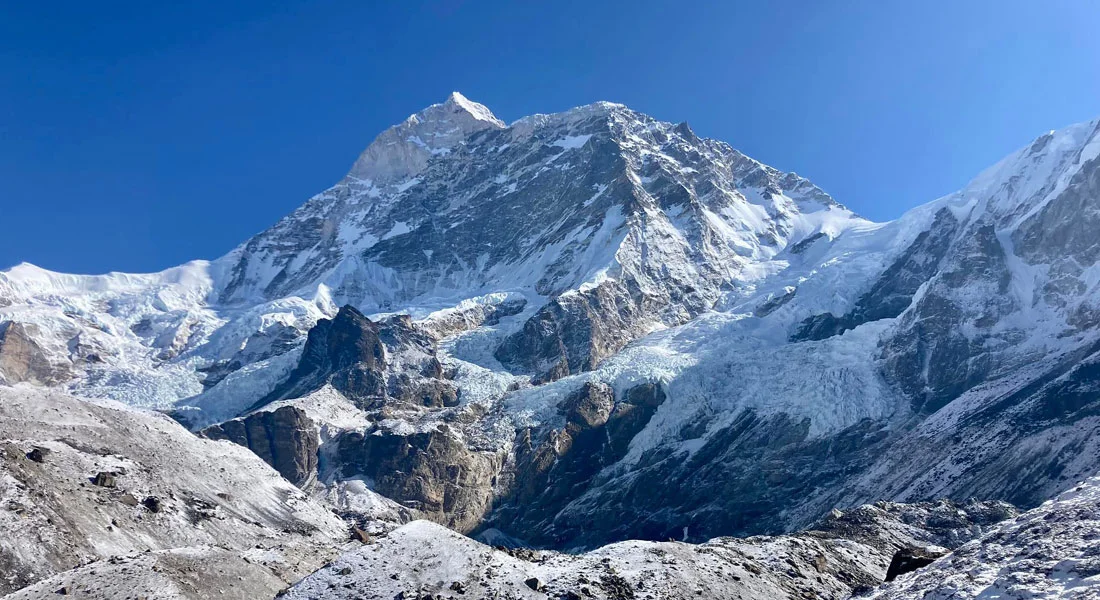
Mount Makalu, the 5th highest mountain in the world.
Mount Makalu Nepal is the fifth-highest peak on Earth, lying on the Nepal-Tibet border, famous for trekking and climbing in Nepal. Learn more about the towering beauty of Mt Makalu, including its first ascent, permits, routes, and the number of days of trekking and climbing.
Mount Makalu Nepal Facts
Height: 8,485 meters / 27,838 feet First Ascent: May 15, 1955, by Lionel Terrey and Jean Couzy Location: Nepal/Tibet border in Mahalangur Himalayas Deaths: 35 (as of 2022) Summit Success Rate: 34%
Key Notes of Mt Makalu Nepal
Distinctive Pyramid Summit The Makalu summit is characterized by its pyramid shape, a distinctive feature that sets it apart from other peaks. The sharp angles of the Makalu summit create a captivating silhouette against the backdrop of the Himalayan sky.
Challenging Ascent Makalu presents a formidable challenge to climbers, earning its reputation as one of the most technically demanding climbs in the world. The ascent involves navigating steep rock walls, ice slopes, and unpredictable weather conditions, testing the skills and resilience of even the most experienced mountaineers.
Makalu Climbing Routes Makalu offers various climbing routes, each with its own challenges and rewards. The most popular route is the standard Southeast Ridge, known for its technical difficulty and breathtaking views. Other paths – the West Pillar and the Northeast Ridge, provide alternative options for seasoned climbers.
Stunning Panoramas The summit of Makalu offers panoramic views of some of the world’s highest peaks, including Everest, Lhotse, and Kanchenjunga. The expansive vistas from Makalu’s peak are a visual feast, rewarding climbers with an unparalleled experience of the Himalayan landscape.
Untouched Wilderness Makalu’s remote location and challenging terrain contribute to the preservation of its pristine wilderness. The surrounding Makalu Barun National Park, a biodiversity hotspot, is home to a diverse range of flora and fauna, making the region a haven for nature lovers and conservation enthusiasts.
History of Makalu Ascents
For centuries, Makalu remained an unknown peak shrouded in clouds and mystery. It was only identified as the world’s fifth highest in the 1850s. After an expedition in 1954, a French team made the first ascent in 1955, two years after the first ascent of Everest (the highest mountain in the world).
The technical difficulty and isolation of Makalu and political restrictions meant few attempts in the early years. By 1970, there were only six successful summits. A legendary American team in 1970 finally conquered the southwest Makalu face.
In the modern era, easier access and routes have enabled more expeditions. But the summit success rate still hovers around 34%, making Makalu among the hardest 8000ers to climb. Storms, avalanches, and technical rock sections regularly turn back teams each season.
Mount Makalu Climbing Permits Costs Makalu-Barun National Park Entry Permit Nepal Government royalty fees Makalu permit (Peak climbing permit) per person, issued by Nepal Mountaineering Association (NMA) Liaison officer expenses (Mandatory for teams) Visa costs for Nepal Flights to/from Kathmandu Insurance, food, supplies, oxygen, etc. We suggest you contact an experienced operator to make the complex logistical and permitting process smoother. You should prepare for the permits 4-6 months in advance of your climb.
Best time to climb Mount Makalu The best time to climb Makalu is either spring or autumn. Spring is the most favorable due to the right temperature and the clear skies. In spring, April, March, and May months are popular. You can also climb Makalu during autumn in September, October, and November.
Climbing Makalu The first step for a Makalu climb is securing a permit. It is an essential step for mountaineers undertaking this challenging expedition. The permit, issued by the Nepalese government, ensures that climbers adhere to regulations designed to preserve the environment and promote responsible mountaineering.
Acclimatization The climbing journey typically begins with an acclimatization process, allowing climbers to adapt to the high-altitude conditions. The trek to Makalu Base Camp, situated at approximately 4,800 meters, serves for acclimatization and preparation for the ascent.
Routes on Mount Makalu Southeast Ridge: This is the original and most common route, first climbed in 1955. It follows the long Southeast ridge, joining the main summit ridge. However, this route is highly prone to rockfall and avalanches, yet this route is not as technical as the northeast ridge.
Northeast Ridge: A direct route first climbed in 1971 involving steep snow, ice, and mixed terrain. It joins the southeast ridge higher up. This path is steeper and harsher to climb than the southeast ridge.
West Pillar – This is a technical route first climbed in 1971 that meets the southern ridge just below the summit. The route is exposed, and the strong winds are frequent.
West Face – Among other routes, this is the most challenging route as it passes through avalanche-prone areas with huge serac barriers. This route was first summited in 1997. All routes require expertise in rock, snow, and ice climbing. Southeast Ridge is the most commonly taken route.
Southeast ridge of Mt. Makalu Southeast ridge is the most frequented route to Makalu Peak. Here are the climbing details through this route.
Makalu Base Camp (5600M): Reaching Makalu Base Camp is the first step for a Makalu Expedition. This base camp serves as the preparation and an acclimatization point for the Makalu expedition.
Makalu Camp 1 (6400m): Once prepared at the Base Camp, you will head to Camp 1. The path passes through rock slabs and moraine before reaching a glacier. It will take around three to four hours to reach the first Camp. The first Camp consists of two sections – lower and upper.
Makalu Camp 2 (6800m): The path from Makalu Camp 1 and Makalu Camp 2 is intermediate in terms of climbing complexity. You will have to cross several steep ice areas. Though you do not need a ladder to complete this section, you must take support from ropes. The average time to reach Camp 1 to Camp 2 is around three hours.
Makalu Camp 3 (7450m): This is the longest section between the camps. You will have to cross a few crevasses and follow the ropes placed by Sherpas. It will take around four hours to reach Camp 3 from Camp 2.
Makalu Camp 4 (7900m): The distance between Camp 3 to Camp 4 is short, but due to altitude and the rough terrain, the climb gets progressively harder as you get closer to the death zone. Due to low oxygen levels, you must push yourself. It will take around 3 hours to reach Camp 4 from Camp 3 as you conquer the route that averages around 50 percent.
Makalu Summit (8485m): After setting up a series of camps along the mountain for acclimatization, the summit push begins from Makalu Camp 4 before midnight to reach the summit at daylight. You must brave 50-60-degree snow slopes using fixed ropes to negotiate steep rock bands and ice cliffs while fighting exhaustion, oxygen deprivation, and bitter cold (-40 C). This 12-18 hour push requires every ounce of strength and stamina. Teamwork is crucial to getting through complex sections. The summit rewards those who endure but comes at a heavy price.
The Challenges of climbing Mount Makalu Makalu is extremely dangerous, and underestimating the mountain can be fatal. You must be ready to face the challenges like
Altitude sickness, edema, exhaustion Sudden blizzards and whiteouts Massive avalanches and ice/rock falls Deep hidden crevasses Cornices and exposed knife-edge ridges Technical climbing errors and accidents You must stay within your limits, plan carefully, trust Sherpa’s judgment, and turn back in time to survive this peak. Makalu continues to claim lives each year.
Is Makalu Right for You? Before embarking on a Makalu expedition, you must honestly assess the skills and experience required. Ask the following questions. Makalu is not to be underestimated. Come prepared for the challenge of a lifetime with humility, caution, and respect for the mountain. The rewards of standing atop this iconic Himalayan pyramid are immense but earned only through determination, suffering, and accepting real risk. Few peaks transform climbers like Makalu.
About Makalu Trekking
Makalu Trek takes you to Makalu Base Camp is in the heart of Makalu-Barun National Park in the Eastern Nepal. Makalu Base Camp Hike is ideal for an experienced trekkers to explore wilderness and stunning natural scenery of Makalu region. Mt Makalu is the 5th highest peak in the world and famous for its outstanding diversity of flora and fauna.
Makalu, an off-the-beaten-path trek in the Himalayas of Nepal presents an intense physical challenge compared to other treks in Nepal. Makalu Trek takes most trekkers at least 8 days to reach Makalu Base Camp (5,050 m). Trekkers then need to retrace their steps on 5 to 6-day journey back out the same way they came in.
At the base camp of Makalu offers a clear view of the mountain. Each morning, you can watch the sunrise over the summit of the fifth tallest mountain in the world. A short walk up the slopes from basecamp reveals incredible views of Everest and Lhotse. The Makalu Base Camp Trek is perfect for adventurers who are looking to avoid the crowded trekking routes of Nepal to experience an authentic experience of trekking amongst the giants of the Himalayas.
Highlights of Makalu Trek
View points
Makalu is derived from the Sanskrit, Maha Kala, which is a name for the Hindu God Shiva. When you stand at base camp and stare up at Makalu you could feel as if you’re in the presence of the gods.
Local life
The villages and trails of Makalu region are a mish-mash of peoples, cultures and religions. In the higher villages live the Buddhist Sherpas, originally from eastern Tibet, while the Rai people, many of whom still follow the ancient Kranti religion, live at lower levels. Whatever their background the welcome is always a warm one.
Bio-diversity
Makalu forms the heart of the Makalu-Barun National Park, a super diverse 2,330sq-km protected area with an 8,000m vertical spread of elevation, ranging from tropical river valleys to the frozen summits of some of the world’s biggest mountains. Not surprisingly, there’s a huge diversity of life and growing species of flowering plants. There’s also the full spectrum of wildlife, from snow leopards to red pandas; black bears to sunbirds.
Exploration possibilities
Almost all of the people who trek Makalu take a simple up and down route along the same path. For those with plenty of time and stamina, and who are very well-equipped with a full, experienced expedition-style support team, there are wildly exciting treks to Kanchenjunga or even Everest.
The Mount Makalu Trek Routes
A. Makalu Base Camp
There’s only one standard route to Makalu base camp and it’s a simple there and back along the same trail. But this is a real wilderness trek and there are only permanent villages for the first and last couple of days. Most of the time the only other people you’ll meet are herders with their yaks. One of the highlights of this trek is camping in gorgeous spring flower meadows well away from other people and waking to soaring mountain views.
Once you clear the villages the route climbs steeply through forests, crosses the high and often snowy Shipton Pass (4,127m; named after Eric Shipton who followed this route with Sir Edmund Hillary during the 1952 Everest reconnaissance expedition) and then goes along the Barun Valley past rapids and waterfalls. Eventually, after crossing scree fields and landslide debris, the valley opens out and you arrive at base camp.
The view at base camp will send shivers of wonder down your spine, but climb up to the nearby ridge on Peak 3 for even more stunning Makalu views as well as side views of Lhotse, Lhotse Sar and Everest. You’ll probably be the only person up there.
B. Fact of Makalu Base Camp Trek
Difficulty: Difficult.
Lots of steep up and down and the fast elevation gain means the risk of altitude sickness is high. Trek Duration: 14 days Max Elevation: 4,870m Accommodation: Camping; very basic herders’ tea houses. Start/End Point: Num
Makalu Circuit Trek(Makalu to Everest)
One of the most challenging treks, the Makalu to Everest traverses via the very high passes of Sherpani (6,135m), West Col (6,143m), Baruntse Base Camp (5,700m) and Amphu Laptsa (5,850m) before descending into the Everest region at Pangboche. You should allow a minimum of three weeks for this trek and a lot more if you want to explore the Everest region in depth. You will need full expedition equipment, an experienced team, mountaineering experience and to be prepared for many nights’ camping above 4,500m.
Facts Of Makalu Circuit Trek
Difficulty: Very strenuous. Borderline mountaineering. Trek Duration: Minimum 21 days Max. Elevation: 6,143m Accommodation: Camping; very basic herders’ tea houses, trekking lodges. Start/End Point: Num/Lukla
Makalu to Kanchenjunga Trek
In recent years a few daring groups have launched expedition-style treks that link Makalu with Kanchenjunga via the 5,160m Sumba Lumba pass. It takes almost four weeks and a lot of determination, but for most people it’s a slightly more realistic proposition than the Makalu to Everest trek mentioned above. Like that trek, you need to approach it as a full expedition and have experience at high altitude and basic mountaineering skills.
Fact of Makalu to Kanchenjunga
Difficulty: Very strenuous/borderline mountaineering. Trek duration: 25 days Max elevation: 5,160m Accommodation: Camping/basic tea houses Start/end point: Num/Taplejung
Attractions of Makalu Circuit Trek
Makalu Circuit Trek is a challenging trek that takes you through breathtaking landscapes, remote villages, and high altitudes, offering stunning views of the Himalayas. The trek typically takes about 14-25 days to complete, depending on the itinerary and the trekker’s pace. It is compulsory for all international trekkers to have a licensed guide for hiking. It is nice to organize a guide through a good trekking company. It is an easier option because they will arrange a guide for you and plan your entire trip. Just make sure you will have a reliable guide with the license.
Makalu Trek Difficulty
The Makalu Base Camp Trek is slightly more difficult than Everest Base Camp or the Annapurna Circuit due to the incline, remoteness, and rugged nature of the trails. You will reach an altitude of 5000m, which will challenge many. Altitude sickness can be common. The route has lots of undulation with several days purely walking upstairs on stairs. These days of ascent are tiring and also require the body to adjust quickly.
Makalu Circuit Trek Permits
You will need a Makalu Barun National Park Conservation Area permit (USD $30 per person and a Trekkers’ Information Management Systems (TIMS) card (USD $20 per person) to do Makalu Trek.
Best Seasons for Makalu Trek
The peak season for the Makalu Base Camp Trek is March to April and October to November. The time to avoid this trek is during the rainy season from June to August. During the winter from December to February, this region gets very cold and there will be snow cover in the higher parts of the trek. Many of the guesthouses actually close up for the winter and re-open in late February to March. However, it is possible to hike the Makalu Base Camp Trek on the fringe of the season in late February/early March and it can be quite beautiful with snow cover.
Hike to Makalu Base Camp Trek in late April/early May and it will be warm during the day and got pretty cold at night. The Shipton La had good snow cover but other than that the paths were clear. We did not need crampons.
Is guide necessary for trekking to Makalu?
A guide is necessary. However, the guide manages all of the logistics, distances, directions, and tea houses for your group. If it’s your first-time trekking in Nepal, I would suggest having a guide.
Makalu Trek-Accommodation
There are basic homestay style tea houses and lodges throughout the route. Fancy lodging and dining facilities are not available. Most tea houses have basic rooms with twin beds, hard mattresses, and blankets. Carrying sleeping bag, mattress and travel liner will keep you warm, on cold nights.
No Camping required as the basic tea houses are available along the way to Base Camp. There are three tea houses at most of the camps including at Makalu Base Camp. But, Mambuk has only one tea house. One lodge can accommodate only six to eight persons per day.
For larger groups, you either have to split between the tea houses or go camping. When you are staying at the tea houses, the rooms are basic with shared toilets and bathrooms. The toilets have Nepali style commodes. For bathing, tea houses can arrange you a bucket of hot water.
Packing Lists for Makalu Trek
Please pack pretty light and manage to wash most of your clothes each afternoon/night for the first half of the trip. In the latter stages of the trip, it is pretty cold and wear warm gear basically nonstop while at the teahouses. There will be no real need for multiple outfits. This is just a guide and it works quite well. You need a sleeping bag as there are not blankets in each guesthouse and when gets cold you also need a good down jacket.
1 pair of pants that maybe convert to shorts 1 pair of shorts 1 Warm or thicker pair of hiking pants 1 Long sleeve quick-dry shirt 1 Long-sleeve thermal shirt 2 Short-sleeve t-shirts 1 Thermal long underwear 4 pairs of quick-dry underwear 1 Lightweight down jacket 1 Heavy-duty summit down jacket 1 Beanie 1 Cap 1 Sunglasses 1 Neck Buff 1 Gloves Hiking boots Micro spikes Headtorch 1 pair Gaiter 1 pair of warm summit socks 2 pairs of regular socks 1 Sunscreen 1 Trekking poles 1 Water filter 1 Power bank
What size of backpack you need to bring trek to Makalu?
All of this should fit into a backpack no bigger than 50L and should be less than 14kg.
How is WIFI Connection during Makalu Circuit Trek?
Unlike many treks in Nepal there is almost no Wi-Fi on this route. NTC sim card work for the first day and a half on the trek but once we reached Tashigaun, the connection is over.
Be prepare not to have electricity, hot water, or wi-fi on the trek even if a place has all the facilities. Often something doesn’t work and there is no power in the village, it is a cloudy day and a solar panel couldn’t warm water in the shower, they ran out of Internet cards, there is no running water because pipes are frozen. I’d recommend asking if everything works fine before checking in.
What is the situation of Electricity?
This was the least power I have experienced on a trek in Nepal so far. Once we left Tashigaun, most places ran off solar and didn’t have places to charge items for the clients. It was possible but not something offered for a fee like in other teahouses around Nepal.
Makalu Circuit Trek Cost
The Makalu Circuit Trek cost ranges from USD 1850 to USD 3550, it depends on the length of trek and the services. Basically, the price covers your transport, accommodation, food, guide fees, porter and trekking permit fees. Any kind of drinks such as beer, snacks, hot showers, recharging your phone or camera, tipping the guide and porter are not included in the package price.
Meals on Makalu Trek.
The meals are quite diverse and usually includes Nepalese, Chinese, Indian, and Western food. The typical dishes on the Makalu Circuit are pasta, noodles, rice with vegetable/chicken/cheese and tomato sauce, omelet, and fried, boiled, or scrambled eggs with potato/cheese/vegetable. Dal Bat (rice, roasted vegetable, chapati, and lentil soup) is the most typical local food. Momos (local dumplings), all sorts of soups (chicken, vegetable, garlic, tomato, noodle, etc.), pizzas, pancakes, different types of bread (chapati, Tibetan bread, toast), porridge, muesli, etc. There is a variety of hot beverages of different teas such as lemon, ginger, Masala, milk, mint, instant coffee.
As you can see there are really many options. You don’t have to eat the same food, you can try something different every day. If you’re vegetarian, vegan, or follow a certain diet you’ll be able to find suitable food. The problem is a lack of fresh fruit and vegetables, especially at higher altitudes. The best value-for-money food on the Makalu Circuit trek is local Dal Bhat. We really like local soups they’re always good. To make a meal more filling you can order Tibetan bread or chapati with it. For breakfast, we usually are omelet, fried eggs, or porridge.
Is travel insurance necessary for Makalu Trek
Nepal can be a dangerous place for trekking or hiking because the high altitude can lead to many illnesses, weakness in trekkers, and misjudgments. There is also a risk on trails for falls, avalanches and other mishaps. Your regular travel insurance probably won’t cover you at high altitudes and won’t cover a helicopter evacuation. There is a solution though.
Travel insurance is necessary for Makalu Trek. It is nice to provide the name and the phone number of your insurance company. You are required to provide your own insurance coverage from your home country. This should be valid for high altitude trekking and helicopter rescue. It’s actually required when applying for the TIMS card hiking permit to have insurance. Getting injured or sick at isolated locations, especially at altitude evacuation can be very complicated and expensive. Travel insurance with coverage for emergency medical, lost luggage, trip cancellation and helicopter rescue/evacuation.
Tips to guide and porter
The guide and porter will expect a tip. This can reflect your overall satisfaction but it should be in the region of USD 150 for a guide, USD 100 for a porter. This amount is shared between the trekkers in your group.
Safety
You have already done the groundwork regarding the safety record of the trekking company, and you have bought your insurance. The guide will be carrying a first aid kit. But we recommend you also carry your own, particularly if there are special medicines you require. Probably the most common injury on a trek is a sprained ankle or sunburn. But you should also take into consideration altitude sickness.
Altitude Sickness
This is not something we can predict. It is not known why some people suffer while others do not. It has nothing to do with age or fitness level. Pushing ahead too quickly, climbing too high too fast can result in problems. AMS or Acute Mountain Sickness occurs when we ascend too quickly. Normally at altitudes 3,000m/ 9,840ft or over.
What does it feel like?
Headache, shortness of breath and light-headedness. These are also related to being dehydrated. Stay hydrated and your body will most likely adjust to the altitude itself.
What if it gets worse?
If the symptoms continue, tell your guide. Especially if you are suffering from: Difficulty in sleeping. Need an unusual amount of sleep. Loss of appetite. Vivid dreams. The need to rest/ catch your breath frequently, especially above 3,500m/ 11,483ft. Runny nose. Need to pee more. Dizziness. Altitude sickness can vary between mild symptoms and more serious stuff. Mild symptoms should clear up themselves with drinking lots of water, walking slowly and taking rest. More severe symptoms are a sign you must descend immediately.
Makalu Circuit Trek Add-on Treks.
It is possible to combine Makalu Base Camp Trek with other treks such as Kanchenjunga and Everest Base Camp via Amphu Laptse (Serpani Col).
Conclusion:
Makalu Base Camp Trek is a hidden gem, obscured from the crowd. The stunning beauty the region makes it worth to hike the arduous trail. If you are looking for a challenging trek into the remote wilderness of Nepal and experience the culture untouched by the westernization, trek to Makalu Base Camp is a good options.
Mount Dhaulagiri-the 7th tallest peak in the world.
Mount Dhaulagiri, the world’s seventh highest mountain in Nepal. Mt Dhaulagiri was first climbed on 13 May 1960 by a Swiss-Austrian-Nepali expedition. Annapurna I (8,091 m is 34 km east of Dhaulagiri. The Kali Gandaki River flows through the Kaligandaki Gorge, the world’s deepest. Dhaulagiri comes from Sanskrit words dhawala means dazzling, white, beautiful and giri means mountain. Dhaulagiri I is also the highest point of the Gandaki river basin.
The South Face of Mount Climbing
Climb Dhaulagiri is not easy. It is a serious high-altitude mountain where climbers lose their lives every year. The fatality rate of Dhaulagiri is slightly more than 16%, making it one of the most dangerous mountains to climb. Records show that by the end of 2023, a total of 669 people ascended Dhaulagiri I, including 392 without supplementary oxygen.
Four major faces present opportunities for ascent: Northeast Ridge – It is the first ascent route. The South Face is regarded as one of the hardest and deadliest routes among the numerous routes that lead to the top of Mount Dhaulagiri.
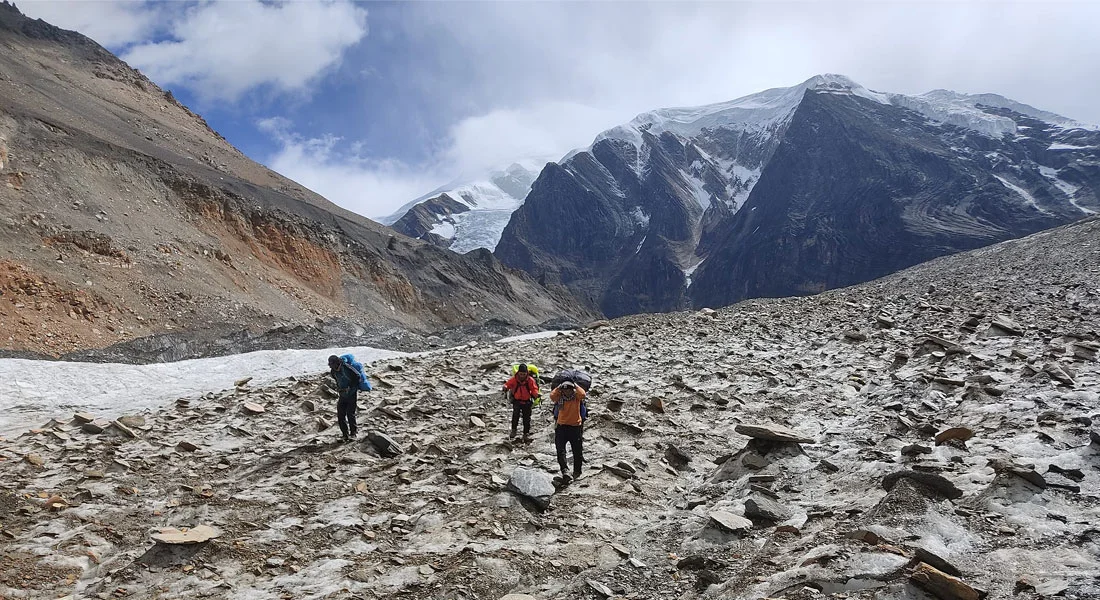
Dhaulagiri Trek is the toughest hiking trip in Nepal due to high passes, remoteness and lack of tea house lodges on the trail. The Dhaulagiri Circuit Package Trek is suitable for trekkers with previous trekking experience of above 5,000m. The Dhaulagiri round trek is good to explore the nature and culture of Western Nepal. The trekking around Dhaulagiri Circuit is challenging hike as you need to cross-the French Pass (5360m) and Dhampus Pass (5240m).
Dhaulagiri Circuit Trek
Dhaulagiri Circuit Trek is a full camping and a quite technical trekking which is demanding and a prior high-altitude experience is recommended. Two high passes-the French Pass (5360 m) and Dhampus Pass (5200 m) need to cross and a high level of fitness is compulsory. Basic mountaineering skills are also recommended. You will get truly a splendid experience of Dhaulagiri mountain range including Tukuche Peak (6920 m), Dhaulagiri I (8167 m), Dhaulagiri ii (7751 m), Dhaulagiri III (7715 m) and Dhaulagiri V (7618 m).
Attractions of Dhaulagiri Base Camp Trek
Dhaulagiri Trek is one of the most popular treks in Nepal. This takes you through some of the most beautiful scenery in the world, including snow-capped mountains, green valleys, and traditional villages. The trek is challenging but rewarding, and it is an experience that you will never forget. The Dhaulagiri Trek is an amazing experience that should not be missed. If you are looking for a challenge, and want to see some of the most beautiful scenery in Nepal, then this trek is for you.
Firstly, the trek takes you to the base camp of Mt. Dhaulagiri (8,167m), which is the seventh highest mountain in the world. The trek also offers stunning views of some of Nepal’s other iconic mountains such as Annapurna I (8,091m) and Machhapuchhre (6,993m). The Dhaulagiri Trek is a challenging but rewarding trek that should not be missed by any adventure seeker visiting Nepal
Highlights of Mount Dhaulagiri Trek
The Dhaulagiri Trek is one of the most popular treks in Nepal. It offers stunning views of the Himalayas, including Mount Dhaulagiri, and is a great way to see some of Nepal’s amazing wildlife. The trek can be done in 7-10 days, depending on your fitness level and how many side trips you take. Here are some of the highlights of the Dhaulagiri Trek.
The scenery-The Dhaulagiri Trek offers some of the most incredible views of the Himalayas that you’ll find anywhere. On a clear day, you can see all the way from Mount Everest to Mount Kanchenjunga.
The wildlife-The Dhaulagiri Trek is home to a variety of wildlife, including rare birds and animals such as the red panda.
The people-You’ll have a chance to meet and interact with the local people who live in the villages along the trekking route. You’ll also get to experience their unique culture and way of life.
The challenge-The Dhaulagiri Trek is a challenging trek, but it’s an achievable goal for most people with a good level of fitness. It’s a great way to push yourself physically and mentally, and you’ll feel an incredible sense of achievement when you reach the summit of Mount Dhaulagiri.
The tea houses-Along the way, you’ll stay in small local guesthouses known as “tea houses”. These are basic but comfortable and a great way to get to know the people in the area.
Dhaulagiri Circuit Trek Routes
Dhaulagiri Circuit Trek route from Beni, 4 to 5 hours drive north from Pokhara. But it is also possible to trek Dhaulagiri from different other location. You can start the trek from Darbang, the best location to start the trek. There are two option from Darbang; you can walk alongside the river or climb high above the ridge to Dharapani. Though the ridge route is tough, the views are way more rewarding than the river route.
We walk through Darbang, Takum, Muri, Bhogara, Doan and Italian Base Camp to reach Dhaulagiri Base Camp. We continue further and walk through highly elevated trail passing multiple high passes (French pass and Thapa Pass) via hidden valley, Yak Kharka, Muktinath, Jomsom to Pokhara and Kathmandu. If you have less time; you can drive to Dharapani and start the trek from there.
Dhaulagiri Trek Difficulty
Dhaulagiri Trek is rated as challenging high-altitude treks in Nepal. Trekkers have to cross 5,000m+ high passes and walk along the remote high-altitude trail for several days. Altitude is major problem in Dhaulagiri Circuit trail. Tourism infrastructure is almost in zero condition above Italian Base Camp. The misleading trail often covered with snows makes it very difficult to point out the right trail.
Some of the location have no water source (if available not healthy to drink), it better to carry enough water and water purifier. As there is no teahouse above Italian Base Camp, trekkers have camp for 4 days in remote region which might not be suitable for every trekker. A high level of fitness, stamina and determination is required for the trek. You will need to walk over the high pass (5,000+) and trek along the remote terrain for several days.
Dhaulagiri Circuit Trek: Permits
The TIMS Card and the Annapurna Conservation Area Project Entry Permit are required to trek around Dhaulagiri. We arrange your permits for you, for this passport photocopies and two photographs are required. It costs USD 50 for both Dhaulagiri Trek Permits.
Best Seasons for Dhaulagiri Trekking
The Dhaulagiri Trek is a classic trekking route in Nepal that takes you through some of the most stunning scenery in the Himalayas. The best time to go on the trek is from March to early June since the weather is dry and stable. This is also the busiest time of year, so be prepared for crowds. If you’re looking for a more challenging trek, you can attempt the Dhaulagiri Circuit, which goes around the entire massif. This route is only recommended for experienced trekkers, as it includes several high-altitude passes. The best time to attempt this circuit is from mid-September to mid-December.
October and November: This is the best time. It’s not too hot at lower altitudes and not too cold at higher altitudes. The mountains are clear and it is the best time to trek Kanchenjunga.
April to May: This is considered the second-best time to visit. The rhododendrons are in bloom on the lower part of the trail. It might be hot and humid at lower altitudes. But with the same great views as you get in October and November, mountain scenery makes up for a few days of sweatiness!
June to September: It does not recommend you to trek at this time of year. It’s raining and there are chances of landslides on the lower parts of the trail. It’s likely be cloudy most of the time. And let’s not even think about those leeches.
December to March: This is the winter season. The Sele Le Pass will be blocked because of snow. Teahouses on the northern and southern base camps are closed. The Kanchenjunga Trek is strongly not advisable in the winter.
Is guide necessary for Dhaulagiri Round Trek?
While it’s possible to trek in Dhaulagiri region independently, hiring a local guide and porter is highly recommended. They can provide valuable insights into the culture, navigate trail and ensure your safety and comfort throughout the journey.
Dhaulagiri Trek: Accommodations
There are many accommodation options available on the Dhaulagiri Trek. You can choose to stay in a basic teahouse, which is a common option for trekkers. These are usually family-run and offer simple accommodations with shared bathrooms. You can also choose to stay in a more luxurious lodge, which will offer private rooms and en-suite bathrooms. There are also a few camping sites available on the trek, which is a great option for those who want to be close to nature.
There are basic homestay style tea houses and lodges throughout the route. Fancy lodging and dining facilities are not available. Most tea houses have basic rooms with twin beds, hard mattresses, and blankets. Carrying sleeping bag, mattress and travel liner will keep you warm, on cold nights.
For larger groups, you either have to split between the tea houses or go camping. When you are staying at the tea houses, the rooms are basic with shared toilets and bathrooms. The toilets have Nepali style commodes. For bathing, tea houses can arrange you a bucket of hot water.
Dhaulagiri Trek Packing Lists
Please pack pretty light and manage to wash most of your clothes each afternoon/night for the first half of the trip. In the latter stages of the trip, it is pretty cold and wear warm gear basically nonstop while at the teahouses. There will be no real need for multiple outfits. This is just a guide and it works quite well. You need a sleeping bag as there are not blankets in each guesthouse and when gets cold you also need a good down jacket.
Below is a list of suggested items that you should bring while going for Dhaulagiri trek.
1 Backpack
1 Sleeping bag and sleeping pad
1 Water bottle or hydration bladder
1 pair of trekking poles
1 pair of trekking boots
Trekking clothes (pants, shirts, jacket, etc.)
1 pair of pants that maybe convert to shorts
1 pair of shorts
1 Warm or thicker pair of hiking pants
1 Long sleeve quick-dry shirt
1 Long-sleeve thermal shirt
2 Short-sleeve t-shirts
1 Thermal long underwear
4 pairs of quick-dry underwear
1 Lightweight down jacket
1 Heavy-duty summit down jacket
1 Beanie
1 Cap
1 Sunglasses
1 Neck Buff
1 Gloves
1 Head Lamp
Micros pikes
1 pair Gaiter
1 pair of warm summit socks
2 pairs of regular socks
1 Sunscreen
1 Trekking poles
1 Water filter
1 Power bank
Toiletries
Personal first-aid kit
High-energy snacks and meals
Map and compass
Camera
What size of backpack you need to bring for Dhaulagiri Trek?
All of this should fit into a backpack no bigger than 50L and should be less than 14 kg.
How is WIFI Connection during Kanchenjunga Trek?
Unlike many treks in Nepal there is almost no WIFI on this route. NTC sim card work for the first day and a half on the trek but once we reached Tashigaun, the connection is over. Be prepare not to have electricity, hot water, or wi-fi on the trek even if a place has all the facilities. Often something doesn’t work and there is no power in the village, it is a cloudy day and a solar panel couldn’t warm water in the shower, they ran out of Internet cards, there is no running water because pipes are frozen. I’d recommend asking if everything works fine before checking in.
What is the situation of Electricity?
This is the least power. Most places run off solar and didn’t have places to charge items for the clients. It is possible but you need to pay for a fee like in other teahouses around Nepal.
Dhaulagiri Circuit Trek Cost
The Dhaulagiri Trek cost ranges from USD 1850 to USD 3550, it depends on the length of trek and the services. Basically, the price covers your transport, accommodation, food, guide fees, porter and trekking permit fees. Any kind of drinks such as beer, snacks, hot showers, recharging your phone or camera, tipping the guide and porter are not included in the package price.
Meals on Dhaulagiri Trek.
You will find a quite basic meals in Dhaulagiri Trek such as Dalbhat, bread, soup, tea or coffee. You will not get varieties of meals like treks in Nepal such as Annapurna and Everest. The Dhaulagiri Trek is a great trek for food lovers. There are plenty of options for food on the trek, from simple snacks to full-course meals. The following are some of the food options available on the Dhaulagiri Trek.
Simple snacks: There are plenty of simple snacks available on the Dhaulagiri Trek, such as biscuits, energy bars, and fruits. These snacks will give you a quick boost of energy and are perfect for when you need a quick snack.
Full-course meals: If you want something more substantial, there are also full-course meals available on the Dhaulagiri Trek. These meals usually include rice, vegetables, meat, and soup. They are perfect for when you need a hearty meal to fuel your trekking adventures.
Local specialties: If you want to try something truly unique, be sure to try some of the local specialties available on the Dhaulagiri Trek. These dishes are usually made with local ingredients and offer a delicious taste of Nepal.
Drinks: It is important to stay hydrated during the trek, so be sure to stock up on plenty of non-alcoholic drinks. These can include energy drinks, soft drinks, and fruit juices.
Alcoholic drinks: If you’re feeling adventurous, there are also some local alcoholic beverages available on the Dhaulagiri Trek, such as raksi and chhyang.
Travel Insurance for Dhaulagiri Trek.
Travel Insurance is vital for Dhaulagiri Trek. In case of unforeseen incident or accident, you might require medical assistance and evacuation which might be expensive; it is wise to get insured that covers the costs of air ambulance and treatment. Make sure your insurance covers all the travel related risks – like stolen, damaged or delayed baggage, interruptions and flight delays.
Tips to guide and porter
The guide and porter will expect a tip. This can reflect your overall satisfaction but it should be in the region of USD 200 for the guide, USD 150 for a porter. This amount is shared between the trekkers in your group.
Safety
You have already done the groundwork regarding the safety record of the trekking company, and you have bought your insurance. The guide will be carrying a first aid kit. But we recommend you also carry your own, particularly if there are special medicines you require. Probably the most common injury on a trek is a sprained ankle or sunburn. But you should also take into consideration altitude sickness.
Altitude Sickness
This is not something we can predict. It is not known why some people suffer while others do not. It has nothing to do with age or fitness level. Pushing ahead too quickly, climbing too high too fast can result in problems. AMS or Acute Mountain Sickness occurs when we ascend too quickly. Normally at altitudes 3,000m/ 9,840ft or over.
What does it feel like?
Headache, shortness of breath and light-headedness. These are also related to being dehydrated. Stay hydrated and your body will most likely adjust to the altitude itself.
What if it gets worse?
If the symptoms continue, tell your guide. Especially if you are suffering from:
Difficulty in sleeping.
Need an unusual amount of sleep.
Loss of appetite.
Vivid dreams.
The need to rest/ catch your breath frequently, especially above 3,500m/ 11,483ft.
Runny nose.
Need to pee more.
Dizziness.
Altitude sickness can vary between mild symptoms and more serious stuff. Mild symptoms should clear up themselves with drinking lots of water, walking slowly and taking rest. More severe symptoms are a sign you must descend immediately.
The Dhaulagiri Trek is not for a weak heart, but the rewards are boundless. The sense of achievement and the memories you’ll create in this remote and stunning part of Nepal will be worth in every step of the journey. As you embark on this adventure, remember to savor the beauty of the Himalayas and the warmth of the local communities that makes, Dhaulagiri a true hidden gem. Please feel free to write us at missionecotreknepal@gmail.com or call or message on WhatsApp at +977 9851023742 to hear more about of the Dhaulagiri Trek.
Mount Kanchenjunga, the third tallest peak in the world.
Mount Kanchenjunga also spelled Kangchenjunga is the third-highest mountain in the world lies in the border of Nepal and India-Sikkim. Until 1852, Kanchenjunga was assumed to be the highest mountain in the world. It was officially announced in 1856 that Kangchenjunga is the third-highest mountain in the world.
Mount Kanchenjunga was first climbed on 25 May 1955 by Joe Brown and George Band, who were part of the 1955 British Kangchenjunga expedition. In 2016, the Kanchenjunga National Park was declared a UNESCO World Heritage Site.
Mount Kangchenjunga Climbing Routes
There are four climbing routes to reach the summit of Mt Kangchenjunga, three of which are in Nepal from the southwest, northwest, and northeast, and one from northeastern Sikkim in India. To date, the northeastern route from Sikkim has been successfully used only three times. The Indian government has banned expeditions to Kanchenjunga; therefore, this route has been closed since 2000.
Myth about Kanchenjunga Kanchenjunga is said to be home to a mountain deity, called Dzö-nga-“Kangchenjunga Demon”, a type of yeti or rakshasa. The people of Sikkim and in Nepal, Kanchenjunga means a valley of immortality hidden on on the slopes. In Tibetan, the valley is known as Beyul Demoshong. In 1962, a Tibetan Lama by the name of Tulshuk Lingpa led over 300 followers into the high snow slopes of Kanchenjunga, to ‘open the way’ to Beyul Demoshong.
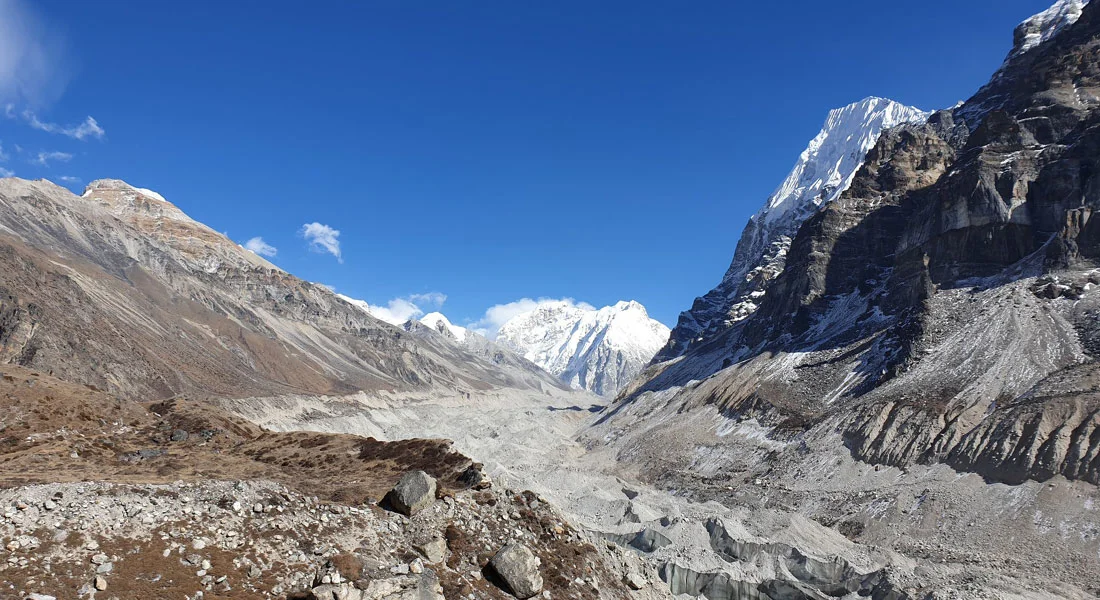
Explore the majestic landscapes of Kanchenjunga, the world’s third highest mountain in Nepal. This is the Himalayan paradise filled with natural wonders. You can visit North and South Base Camp of Mount Kanchenjunga through Kanchenjunga Circuit Trek in Nepal. The Kanchenjunga trek is one of the finest in the Himalayas.
Kanchenjunga Package Trip caters all travel information of Kanchenjunga Base Camp Trek Itinerary and cost. Kanchenjunga Package Tour offers a great view of Kanchenjunga, the third highest mountain in the world with good food and teahouse accomodation. Trek to both the North and South Kangchenjunga base camp in Nepal: Ramche and Pang Pema, and enjoy spectacular views of Makalu, Chamlang, Everest and Kangchenjunga, joining Kanchenjunga Hike.
Kanchenjunga Base Camp Trek in Eastern Nepal is neglected by the trekkers due to its remoteness and difficult access. Kanchenjunga, the ‘five treasures of the snows’ is one of the most difficult and dangerous peaks in the Himalayas. The third highest peaks in the world, Mt Kanchenjunga is the hardest to reach, hiding away at the end of a maze of contorted valleys.
Peaks such as Khumbakarna (Jannu), Mera, Pathibhara Chuli, Chang Himal (Wedge Peak), Kabru, Talung and Rathong are seen from airy ridges and high notches en route to the base camp. The forests are enticing, mysterious, enchanting and pristine – even though they do seem to dominate a little too much of the march in. The region is a naturalist’s paradise.
Attractions of Kanchenjunga Trek
It’s not just jaw-dropping scenery; there are many other dimensions: the local people, the culture, the challenge and remoteness of the countryside, together with the plants and animals makes it a world class trek. Kanchenjunga (8586m) is the third-highest mountain in the world. Kanchenjunga was first climbed by Joe Brown and George Band in 1955 from the South Base Camp. This creates two objectives for the trekker, with different perspectives of the mountain and its surrounding peaks and glaciers from the Nepal side.
Kanchenjunga Trek is also attractive because it is little visited by tourists compared with Annapurna or Everest and there are few tea houses and lodges. The entire district was closed to trekkers until 1989 and eastern Nepal probably sees no more than 500 trekkers each year undertaking the Kanchenjunga.
The Kanchenjunga Trek route ascends through five of Nepal’s climatic zones (tropical, sub-tropical, temperate, sub-alpine and alpine). It progresses from the hot and humid lowlands of the Nepal–India border (the Terai), up through the foothills through a progression of habitats – past the rice paddy terraces on cultivated hillsides and black cardamom plantations, then bamboo, rhododendron, pine and larch forests and on to more familiar terrain higher up as the mountains and glaciers are reached.
The houses in the villages are adapted to weather conditions in these zones, with thatched roofs lower down, then tin roofs and finally simple timber-planked roofs held in place with numerous heavy rocks. The birders in our party were kept busy and there were plenty of plants and wildlife to see, including orchids, gentians, edelweiss, blue sheep, lizards, geckos, frogs, cicadas, butterflies, moths, spiders and some slippery leeches.
The villages lower down are predominantly Limbu and Rai and the trails between the settlements is dotted with poignant carved memorial stones often set in Chautaara (trailside resting places often used by porters). The higher villages at Pangpema and Ghunsa is home to people from Tibet and is complete with Buddhist gompas, chortens and mane walls, with many prayer flags in evidence.
Facts of Kanchenjunga Trek
Number of days: 20 to 22 days
Trek Distance: Approx. 210 km
Highest point: 5143 m
Difficulty: Demanding
Required permits: Two
Average cost: USD 90 – 110 per day
Accommodation: Teahouse
Highlights: Kanchenjunga North and South Base Camp, Sele Le Pass
Kanchenjunga Base Trekking Routes
There are two primary trekking routes in the Kanchenjunga region. Kanchenjunga Base Camp Trek that takes you to the base camp of the majestic Kanchenjunga. The trek is a challenging one and usually takes around 18–20 days. Along the way, you’ll traverse through lush forests, remote villages, and beautiful alpine landscapes.
The others Kanchenjunga Circuit Trek offers a more extensive and less-traveled route around the entire Kanchenjunga massif. It takes approximately 25–27 days and is known for its untouched wilderness and pristine landscapes.
Difficulty of Mount Kangchenjunga Trek
The Kanchenjunga Trek is more difficult than the Everest Base Camp Trek due to the incline, remoteness, and rugged nature of the trails. You will reach an altitude of 5300m, which will challenge many. Altitude sickness can be common. The route has lots of undulation with several days purely walking upstairs on stairs. These days of ascent are tiring and also require the body to adjust quickly.
Permits for Kanchenjunga Circuit Trek
Like many trekking destinations in Nepal, you’ll need the permits to explore the Kanchenjunga area. You’ll need both a Restricted Area Permit (RAP), a TIMS card and Kanchenjunga Conservation Area Entry Permit. The RAP-basic permit cost ranges from 10 USD to 50 USD per week, it depends on seasons. The permit for Kanchenjunga Conservation Area will be around NPR 3000.
Best Seasons for Kanchenjunga Trek
The best time to trek in the Kanchenjunga region is during the spring (March to May) and autumn (September to November). During these months, the weather is generally stable, and the skies are clear, providing stunning mountain views. The time of year that you trek will have a huge influence on your hike.
October and November: This is the best time. It’s not too hot at lower altitudes and not too cold at higher altitudes. The mountains are clear and it is the best time to trek Kanchenjunga.
April to May: This is considered the second-best time to visit. The rhododendrons are in bloom on the lower part of the trail. It might be hot and humid at lower altitudes. But with the same great views as you get in October and November, mountain scenery makes up for a few days of sweatiness!
June to September: It does not recommend you to trek at this time of year. It’s raining and there are chances of landslides on the lower parts of the trail. It’s likely be cloudy most of the time. And let’s not even think about those leeches.
December to March: This is the winter season. The Sele Le Pass will be blocked because of snow. Teahouses on the northern and southern base camps are closed. The Kanchenjunga Trek is strongly not advisable in the winter.
Is guide necessary for trekking to Kanchenjunga?
While it’s possible to trek in the Kanchenjunga region independently, hiring a local guide and porter is highly recommended. They can provide valuable insights into the culture, navigate the trail, and ensure your safety and comfort throughout the journey.
Accommodations on Kanchenjunga Trek
There are basic homestay style tea houses and lodges throughout the route. Fancy lodging and dining facilities are not available. Most tea houses have basic rooms with twin beds, hard mattresses, and blankets. Carrying sleeping bag, mattress and travel liner will keep you warm, on cold nights.
No Camping required as the basic tea houses are available along the way to Base Camp. For larger groups, you either have to split between the tea houses or go camping. When you are staying at the tea houses, the rooms are basic with shared toilets and bathrooms. The toilets have Nepali style commodes. For bathing, tea houses can arrange you a bucket of hot water.
Packing Lists for Kanchenjunga Trek
Please pack pretty light and manage to wash most of your clothes each afternoon/night for the first half of the trip. In the latter stages of the trip, it is pretty cold and wear warm gear basically nonstop while at the teahouses. There will be no real need for multiple outfits. This is just a guide and it works quite well. You need a sleeping bag as there are not blankets in each guesthouse and when gets cold you also need a good down jacket.
1 pair of pants that maybe convert to shorts
1 pair of shorts
1 Warm or thicker pair of hiking pants
1 Long sleeve quick-dry shirt
1 Long-sleeve thermal shirt
2 Short-sleeve t-shirts
1 Thermal long underwear
4 pairs of quick-dry underwear
1 Lightweight down jacket
1 Heavy-duty summit down jacket
1 Beanie
1 Cap
1 Sunglasses
1 Neck Buff
1 Gloves
Hiking boots
Micro spikes
Headtorch
1 pair Gaiter
1 pair of warm summit socks
2 pairs of regular socks
1 Sunscreen
1 Trekking poles
1 Water filter
1 Power bank
What size of backpack you need to bring to trek to Kanchenjunga?
All of this should fit into a backpack no bigger than 50L and should be less than 14kg.
How is Wi-Fi Connection during Kanchenjunga Trek?
Unlike many treks in Nepal there is almost no Wi-Fi on this route. NTC sim card work for the first day and a half on the trek but once we reached Tashigaun, the connection is over.
Be prepare not to have electricity, hot water, or wi-fi on the trek even if a place has all the facilities. Often something doesn’t work and there is no power in the village, it is a cloudy day and a solar panel couldn’t warm water in the shower, they ran out of Internet cards, there is no running water because pipes are frozen. I’d recommend asking if everything works fine before checking in.
What is the situation of Electricity?
This is the least power. Most places run off solar and didn’t have places to charge items for the clients. It is possible but you need to pay for a fee like in other teahouses around Nepal.
Kanchenjunga Circuit Trek Cost
The Kanchenjunga Trek cost ranges from USD 1850 to USD 3550, it depends on the length of trek and the services. Basically, the price covers your transport, accommodation, food, guide fees, porter and trekking permit fees. Any kind of drinks such as beer, snacks, hot showers, recharging your phone or camera, tipping the guide and porter are not included in the package price.
Meals on Kanchenjunga Trek.
You will find a quite basic meals in Kanchenjunga Trek like Dalbhat, bread, soup, tea or coffee. You will not get varieties of meals like treks in Nepal such as Annapurna and Everest.
1. Breakfast-
Eggs and toast or chapattis, and Tibetan bread are pretty guaranteed. Porridge and pancakes may be also on the menu.
2. Lunch-
Lunch will be on the trail itself as you move between overnight stops and most definitely dal bhat!
3. Dinner-
Probably dal Bhat, you will be hungry enough to enjoy it! You can also expect to see noodles, egg curry, fried rice, fried potatoes, and momo (Delicious packets of meat or vegetables) on the menu.
4. Drinks-
Tea is the thing on the trails. Great first thing in the morning and last thing at night and in between too! Instant coffee is also available as is hot lemon. Soft drinks such as coke and fanta are often available. Bottled water may be available in some teahouses. Or they will boil water for you at a cost. Beer and Tumba (Fermented millet local hot drink) are on the bar list.
Travel Insurance for Kanchenjunga Trek
Nepal can be a dangerous place for trekking or hiking because the high altitude can lead to many illnesses, weakness in trekkers, and misjudgments. There is also a risk on trails for rock falls, avalanches and other mishaps. Your regular travel insurance probably won’t cover you at high altitudes and won’t cover a helicopter evacuation. There is a solution though. You will need insurance coverage from your home country ensure it is valid for high altitude trekking and helicopter rescue.
Travel insurance is necessary for Kanchenjunga Trek. It is nice to provide the name and the phone number of your insurance company. You are required to provide your own insurance coverage from your home country. This should be valid for high altitude trekking and helicopter rescue. It’s actually required when applying for the TIMS card hiking permit to have insurance. Getting injured or sick at isolated locations, especially at altitude evacuation can be very complicated and expensive. Travel insurance with coverage for emergency medical, lost luggage, trip cancellation and helicopter rescue/evacuation.
Tips to guide and porter
The guide and porter will expect a tip. This can reflect your overall satisfaction but it should be in the region of USD 200 for the guide, USD 150 for a porter. This amount is shared between the trekkers in your group.
Safety
You have already done the groundwork regarding the safety record of the trekking company, and you have bought your insurance. The guide will be carrying a first aid kit. But we recommend you also carry your own, particularly if there are special medicines you require. Probably the most common injury on a trek is a sprained ankle or sunburn. But you should also take into consideration altitude sickness.
Altitude Sickness
This is not something we can predict. It is not known why some people suffer while others do not. It has nothing to do with age or fitness level. Pushing ahead too quickly, climbing too high too fast can result in problems. AMS or Acute Mountain Sickness occurs when we ascend too quickly. Normally at altitudes 3,000m/ 9,840ft or over.
What does it feel like?
Headache, shortness of breath and light-headedness. These are also related to being dehydrated. Stay hydrated and your body will most likely adjust to the altitude itself.
What if it gets worse?
If the symptoms continue, tell your guide. Especially if you are suffering from:
Difficulty in sleeping.
Need an unusual amount of sleep.
Loss of appetite.
Vivid dreams.
The need to rest/ catch your breath frequently, especially above 3,500m/ 11,483ft.
Runny nose.
Need to pee more.
Dizziness.
Altitude sickness can vary between mild symptoms and more serious stuff. Mild symptoms should clear up themselves with drinking lots of water, walking slowly and taking rest. More severe symptoms are a sign you must descend immediately.
Kanchenjunga Circuit Trek Add-on Treks.
It is possible to combine Kanchenjunga Base Camp Trek with other treks such as Pathivara Temple, Makalu and Everest Base Camp via Amphu Laptse(Serpani Col).
Conclusion
The Kanchenjunga trek is not for a weak heart, but the rewards are boundless. The sense of achievement and the memories you’ll create in this remote and stunning part of Nepal will be worth in every step of the journey. As you embark on this adventure, remember to savor the beauty of the Himalayas and the warmth of the local communities that makes, Kanchenjunga a true hidden gem. Please feel free to write us at missionecotreknepal@gmail.com or call or message on WhatsApp at +977 9851023742 to hear more of the trek.
Learn how to trek to Everest Base Camp before you go.
Mount Everest has two base camps-the Everest South Base Camp is in Nepal at an altitude of 5,364 metres, while North Everest Base Camp is in Tibet at 5,150 metres. The base camps are rudimentary campsites at the base of Mount Everest that are used by mountain climbers during their ascent and descent. They are also visited by hikers. Everest South Base Camp is used when climbing via the southeast ridge, while the North Everest Base Camp is used when climbing via the northeast ridge.
Supply to the South Base Camp is carried by porters, and the yaks. The North Base Camp is accessed by a paved road. Climbers typically rest at base camp for several days for acclimatization, to reduce the risk of altitude sickness.
Nepal Everest Base Camp
The Everest Base Camp trek on the south side, at an elevation of 5,364 m is one of the most popular trekking routes in the Himalayas. About 40,000 people per year make the trek there from Lukla Airport (2,846 m). Trekkers usually fly from Kathmandu to Lukla to save time and energy before beginning the trek to the base camp. However, trekking to Lukla is possible. There are no roads from Kathmandu to Lukla and as a result, the only method of transporting large and heavy goods is by plane.
Everest Base Camp Trek Route
From Lukla, climbers trek upward to the Sherpa capital of Namche Bazaar, 3,440 metres (11,290 ft.), following the valley of the Dudh Kosi river. It takes about two days to reach the village, which is the central hub of the area. Typically at this point, climbers allow a day of rest for acclimatization. They then trek for another two days to Dingboche, 4,260 metres (13,980 ft.) before resting for another day for further acclimatization.
Most trekkers use the traditional trail via Tengboche monastery, but recently, the high trail via Mong La and Phortse has gained popularity due to the impressive views it offers. Another two days takes them to Everest Base Camp via Gorakshep, the flat field below Kala Patthar, 5,545 metres (18,192 ft) and Mt. Pumori.
Everest Base Camp Height(Elevation)
Everest Base Camp on the South side (Nepal) is located at an altitude of 5,364 meters (17,598 feet) above sea level. This base camp is on the Khumbu Glacier, a constantly moving glacier that can cause the location of the base camp to shift slightly year on year.
The youngest person visited Everest Base Camp
Zara, a four-year-old girl from the Czech Republic has made history by becoming the youngest ever person to reach Mount Everest base camp. She managed to make the 170-mile journey to base camp at an elevation of 17,598 feet.
Permits and Paperwork
As well as arranging a guide, trekkers need to register for a Trekkers’ Information Management System (TIMS) card, administered by the Trekking Agencies’ Association of Nepal (TAAN), purchase a Khumbu Rural Municipality permit (available in Lukla), and pay the entry fees for Sagarmatha National Park (available in Monjo or at the Tourist Service Center at Bhrikutimandap in Kathmandu). We take care of all your paperwork for trekking to Everest Base Camp.
Health and safety
Acute Mountain Sickness (AMS) is a risk on any trek above 2500m (8202ft). To give your body time to adjust, acclimatization days are essential, and guides will build these stops into the schedule. Some people start to feel the effects of altitude above 3000m (9800ft), and by 4000m (13,100ft), almost everyone will have an elevated heart rate, faster breathing, and maybe a headache and difficulty sleeping.
Some people adjust quickly to altitude, but others don’t. While everybody responds to altitude differently and there’s no guarantee a fit traveler will withstand altitude better than their out-of-shape friend, the overall experience tends to be easier if you’re fit and healthy.
Medications such as Diamox (Acetazolamide) are available in Kathmandu (or at home) to help reduce mild symptoms as you adjust to the altitude, but it’s important to be alert for more serious warning signs of AMS and other high-altitude illnesses. If you feel unwell, descend immediately to a lower elevation – mountain sickness can be deadly.
Everest Base Camp Height/Altitude
The base camp is 17,600 ft or 5,380m. However, you will probably also trek to Kala Patthar, which looks over the base camp. Kala Patthar is 5,644m high.
Everest Base Camp Trek Distance
The distance from Lukla the first town to Everest Base Camp is 38.58 miles or 62 kilometers. Most people take 8-9 days trekking to Everest Base Camp and 3-4 days trekking back to Lukla. It took 8 days to trek to Base camp and two days to trek out.
Everest Base Camp Temperature
During June when I trekked it was sunny in the days and I actually wore shorts every day. However as I mentioned above about when the best time to be trekking to Everest Base Camp is, it can get very cold at high elevations during November to January (-20 to-30)
Meals/Food on Everest Base Camp Trek
Meals on the Everest Base Camp trek offer a mix of local Nepali dishes and some Western options. You can expect to find traditional Nepali staples like Dal Bhat, Momo, and various vegetable dishes. Additionally, teahouses often serve Western dishes like pizza, pasta, and sandwiches, providing familiar flavors for those seeking variety.
Dal Bhat-A staple of the region, Dal Bhat consists of lentil soup (dal), rice (bhat), and various vegetable dishes (Tarkari). Meal prices vary depending on the location and teahouse, but you can generally expect to pay between $10-$15 per dish, potentially more at higher altitudes.
Everest Base Camp Trek-Accommodations
Accommodation during the Everest Base Camp trek typically involves staying in teahouses or lodges, offering simple but comfortable rooms with beds and blankets. These basic accommodations provide a unique trekking experience and are often family-run, offering a warm and welcoming atmosphere.
Teahouses and Lodges
Basic but Comfortable-Rooms usually have two single beds with mattresses, pillows, and blankets. Some lodges may offer better facilities like en-suite bathrooms and hot showers.
Shared Bathrooms-Bathrooms are typically shared, and toilets are often squat-type.
Communal Dining-Teahouses have spacious dining rooms where trekkers can enjoy meals and socialize.
Electricity and Wi-Fi-Most teahouses have electricity and Wi-Fi, though internet speeds can vary.
Hot Showers-Hot showers are available at many teahouses, often heated with solar or gas.
Social Hubs-Teahouses are known for being social hubs where trekkers can meet and share stories.
Local Hospitality-Stays at teahouses allow trekkers to experience local culture and hospitality.
Luxury Options-Luxury lodges with better facilities are also available for those who prefer more comfort.
Additional Considerations
Sleeping Bag-While teahouses provide blankets, it’s recommended to bring a warm sleeping bag for added warmth, especially at higher altitudes.
Shared Spaces-Teahouses are shared spaces, so be prepared for some noise and potential for sharing rooms.
Wifi and Electricity Availability on Everest Base Camp
Wifi-Costs anywhere from $3 to $10 to use wifi at the guesthouses. Buy a Ncell Sim before you go. Ncell works at 50% of the guesthouses.
Electricity-You will have to pay anywhere from $2 at low elevation to $8 at high elevation to charge your power banks, cameras, and phones. The key is to get a fat power bank. Pay to charge that then charge everything from your power bank. My power bank lets me charge my phone and four camera batteries before it would be done.
Everest Base Camp Package
Everest Base Camp Package Cost ranges from $1400 to $2500, depending on trip days and the services. In the package price, it includes flight, guide, permits, meals and accommodations.
Everest Base Camp Packing List
Keep in mind you won’t be doing any washing. Clothes that dry quickly and are lightweight are key. Here is a packing list for Everest Base Camp. All of this should fit into a backpack no bigger than 50L and be less than 15kg.
Clothes 2 pairs of pants that rip off into shorts 2 long sleeve quick-dry material shirts 5 Pairs of Thermal North Face socks 1 Fleece pants and sweater. 1 Thermal Lycra long sleeve and pants 5-6 pairs of quick-dry underwear 1 huge waterproof down jacket Beanie Neck Buff Gloves
Other gear Headlamp Water Purification pills and 1L bottle Sunblock Sunglasses Hat Watch Camera gear and electronics (Not necessary but up to you. Obviously I carried a lot) Power bank
Why trek to Everest Base Camp in Nepal?
Mt Everest straddles the Nepal-Tibet border, but when people talk about trekking to Everest Base Camp, they almost always mean the route in Nepal. As well as having excellent infrastructure for trekkers, Nepal is more open and accessible to tourists, and from this side, the only way to reach Base Camp is on foot (or by helicopter, if you’re short on time but flush with funds). A nicely paved road leads most of the way to the mountain on the Tibetan side.
While the unobstructed views of Everest are arguably better from the Tibetan side (take it from someone who’s seen both) there’s more to this trek than just the views of the mother mountain. You’ll enjoy an unforgettable cultural experience alongside the physical challenge of one of the world’s best trekking trails. If you’re a physically active, outdoors-loving, adventurous traveler, this trek ticks all the boxes!
How much does it cost to climb Everest Base Camp from Nepal?
If you are planning to climb Everest Base camp from Nepal, it costs from US$800 to US$ 5000, depending on services, and days of trekking to EBC. Everest Base Camp trek in 2025 cost ranges in between $1000 and $3000 for a 12 to 14-day trek, depending services and tour operators.
Is Free to visit Everest Base Camp?
Trek to visit Everest Base Camp is not free. The Khumbu Pasang Lhamu Rural Municipality Permit and the Sagarmatha National Park Entry Permit with cost USD 60, you have to pay to get permission to go to the Everest Base Camp. The food costs range from $30 to $40 per day, approximately $10 to $15 per meals, it depends on the food items you choose.
Is there a age limit for Everest Base Camp Trek?
There’s no upper age limit for this trek, but it would be wise to approach it extremely carefully if you’re over 70 years old. You can do it, of course, just visit your GP for a full medical and be honest with yourself about your stamina. In the past, people aged from 18 to 80 have trekked to Everest Base Camp.
A normal person can trek to Everest Base Camp (EBC). You don’t need to be an elite athlete, but a good level of fitness, preparation, and determination are essential. Many people with varying fitness levels and trekking experience have successfully completed the EBC trek. The beginners can go for the Everest Base Camp and enjoy the unforgettable journey to the lap of the highest peak in the world.
Can anyone visit Everest Base Camp?
While summiting Mount Everest itself obviously requires years of mountaineering experience and technique. Trekking to Everest Base Camp (EBC) requires no mountaineering experience and technique. A fact that makes it wonderfully open to many, including, most probably, you.
Is a sleeping bag needed for Everest Base Camp Trek?
A warm sleeping bag is nice to keeping warm and having a good nights sleep on an Everest Base Camp trek. The nights on your trek, especially in the high mountain regions, can get extremely cold. I strongly suggest a goose down sleeping bag if it’s within budget.
Is Everest Base Camp worth it ?
Trekking to Everest Base Camp is really a worth it for the stunning scenery, the sense of accomplishment, and the unique cultural experience it offers. While it’s a physically challenging trek, the rewards are numerous, making it a bucket-list experience for many adventurers.
Unforgettable Scenery-The trek takes you through breathtaking landscapes, including stunning mountain views, glacial plains, and vibrant valleys. The Majesty of Everest-you’ll have a chance to witness the sheer scale and beauty of Mount Everest from a close vantage point. Cultural Immersion-the trek provides an opportunity to experience Sherpa culture, interact with local guides and porters, and learn about their way of life.
Personal Growth-The trek can be a physically and mentally challenging experience, pushing individuals to their limits and fostering a sense of accomplishment. A Sense of Adventure-the Everest Base Camp Trek is a classic adventure, offering a unique and unforgettable experience.
However, it’s also important to be aware of potential challenges such as altitude Sickness-the trek involves significant elevation gains, and altitude sickness can be a serious concern. physical demands-the trek requires a moderate level of fitness and can be physically demanding, especially at high altitudes.
Logistical Considerations-planning and booking the trek can require careful attention to detail. potential crowding-The trek can be crowded, especially during peak season, which may impact the experience.
Which is good Kilimanjaro or Everest Base Camp?
The Everest Base Camp trek is generally considered harder than Kilimanjaro due to its longer duration (12-14 days) and sustained high altitude, which increases the risk of altitude sickness. However, Kilimanjaro’s summit is higher, and the final ascent is more physically demanding. Everest Base Camp trek is more challenging due to higher altitudes and longer days than the Annapurna Base Camp Trek.
When is the best time to trek to Everest Base Camp?
The peak seasons for trekking in Nepal are from October to November and March to May. These are the busiest times to trek to Everest Base Camp but also the best times to go for fine weather. The season for mountaineering ascents of Everest is the spring – while climbing and trekking are not the same thing, trails will be more crowded at this time as mountaineering groups also trek to Everest Base Camp.
During the monsoon season from June to September, trails can be slippery, visibility poor, and flights into and out of Lukla often delayed or canceled. Winter (December–February) is not necessarily a bad time to trek, but you’ll need to be well-prepared for the cold. Not all tour operators offer treks in winter and many businesses on the trail close, but those who hit the trails can enjoy an uncrowded experience.
How long does the Everest Base Camp trek take?
The most commonly trekked route starts in Lukla, a mountain village with a tiny airstrip served by regular turboprop flights from Kathmandu. The trail meanders through Sagarmatha National Park – Nepal’s highest national park – climbing steadily to Everest Base Camp before returning to Lukla. It’s an in-and-out route, rather than a circuit, and the trek typically takes 9 to 20 days. Here’s the most popular itineraries to Everest Base Camp.
The two-week trek to Everest Base Camp requires stamina but not superhuman powers. Many older kids manage it, for example, but you’ll find it easier if you’re reasonably fit and have some experience with multi-day mountain trekking. If you’ve never hiked in your life, you may struggle, but if you have a regular workout routine of some kind, you’ll probably do fine. Pre-trek gym-based or outdoor training is a good idea.
Lukla – the most common starting point for the trek – sits at 2860m (9383ft), and you’ll climb to 5364m (17,598ft) at base camp. The trek gets harder the higher you go because the air gets thinner and the temperatures colder, especially at night. The trail is steep in places, and some of the earlier days are relentlessly uphill, such as the climb from Phakding to Namche Bazaar at 3440m (11,286ft) on day two of the hike.
The best time to trek to Everest Base Camp
The peak seasons for trekking in Nepal are from October to November and March to May. These are the busiest times to trek to Everest Base Camp but also the best times to go for fine weather. The season for mountaineering ascents of Everest is the spring – while climbing and trekking are not the same thing, trails will be more crowded at this time as mountaineering groups also trek to Everest Base Camp.
During the monsoon season from June to September, trails can be slippery, visibility poor, and flights into and out of Lukla often delayed or canceled. Winter (December–February) is not necessarily a bad time to trek, but you’ll need to be well-prepared for the cold. Not all tour operators offer treks in winter and many businesses on the trail close, but those who hit the trails can enjoy an uncrowded experience.
Where is Everest Base Camp?
The Everest Base Camp Trek is one of the most iconic and well-known treks in the world. Mount Everest is the world’s highest mountain and part of the Nepalese Himalayas, standing at 8,848m above sea level. Everest Base Camp is either one of two base camps-South Base Camp is in Nepal and North Base Camp is in Tibet. These camps are primarily used by mountaineers to ascend and descend the World’s highest mountain. The Everest Base Camp Trek Nepal is one of the most popular trekking routes in the Himalayas.
What is trekking to Everest Base Camp?
Trekking to Everest Base Camp really is a once in a lifetime experience! Hiking through the foothills of the Nepalese Himalayas is an incredible experience; eight of the world’s fourteen highest peaks are located here – there really isn’t a mountain range quite like this anywhere else on Earth.
The trek starts in the picturesque village of Lukla, before trekking along the Dudh Koshi River, through rhododendron forests, along a glacial lake and up onto the Khumbu Glacier itself. We then reach the prayer flags of Everest Base Camp. An experience like no other!
Our Everest Base Camp Trek sees us spend the following day pushing on further to summit Kala Patthar – a mighty peak at 5,545m, overlooking Base Camp, with the most incredible view of Everest. Over the next couple of days, we retrace our steps (with a few diversions to experience new exciting views!), back to Lukla.
How hard is it to trek to Everest Base Camp?
Climbing to Everest Base Camp is a challenge – but an achievable one! You don’t need any specialist equipment or technical climbing skills. This is a trek – on mountain paths, gentle gradients and, of course, with some steep sections. No matter what your age, experience or fitness level, as long as you put in the correct training you will be able to conquer Everest Base Camp. It is a long trek at altitude, covering a distance of 120km. The days will be long and tough; tackling some significant climbs across varied terrain. However, our itinerary has been designed to maximize your chances of success – remember, this is not a race.
Meals/Food on Everest Base Camp Trek
Meals on the Everest Base Camp trek offer a mix of local Nepali dishes and some Western options. You can expect to find traditional Nepali staples like Dal Bhat, Momo, and various vegetable dishes. Additionally, teahouses often serve Western dishes like pizza, pasta, and sandwiches, providing familiar flavors for those seeking variety.
Dal Bhat-A staple of the region, Dal Bhat consists of lentil soup (dal), rice (bhat), and various vegetable dishes (tarkari). Meal prices vary depending on the location and teahouse, but you can generally expect to pay between $10-$15 per dish, potentially more at higher altitudes.
Everest Base Camp Trek-Accommodations
Accommodation during the Everest Base Camp trek typically involves staying in teahouses or lodges, offering simple but comfortable rooms with beds and blankets. These basic accommodations provide a unique trekking experience and are often family-run, offering a warm and welcoming atmosphere.
Teahouses and Lodges
Basic but Comfortable-Rooms usually have two single beds with mattresses, pillows, and blankets. Some lodges may offer better facilities like en-suite bathrooms and hot showers.
Shared Bathrooms-Bathrooms are typically shared, and toilets are often squat-type.
Communal Dining-Teahouses have spacious dining rooms where trekkers can enjoy meals and socialize.
Electricity and Wi-Fi-Most teahouses have electricity and Wi-Fi, though internet speeds can vary.
Hot Showers-Hot showers are available at many teahouses, often heated with solar or gas.
Social Hubs-Teahouses are known for being social hubs where trekkers can meet and share stories.
Local Hospitality-Stays at teahouses allow trekkers to experience local culture and hospitality.
Luxury Options-Luxury lodges with better facilities are also available for those who prefer more comfort.
Additional Considerations
Sleeping Bag-While teahouses provide blankets, it’s recommended to bring a warm sleeping bag for added warmth, especially at higher altitudes.
Shared Spaces-Teahouses are shared spaces, so be prepared for some noise and potential for sharing rooms.
Nepal Langtang Valley, Langtang River and Langtang Lirung Mountains.
Nepal Langtang Valley for decades is high on many trekkers’ bucket list. The beautiful Langtang Valley is the third of the great trekking areas of Nepal after Everest and the Annapurna Trek.
But in recent years, Langtang Valley Nepal has become better known due to the devastation wreaked on the main village during the earthquake of 2015. Where many villages around Nepal made significant damage, high above Langtang village, part of the great peak of Langtang Lirung sheared off, and a huge avalanche of ice and rock buried homes and buildings.
Many died and, understandably, people stayed away for a time. But the surviving families have worked incredibly hard to get back on their feet. Trekking trails are open once more, lodges have been rebuilt, and the valley can once again be visited. There are some incredibly painful sights and stories, of course – a huge fan of grey rock covers the area where the village once stood, and close-knit families lost many loved ones. But that is no reason to turn away, and the people of Langtang don’t want sympathy. They just want travelers to return, as they always had before.
Langtang Valley is spectacularly beautiful
There are no 8000m peaks here, but Langtang Lirung rises well over 7000m and its east face rears up for more than 3km. The village of Kyanjin Gompa is surrounded by snowy peaks on all sides, and if you head farther up the valley to the shrines of Langshisha Kharka, you’ll have breathtaking views all around. A vast wall of peaks lies between you and Tibet and to the south Gangchenpo (Fluted Mountain) climbs gracefully into the heavens.
Easy access to Langtang Trek Nepal
You can walk there all the way from the outskirts of Kathmandu, climbing through Helambu and past the holy lakes of Gosainkund, before dropping into the Langtang Valley itself. Alternatively, a half-day jeep ride will deliver you to Syabru Besi, at the bottom of the valley – from where three days of gentle climbing will get you to Langtang Kyanjin Gompa at the head of the valley, with no high passes to cross.
Diverse cultures and landscapes
As you rise through Helambu, or the lower part of the Langtang valley, you’ll pass through rich forests filled with birds and the occasional monkey. Tamang villagers grow their crops on steep terraces. Slowly you’ll pass through to thin pinewoods split by waterfalls. And then it’s on to the high valley with yak pastures, open skies and glaciers, and the homes of the Langtang people. Throughout the Langtang/Helambu region you’ll find some of the best flower displays in Nepal and a blend of cultures from Newari, Hindu, Tamang, Bhotia and Sherpa communities.
Langtang Valley is quiet – so you can experience much more than elsewhere Going on a Langtang Trek means you’ll escape the busy trails and teahouses of Annapurna and Khumbu, which can, at certain times of year, make you feel like just a face in the crowd. In Langtang, local Nepali people are incredibly keen to see trekkers come back – and the welcome you receive will be genuinely warm and occasionally emotional.
Even if you know nothing of its recent history, Nepal’s Langtang is a special part of the world. By choosing to spend time in Langtang and with its people, you can perhaps gain richer insights into what life is really like here, beneath the great snow mountains of Nepal. Interested in a Langtang trek yourself. Mission Eco Trek organizes several Langtang Valley Treks in Nepal.
The Langtang Valley Trek
Langtang Valley Trek is a unique hike in the Himalayas of Nepal. While shorter than many other popular treks in Nepal, the adventurous day-hikes throughout this route make it one of your favorites. After three days of trekking, you will reach Kyanjin Gompa. From this small mountain town, there are several incredible day-hikes with fantastic views.
The short 3-day trek into Kyanjin Gompa makes this trek shorter, cheaper but arguably more beautiful than other treks such as Manaslu Circuit, Everest Base Camp Trek, and the Annapurna Circuit.
A Trek Guide to Langtang Valley Nepal
In this guide, you will find all of the valuable information you need to plan your trek including the Kyanjin Ri Viewpoint, Tserko Ri Viewpoint, and Yala Peak climb.
Langtang Trek Difficulty
The Langtang Valley Trek is much shorter than Everest Base Camp or the Annapurna Circuit although relatively similar. You will reach an altitude of 5000m, which will challenge many. Altitude sickness can be common. The route ascends quite quickly with several days having more than 1000m of altitude gain. These days of ascent are tiring and also require the body to adjust quickly. It is a good beginner trek in Nepal but not one to be taken lightly.
Permits for Langtang Valley Trek
You will need a TIMS card and Langtang National Park Entrance Permit, both can be purchased when entering the park.
Guide for Langtang Trek
A guide is required on this trek. However, the guide manages all of the logistics, distances, directions, and tea houses for your group. If it’s your first time trekking in Nepal, I would suggest having a guide.
Accommodation in Langtang Valley
Guest Houses, also known as Tea Houses, are available along the way where you will sleep in a comfortable bed and have access to showers (extra charge) and restaurant facilities. It has very comfortable accommodation and great after a long day of hiking. Most of the villages are Tibetan, which gives you a great insight into their unique culture.
Key Points about the Langtang Valley Trek
Langtang Valley is way less crowded than Everest Base Camp Trek or the Annapurna Circuit. It is growing in popularity but it’s still a great time to trek to Langtang valley before it hits the mainstream.
There are teahouses in each village along the way so each night you get a great sleep in a bed with blankets, have access to showers, eat great meals in a restaurant, and can charge your electronics and cameras.
The trailhead can be reached by bus and jeep so there is no need to pay for expensive domestic flights. It is important to base in Kyanjin Gompa for at least two nights so you can hike up to Kyanjin Ri and Tserko Ri, which are the highlight of the trip.
Langtang Valley Elevation(Height)
Langtang Valley is one of the popular trekking destinations near Kathmandu valley. It is situated at an elevation of 3,430 meters above sea level. The Langtang Valley Trek in Nepal is moderately difficult, both beautiful and challenging at the same time. The steep and narrow trails make the journey physically demanding.
Climate and Temperature in Langtang Valley
The Langtang Valley temperature ranges from 10°C to 20°C (50°F to 68°F) during the spring and autumn season, which starts in March and lasts until May. Nights get colder, with temperatures dropping from -10°C to -1°C. The winter season in Langtang is quite cold and snowy, with temperatures of 4°C to 10°C during the day.
Packing List for Langtang Valley Trek in Nepal
Pack light and managed to wash most of my clothes each afternoon/night for the first half of the trip. In the latter stages of the trip, it is pretty cold so you are not sweating as much and wear your warm gear basically nonstop while at the teahouses. There is no real need for multiple outfits.
This is just a guide and it works quite well for you with no complaints from your set-up. You won’t need a sleeping bag as there are blankets in each guesthouse and when it get cold you just wear your down jacket to bed. This meant you don’t have to carry a sleeping bag for the entire trek. All of the below items should fit into a backpack no bigger than 50L and should be less than 14kg.
1 pair of pants that maybe convert to shorts 1 pair of shorts 1 Warm or thicker pair of hiking pants 1 Long sleeve quick-dry shirt 1 Long-sleeve thermal shirt 2 Short-sleeve t-shirts 1 Thermal long underwear 4 pairs of quick-dry underwear 1 Lightweight down jacket 1 Heavy-duty summit down jacket 1 Beanie 1 Cap 1 pair of warm summit socks 2-3 pairs of regular socks 1 Neck Buff Sunglasses Gloves Hiking boots Headtorch Sunscreen Trekking poles Water filter Power bank
Wifi and Electricity Available on Langtang Valley Trek in Nepal
Wifi-Costs anywhere from free to $4 to use wifi at the guesthouses. Buy an NTC Sim before you go. It worked in most spots after Lama Hotel with a weak signal but we were able to send emails, watch Youtube, and message friends from Langtang and Kyanjin Gompa.
Electricity-You will have to pay anywhere from $free at low elevation to $5 to charge your power banks, cameras, and phones. The key is to get a big power bank. Pay to charge it then charge everything from your power bank. My power bank lets me charge my phone and four camera batteries before it dies. Most of the places we stayed let us charge our gear for free but when it is busy they usually charge a fee as many teahouses run off gas or solar.
Drinking Water on the Langtang Valley Trek
You don’t need to buy bottled water at every tea-house contributing to large amounts of plastic waste and costing you $4+ per day. Along the Langtang Valley Trek, fill up at tea-houses, rivers, and local village taps. Unlike aqua purification tablets which require you to wait 30 minutes before drinking, you can have rehydrated yourself immediately with the Grayl Ultralight Water Purifier.
Travel Insurance for Langtang Valley Trek
Nepal can be a dangerous place for trekking and hiking because the high altitude can lead to many illnesses, weakness in trekkers, and misjudgments. There is also a risk on trails for falls, avalanches, or other mishaps. Your regular travel insurance probably won’t cover you at high altitude and won’t cover a helicopter evacuation. There is a solution though.
Best Time and Seasons for Langtang Valley Trek
The peak season for the Langtang Valley Trek is March to April and October to November. The time to avoid this trek is during the rainy season from June to August. During the winter from December to February, this region gets very cold and there will be snow cover in the higher parts of the trek.
Many of the guesthouses actually close up for the winter and re-open in late February to March. However, it is possible to hike the Langtang Valley Trek in Winter and it can be quite beautiful with snow cover. Langtang Valley Trek in early March and it is warm during the day and got pretty cold at night. You may experienced some heavy snow on Tserko Ri and Yala Peak but the trekking routes is clear.
How to get to Langtang Valley in Nepal
There are two main ways to reach Syabrubesi, which is the small town at the starting point of the trek. Despite the distance from Kathmandu to Syabrubesi only being 125km, the journey takes a long time due to the traffic and quality of the road.
You can reach there by jeep and bus ride. Jeep costs about $180 to hire the vehicle out for the drive so can be split between your group. It’s not cheap but much less brutal than the lengthy bus journey.
The bus costs about $15 USD and can take anywhere from 7-10 hours depending on the traffic and if there are any roadworks or landslides recently. The bus leaves every day from Kathmandu to Syabrubesi at 6 am and 8 am as well as other defined times.
The Langtang Valley Trek is quite unique. You get an incredible experience once you reached Kyanjin Gompa and hikes in Tserko Ri and Kyanjin Ri as well as the Yala Peak climb. Trek into Kyanjin Gompa is relatively mild.
About Kyanjin Gompa
Kyanjin Gompa is the end of the trek for most people. It’s a beautiful town with an incredible backdrop of snow peaks in all directions. The biggest mistake you can make on the Langtang Valley Trek is to stay one night and turn around and hike back down.
The absolute highlight of this trek is to base in Kyanjin Gompa for a few nights and spend one day hiking up Kyanjin Ri and one day hiking up Tserko Ri. You can spend some days climbing Yala Peak but that requires certain gear and experience.
Kyanjin Ri Peak Hiking
From Kyanjin Gompa there are two awesome day-hikes. The smaller and most popular hike is Kyanjin Ri. This viewpoint towers over Kyanjin Gompa and has more than 700m of vertical gain in just a few kilometers. While short in distance, don’t underestimate this hike as it is incredibly steep and reaches heights of 4,700 meters.
The trail begins directly out of the town up the nearest ridge. A series of switchbacks leads you up to Lower Kyanjin Ri, which is the first viewpoint on the route. Covered in prayer flags, this viewpoint you will have you peering down over the entire town with jaw-dropping views across the valley.
Continuing on, the ridge-line track continues higher and higher. We trekked just after winter and there was still considerable snow coverage for this trekking peak. Reaching Kyanjin Ri, we were walking across the snow at 4700m on a ridge overlooking the Langtang Lirung Glacier and the Langtang Lirung Peak (7,227m). To the right of Langtang Lirung you can find Changbu (6251m) and Yubra (6264m).
You can also spot Yala Peak (5,500m), which is the peak we ended up climbing on our trip to Kyanjin Gompa. And finally, across to the nearest peak, you can see Tserko Ri (5,000m), which will be your final objective on this trek.
Tserko Ri Peak Hiking
Tserko Ri (5,700m) is the finale for the Langtang Valley Trek. At 5,000m of elevation, this is a true test for trekkers against the elements and the altitude. It’s an optional day-hike, but highly suggest. Tserko Ri isn’t as hard as it sounds and is similar in many ways to its smaller brother, Kyanjin Ri.
The trek is about 8 kilometers in total with almost 1500m of incline throughout the day. It will definitely be a tough test and took us about seven hours to complete at a slow pace with lots of photos.
The trek takes you up a ridge all the way to the summit with very little danger to be found along the relatively wide and safe path. You may encounter snow right at the last portion of the hike that make it slow-going and difficult.
The summit of Tserko Ri is quite unique. There are so many poles and flags the summit has begun to look like a sailing ship. Many prayer flags at a summit, which makes for a colorful, vibrant setting atop the peak. The views from Tserko Ri are simply phenomenal. With panoramic views, you can expect to see Yala Peak, Langtang Ri, Langtang Lirung, Naya Khang and many more.
Yala Peak Climbing
Yala Peak is a non-technical peak near Tserko Ri, which could be a great trekking peak for those on the hunt for a challenge. Yala Peak is not commonly part of the Langtang Valley Trek and involves prior preparation. You have to carry in your 6000m boots, extra warm gear, and climbing gear and arranged your climb in advance. While a guide can be arranged in Kyanjin Gompa, there is no gear rental shop so you may need to decide if Yala Peak is on your agenda before you begin the trek.
Langtang Village
Nepal Langtang Valley is well-known for its trekking routes and natural environment. The Langtang Valley lies in Rasuwa district of the Bagmati Province in Nepal. It is situated about 80 kilometres north of the Kathmandu Valley, the valley glacier-Langtang lies within the Langtang National Park, which borders Tibet and Nepal. Prior to the 2015 earthquake, 668 people were living in Langtang Valley.
Langtang Valley Ecology
Nepal Langtang Valley of Langtang National Park contains a wide variety of climatic zones, from subtropical to alpine. The 25% of the park is forested. Trees include the deciduous oak and maple, evergreens like pine, and various types of rhododendron. Animal life includes the Himalayan black bear, Himalayan tahr, Red monkey, langur Assam macaque, snow leopard, yak, red panda and more than 250 species of birds.
Culture in Langtang Valley
Tamang people are the local inhabitants of Langtang valley. They generally follow Tibetan Buddhism, and speak a Tibetan language that is closely related to the Tibetan spoken in Gyirong, southern Tibet. Langtang valley is believed to be the Beyul Dagam Namgo, one of the many hidden valleys blessed by Guru Padmasambhava.
Economy of Langtang Valley Nepal
Tourism has grown to become an important source of livelihoods in the Langtang Valley. Swiss cheese-making was introduced in Langtang in the 1950s by Werner Schulte’s. Over time, Swiss cheese became a popular product of Langtang, and its production in the valley continues to this day.
Langtang Valley is popular for trekking and tourism
The Langtang Valley is the third most popular trek in Nepal, after the Annapurna Circuit and Everest Base Camp (EBC) treks. Several treks go through the Langtang valley and link it to nearby valleys like the Helambu valley. In most of these treks, one can stay at local ‘tea houses’, which are run by locals in nearly every village in the valley, and where one gets basic lodging and food.
Around 2000, with the support of the United Nations Development Programmed, some of these were equipped with solar panels so that hikers could shower with warm water. There are also several mountain-climbing options available in the Langtang valley, ranging from relatively easy-to-climb peaks around 5,000 m high, such as Kyanjin Ri and Tsergo Ri, to technically challenging peaks, such as Dorje Lhakpa and Langtang Lirung.
Effect of 2015 Nepal earthquake in Langtang Valley
The Langtang Village of Langtang Valley was almost completely destroyed by a massive avalanche caused by the April 2015 Nepal earthquake. The village suffered an estimated 310 deaths, including 176 Langtang residents, 80 foreigners, and 10 army personnel. More than 100 bodies were never recovered. Several other villages in upper Langtang valley were also destroyed.
The people who survived on the destruction of the earthquake were evacuated by helicopter to Kathmandu, and temporarily set up at the Yellow Gumba near Swayambhu. Many people of Langtang valley returned to the valley in the following months, and a significant amount of reconstruction was completed within the first year after the earthquake 2015. By early 2018, the centuries-old gompa at Kyanjin Gompa, which had also been destroyed in the earthquake, had been rebuilt. The Swiss-cheese factory at Kyanjin Gompa village was destroyed too, but has been rebuilt and since then become operational again.
How many days does it take to trek to Langtang Valley?
Usually, 6 to 8 days take to trek in Langtang valley from Kathmandu to Kathmandu. If you’ve more time for nature and culture. The Langtang Valley Trek also possible to combine other popular treks in Langtang such as to Tamang Heritage Trail, Ganjala Pass, Gosainkunda Lake, and Pangsang Pass too.
Can you see Everest from Langtang Valley?
No, you cannot see Mount Everest from Langtang Valley. While Langtang Valley offers stunning views of the Langtang Himal range, it’s not in the same direction as Everest and is too far away to be visible. To see Everest, you would need to trek to the Everest region, such as Everest Base Camp or viewpoints like Kala Patthar.
Now, how is Langtang Valley?
Langtang Valley looks more beautiful now and managed than it used to be before. The villagers are united not just to rebuild their houses but also to rebuild the entire trekking trail. The trekking route now has become more beautiful and safer now.
Annapurna Base Camp is a high glacial basin lying 40 km directly north of Pokhara. ABC, an oval-shaped plateau sits at an altitude of over 4000 metres, and is surrounded by a ring of mountains, the Annapurna ranges over 7000 metres. You will walk in a narrow valley between the peaks of Hiunchuli and Machapuchare to reach MBC and ABC.
Because of the high mountains on all sides, the Annapurna Sanctuary receives only seven hours of sunlight a day at the height of summer. The south-facing slopes are covered in dense tropical jungles of rhododendron and bamboo, while the north-facing slopes, in the rain shadow, have a drier colder climate similar to that of the near-by Tibetan Plateau.
The entire Annapurna sanctuary is a sacred land to the Gurung people, one of the many native people to inhabit the area. They believed it is the repository of gold and various treasures left by the Nāgas, the serpent-gods. The sanctuary is believed to be the home of several deities of Hinduism and Buddhism as well as older animistic gods.
The beautiful peak of Machapuchare is believed to be the home of the god Shiva, and the daily plumes of snow is thought to be the smoke of his divine incense. Until recently, the local Gurung people forbidden anyone from bringing eggs and meat into the Annapurna Sanctuary, and women and untouchables is prohibited from going the Annapurna Base Camp as well.
The Annapurna Sanctuary is closed for tourists until 1956 when Colonel Jimmy Roberts, who was reconnoitering the approach to Machapuchare in preparation for an attempt on the peak the following year, reached the area enclosed by the various peaks of the Annapurnas, Machapuchare and Hiunchuli. He had spent three days climbing through the gorge of the Modi Khola ‘most of the way by dismal bamboo slogging’ after leaving the village of Chhomrong. The area was first described as the Sanctuary in the book which was written about the Machapuchare expedition.
The Annapurna Sanctuary is now part of the Annapurna Conservation Area Project, which places restrictions on number of outside travelers, gathering of firewood, and domestic animal grazing. Here are some trek options to reach the Annapurna Base Camp(ABC)
When to Trek Annapurna Base Camp
The best time to trek the Annapurna Base Camp is during the peak seasons of either March – May in Spring or September – November in Autumn. This time is considered to be pre-monsoon and before winter respectively. The weather is mildly hot during the day while hiking and cold at night, depending on the altitude. There is also a lesser chance of rain during this time, and you will like to get clear days consecutively, which is perfect for hiking.
How to Get from Kathmandu to Pokhara?
There are several domestic airlines (Buddha Air, Yeti Airline, and Simrik Airline) that fly from Kathmandu to Pokhara on a daily basis. The price should be around 100 – 150 USD one way and it should take around 30 minutes. If you have time and want to save costs, you can take a tourist bus from Kathmandu at 7-8 AM for around 12-25 USD, depending on the comfort level of the bus, and that should take you 6-8 hours.
Budget for Annapurna Base Camp
Here is an approximate breakdown budget cost for the things you will have to pay on the trail. Accommodation: USD 8 to 10 USD per night. Food: USD 35 to 40 USD for a day, and gets more expensive the higher you go. Water: Free tap water, USD 2 per liter of purified water. Permits: The TIMS permit costs 20 USD and the ACAP permit costs 30 USD, totaling 50 USD. Nepal Visa: $15 for a 15-day and USD 45 for a 30-day entry visa.
Transfer: USD 60 to USD 90(Pokhara to Pokhara from trekking starting and ending point. Flights to Pokhara and Back: USD 200 to 300 round-trip. Guide: USD 30 to 40 a day and porter-USD 25 to 30 USD includes all their expenses such as meals, salary, transfer, accommodation and insurance.
From the breakdown above, you can expect to spend around 40 USD (4500 NPR) per day on the trail, including food and accommodation. Adding it all up, expect to carry a minimum of 60,000 NPR in cash when you are on the trail. Your last chance of getting money from an ATM is in Pokhara, so prepare accordingly. The best way is to have more cash than you need for a smoother experience in the mountains.
Annapurna Base Camp Distance
Annapurna base camp trek distance is approximately 60km to 90km depending on the trek route and the beginning and ending point of the trek. The trip is moderate-difficult with some very steep areas and high altitude but good paths most of the way. The Annapurna Base Camp Trek beginning from a base in Pokhara is a great beginner multi-day trek for reasonably fit travelers. It is challenging but completely manageable and so worth it to go for Annapurna Base Camp.
Permits for Annapurna Base Camp Trek
In order to trek in most parts of Nepal you will need a TIMs card and permit. It costs USD 60 for both permits. For issuing permit, needs 4 passport photos and passport copy.
Need a guide for the Annapurna Base Camp Trek?
It is nice to trek with guide and porter to Annapurna Base Camp, though it is not necessary. A guide cost will be USD 35 to USD 40 a day and porter will carry your luggage, it costs USD 25 to USD 30 a day.
Temperatures on the Annapurna Base Camp
During the day temperatures are mostly pleasant and after warming up a t-shirt is fine for trekking with a warmer layer to put on when you stop. At night the temperature drops sometimes quite dramatically and you will need a couple of warmer layers. Expect it to get below zero at the base camp at night and below 10 degree Celsius further down.
Accommodation on the Annapurna base camp trek
Accommodation along the route is in the form of tea houses. At the start of the trek they are in villages where locals live and work, and further up these huts have been specifically built for trekkers. The standards are basic but comfortable mostly. Rooms have anywhere from 2 beds to a dorm of 7 or 8. Expect a thin mattress, pillow and warm blanket. The sheets are varying levels of clean and it is nice to use your sleeping bag.
Hot water is available throughout most of the trek but cost an extra fee, usually around 150 NPR per litre. There is cellphone signal as far as Sinuwa, past there almost everywhere, including the base camp, have WiFi for an additional fee.
Food on the Annapurna base camp trek
Almost all the huts serve the same menu which is regulated by the authorities and prices are set. The menu is surprisingly good and prices are increasing slightly as you get higher up. Dal baht is a standard option it provides great sustenance for trekking, it’s one of the more expensive options on offer but you get unlimited refills so it’s worth it. There are also a range of pasta meals, noodles, rice and egg and toast combinations for breakfast. Expect to pay NPR 1200-1800 NPR for a meal and around 100-200 for a tea or coffee.
Drinking Water on Annapurna Base Camp
Plastic bottles are banned after a certain point so make sure you bring a refillable bottle. Tea houses sell 1L of safe drinking water for between 150-200 NPR. It is nice to bring your own sterilizing method such as Steripen (UV sterilizer) and water purification tablets.
Packing List for the Annapurna Base Camp Trek
Trekking in Nepal requires decent gear. Especially the basics like an 80-90 L backpack and quality trekking socks. Please kindly bring below equipment with you.
Document
Passport Travel insurance Boarding passes for flights 2 passport photos Driving license (if applicable) Dollars in cash Credit card (make sure you have $500 available on your card in case evacuation by helicopter is required)
Sleep
Sleeping bag Sleeping bag liner
Footwear
Mountain Boots: B1 / B2 waterproof Slippers or sandals for the city Aircraft shoes (optional)
Clothing
Make sure you have non-cotton clothing for during the trek 2 t-shirts with underlayer (e.g. running t-shirts) Fleece / softshell jacket Waterproof jacket (breathable) Down jacket for warmth Travel and city wear Underwear Trousers for underlayer (optional) Waterproof pants Trekking pants Trekking shorts (optional) 2 thick trekking socks Lightweight and breathable trekking socks Gloves and woolen hat
Accessories
One backpack: 35 liters A duffel bag or backpack (80-100L) with straps to go over your back (max. 12kg weight for the porters to carry) Drybag or waterproof cover for your backpack Water bottle/thermos: at least 2 liters Sunglasses Sunscreen Personal medication (Inhaler, blister plasters…) Inhaler, blister plasters, etc. General toiletries, contact lenses, spectacles (if necessary) Towel Electronics Headlight, travel adapter, phone & charger Lip balm Book MP3/Music and headphones Hand disinfectant, biodegradable wet wipes
The Annapurna Base Camp Trek Difficulty
Most of the mountain adventures that you do is trekking, except for our Island Peak and Mera Peak climb. Trekking is hard, but in most cases the technical difficulty is fairly low. Walking paths are clear and the terrain itself is safe. What makes trekking in Nepal often hard is the altitude. To get closer to the high mountains you will have to go up.
The Annapurna Base Camp height is fairly modest compared to the likes of Everest Base Camp. At just over 4000 meters, and with a gradual approach in terms of elevation difference, the hike to Annapurna Base Camp is not extreme by any means. It would make a great first time Himalayan trek.
Travel to and from-All treks in the Everest region start in Lukla and require a flight by either a small airplane or a helicopter. The trekking routes in the Annapurnas can be reached by vehicle, although flights (to Pokhara) are optional.
The mountains-The Everest region has the highest mountain in the world, Mount Everest. However, trekking in either area gives you the chance to see three or four 8000 meter peaks. It’s basically Everest, Lhotse, Cho Oyu and Makalu versus Annapurna l, Manaslu and Dhaulagiri. Apples and oranges, all phenomenal mountains to look at.
The length of trekking routes-Both areas have short and long trekking routes. Generally, treks around Everest are longer, and you need to commit at least 10 days to complete a route. There are more options for shorter hikes in the Annapurna region, such as Mardi Himal and the Ghorepani Poon Hill trek. These can all be done in 8 days or less.
The altitude-The main reason that you need more time in the Everest region is the altitude. If you want to avoid doing a return hike, you need to scale passes that are over 5000 meters in order to do a loop. The Annapurnas have options. You can go high on the Annapurna Circuit. But it’s possible to trek below the 4000 meter mark and still have incredible views. It lowers the bar for people with less time, or those who don’t want to reach extreme altitudes.
The people-It is a common misconception that all the mountain people in Nepal are Sherpa. The Sherpa people live and work primarily in the Solu-Khumbu Valley, the main inhabited area in the Everest region. The Annapurna region has two main ethnic groups: the Gurung and Magar people.
Our View-Both areas are world-class trekking destinations. If you don’t have a lot of time, you want to avoid flying or you trekking to very high elevations is not what you’re after, then the Annapurna region is probably a better choice. If you crave high altitude adventures, away from the crowds and possibly scaling a 6000-er then the Everest region may be up your street. In either case, we will make sure your Nepal trek will be unforgettable.
These treks are in the same area, yet they are quite different in character. One of the main differences is the altitude. On the Annapurna Circuit, you have to scale the 5,416 meter high Thorung La, if you want to finish the trek. The Annapurna Base Camp elevation at 4,130 meters is much lower, and if things don’t go well, there is no absolute necessity to make it up there.
Most itineraries on the full Circuit are more than two weeks. ABC can be done in 9 days, ideal for trekkers with less time on their hands. Finally, the Annapurna Circuit has seen lots of road development, forcing trekkers to walk on the road. That won’t happen to the Annapurna Base Camp hike , as the route to the Sanctuary is a dead-end. So, take your pick, both treks are excellent.
How difficult is Annapurna Base Camp?
The Annapurna Base Camp trek is generally considered a moderate-to-challenging trek, suitable for individuals with a reasonable level of fitness and experience. While it’s not technically difficult in terms of mountaineering, it does present challenges related to altitude, terrain, and weather.
Altitude-The trek reaches altitudes of over 4,000 meters, where altitude sickness can be a concern. Terrain-The trail includes steep ascents, descents, and sections with stairs, requiring good stamina and leg strength. Weather-The Himalayan weather can be unpredictable, with potential for snow, rain, and strong winds. Physical Endurance-Daily treks of 4-6.5 hours, including uphill climbs and descents, require a reasonable level of fitness. Acclimatization-Proper acclimatization is crucial to minimize the risk of altitude sickness, as the trek begins at lower altitudes and gradually ascends.
How hard is it to climb to Annapurna Base Camp?
In summary, while accessible to both beginners and experienced trekkers with adequate preparation, the Annapurna Base Camp trek requires a good level of physical fitness, awareness of altitude sickness, and an ability to handle challenging terrain and weather conditions.
Is Annapurna harder than Everest Base Camp?
Generally, Everest Base Camp is considered slightly harder than Annapurna Base Camp, primarily due to higher average altitude and more challenging terrain. While Annapurna offers a more manageable elevation, Everest Base Camp takes trekkers to higher altitudes, increasing the risk of altitude sickness.
Comparison between Annapurna Base Camp and Everest Base Camp
Everest Base Camp
Higher altitude-Reaches 5,300 meters (17,598 feet). More challenging terrain-Includes steeper sections and longer treks with higher altitude. Remote location-More remote and less developed than Annapurna. More demanding-Often considered more challenging due to the higher altitude and terrain.
Lower altitude-Reaches 4,130 meters (13,550 feet). More accessible-Easier to reach with a bus ride from Pokhara. More varied terrain-Offers diverse landscapes, including villages with traditional life. Shorter duration-The trek can be completed in a shorter timeframe.
Altitude sickness-Everest Base Camp presents a higher risk of altitude sickness due to the higher altitude.
Acclimatization-Both treks allow for acclimatization days to help the body adjust to the altitude.
Experience level-Annapurna Base Camp can be a good option for first-time high-altitude trekkers due to its lower altitude and manageable terrain.
In conclusion, while both treks offer incredible views and challenges, Everest Base Camp is generally considered slightly more difficult due to its higher altitude and more demanding terrain.
How many days does it take for Annapurna Base Camp?
The Annapurna Base Camp trek typically takes between 5 and 12 days, depending on the chosen route and the starting point. A shorter, more intense trek can be completed in 5 days, while longer, more leisurely treks can extend to 12 days or more.
Shortest routes-The shortest 5-day Annapurna base camp itineraries is suitable for fit and experienced trekkers.
Longer routes-Itineraries can be extended to 12 days or more, allowing for more time to acclimatize, explore surrounding villages, and enjoy the trek at a slower pace. The chosen route, the pace of the trek, and acclimatization time all influence the overall duration.
Annapurna Base Camp is famous for its breathtaking views of the Annapurna massif, particularly Annapurna I, and its rich cultural experiences along the trek. It’s a popular destination for trekkers due to its accessible nature and the opportunity to experience diverse landscapes, including villages, waterfalls, and forests. The region also offers a chance to see unique wildlife and enjoy local cuisine, making it a rewarding and memorable adventure.
Here is why Annapurna Base Camp is so popular.
Iconic Landscapes-The trek offers stunning views of the Annapurna range, including the iconic Annapurna I (8,091m), the tenth highest peak in the world.
Diverse Cultural Experiences-The trail passes through picturesque villages inhabited by ethnic communities, allowing trekkers to experience their unique culture.
Accessible Trek-While it’s a challenging trek, it’s considered relatively accessible for those with moderate fitness levels, making it a popular choice for both experienced and beginner trekkers.
Variety of Scenery-The trek traverses various landscapes, including lush forests, cascading waterfalls, and snow-capped mountains, providing a diverse and visually appealing experience.
Wildlife Viewing-The region is home to a variety of wildlife, including the rare red panda, Himalayan griffon vulture, and Himalayan pheasant.
Local Cuisine-Trekkers can enjoy delicious local dishes like Dal Bhat (Nepal’s national dish) and Yak butter tea, offering a taste of Nepalese cuisine.
What is the mortality rate at Annapurna Base Camp?
The mortality rate for climbers attempting to summit Annapurna I is high, around 38%, making it a particularly dangerous mountain. The mortality rate for trekkers in the Annapurna Base Camp trek is significantly lower, normally below 1%.
Annapurna I (the main peak)-Annapurna I, a member of the Annapurna range, has a high fatality-to-summit ratio, with approximately 38% of climbers dying during their attempts to summit. This is the highest fatality rate among all eight-thousand mountains, meaning it’s statistically the most dangerous to climb.
Annapurna Base Camp (ABC)-The trek to Annapurna Base Camp is generally considered safe, with a very low mortality rate, typically less than 1%. This is because the trek does not involve the same high-altitude climbing challenges and risks as attempting to summit the mountain.
Why the difference-The high mortality rate on Annapurna I is primarily due to the extreme altitude, treacherous terrain, and the potential for dangerous weather conditions. The trek to ABC, while challenging in its own right, avoids these more extreme risks.
Everest Base Camp Helicopter Tour is perfect for time limited travelers and lack of physical power, trekking to Everest Base Camp Nepal. Everest Base Camp Helicopter Tour is an alternative travel to Everest Base Camp from Kathmandu. You will enjoy astounding view of snow-capped peaks like Mt. Everest, Lhotse, Nuptse, Pumori, and Khumbu glacier during the Everest Base Camp Helicopter Flight Tour.
For an unbelievable Everest experience, there is no other better option than the Everest Base Camp Helicopter Tour. The trip takes you in front of Mount Everest(Himalayas), the highest mountain in the world. The Autumn, Spring and Winter are good months to do Everest base camp helicopter tour.
The Everest Base Camp Helicopter Tour from Kathmandu to Lukla takes for 45 minutes and then to Everest Base Camp and Kala Patthar from Lukla for 25 minutes. Spend an hour at Everest View Hotel flying over Everest Base Camp and Kalapatthar, followed by a scenic flight back to Kathmandu.
Everest Base Camp Helicopter Package tour cost-USD 1450 per person joining in a group sharing basis, private helicopter tour for 2 pax basis, it costs USD 2850 per person and private helicopter tour for 5 pax basis, it costs USD 1250 per person. We cater Everest Base Camp Helicopter Package Tour on a group sharing basis. The USD 80 per person will be an additional cost that covers airport tax, national park entry fee, Khumbu Pasang Lhambu Rural Municipality Tax, and breakfast.
The Everest Heli ride will take 4 to 5 hours from Kathmandu to Lukla to Everest Base Camp/Kala Patthar to Kathmandu including a half an hour landing at the hotel Everest view. Enjoy the granduer of Mt. Everest and its surrounding peaks on a day Everest Base Camp Helicopter Tour with landing at Lukla, Pheriche and Syangboche
Flying by helicopter over major places of Sagarmatha National Park and Khumbu, enjoying an aerial view of Lukla, Namche, Tengboche, Pheriche, Lobuche, Gorakshep, Kalapatthar and Everest Base Camp. A wonderful aerial adventure once a must to do life time trip.
Highlights of Everest Base Camp Helicopter Tour
Fly to the Mount Everest Base Camp, and witness the mountaineers who camp there before ascending Mt. Everest.
Enjoy the outstanding view of the Himalayas from a helicopter ride. Land at Everest View Hotel at 3800m
UNESCO world heritage sites-Sagarmatha National Park, the world’s famous nature reserve in the Himalayas.
Bird-eye view of Everest, Ama Dablam and the surrounding peaks, including Lhotse (8,516 m), Nuptse (7,861 m), Phortse (3,950 m), Cho Oyu (8,210 m), etc.
Stand at the world’s base camp and enjoy the jaw-dropping views of the Himalayas.
Outstanding view of the Khumbu icefall.
Enjoy the delicious breakfast at the highest place hotel in the world- Everest View Hotel.
Thrilling helicopter tour to Everest Base camp.
Helicopter Land and stop for breakfast in Everest View Hotel.
Short Landing in Kala Patthar to see Everest and other high mountains and feel the altitude.
Stunning landscapes, Icefalls, and glaciers.
Beautiful villages and valleys.
Why Everest Base Camp Helicopter Tour
There is no better way than the Everest Base Camp Helicopter Tour to enjoy the beauty of Everest in a day. Get an actual bird’s eye view of hard-to-reach locations, eye-popping geography, and a vast array of wildlife.
Everest Base Camp Helicopter Tour could be a good option for limited time people and not physically capable for a classic Everest Base Camp Trek. For less than $1500, you get the best seat in the world to enjoy the real beauty of mountains. Below are the reasons why to do the Everest Base Camp Helicopter Package Tour.
The Helicopter Tour takes few hours to visit Everest Base Camp and the entire Everest region.
Everest Base Camp trek 10 days to 14 days to complete Everest base camp trip. So, if you don’t have this time for EBC trek, the Everest base camp/ Kala Patthar helicopter package tour, the right trip for you.
The 4 hours to 5 hours Everest Base Camp Helicopter Tour from Kathmandu to Lukla, Kala Patthar and Everest Base Camp to Kathmandu, including half an hour stop at the hotel Everest view. The trip leave you a lifetime memory. The short travel time is perfect to those people who have many places to visit in a single day.
Get the best Everest View and it surrounding peaks
If you are having a helicopter ride for the first time, it is going to be like walking and chewing gum at the same time. You will experience thrill of riding a helicopter along with enjoying marvelous views of Mt. Everest and the surrounding snow-capped Himalayas.
The helicopter with large transparent windows caters the best view of Everest, Khumbu Glacier, and the Sherpa villages. You have enough opportunities to click incredible shots as you are flying over the beautiful mountains.
Escape from the crowds of travelers on the EBC trail
Everest Base Camp Trek is an adventurous trekking packages with breathtaking sceneries of the world’s highest peaks. The thousands of tourists trek to Everest region each year.
Landing at Lukla airport to Everest Base Camp, you will share the trail with hundreds of other trekkers, the trail is crowded. The helicopter tour is good to escape from the crowds of hikers.
Everest Base Camp Helicopter Tour is for all age groups
Everest Base Camp Helicopter Tour is suitable for all age groups. There is no risk of altitude sickness. The tour is perfect for everybody such as physically unable people, family with kids and senior citizens. There is lesser trouble and exhaustion in the trip.
The Everest Helicopter Tour is safe-choice.
We take extreme precautions to ensure the safety of passengers. There are multiple layers of protection provided to passengers from a safety briefing to emergency supplies such as an oxygen cylinder onboard. If you follow the safety guidelines, you will have a safe flight. Likewise, our pilots have extensive experience in giving passengers exhilarating helicopter tours in the Himalayas with safe landing and take off procedures.
Everest Base Camp Helicopter Package Tour Joining in a group-4/5 hours
The sharing Everest Base Camp helicopter Tour joining in a group is perfect for individuals and small groups of 1 to 5 people. The trip starts from Kathmandu Airport and fly to Lukla, Pheriche, and Syangboche landing for certain purposes. In Pheriche, stop and take a shuttle flight to Everest taking only 2 to 3 people on Helicopter at a time.
Fly over Everest Base Camp, Khumbu Glacier, and Kala Patthar and return back to Pheriche. Once completing shuttle flight in Pheriche, fly to Everest View Hotel to enjoy breakfast and breathtaking view of Everest and Ama Dablam with landing for 30 to 60 minutes. From HEV, you will fly back to Lukla and then back to Kathmandu.
Group Sharing Everest Base Camp Helicopter Tour Cost will be USD 1,300 per person and additional Costs will be USD 80 per person that covers airport tax, national park entry fee, Khumbu Pasang Lhamu Rural Municipality Tax, and breakfast. The helicopter flight landing at Lukla, Pheriche, Syangboche.
Private Everest Base Camp Tour by charter helicopter with Kala Patthar Landing – 5/6 hours
Private Everest Base Camp Tour by charter helicopter is ideal for a group of 1 to 2 people for an exclusive experience, flight landing at Kala Patthar. The Everest Base Camp Helicopter Trip begins from Kathmandu and fly to Lukla is itself adventurous and scenic. From Lukla, you’ll fly over Everest Base Camp, Khumbu Glacier and Kalapatthar, experiencing bird’s-eye view of peaks.
The helicopter flight landing at Kala Patthar for 5 to 10 minutes, take the best photograph of Everest and its surrounding peaks. You can not stay longer in Kalapatthar due to altitude and the engine of helicopter stop in cold temperature and pressure. From Kalapatthar, fly to Syangboche landing for breakfast at Hotel Everest View and for stunning Mt Everest view. Finally, you’ll return back to Kathmandu via Lukla, short stop.
The private Everest Base Camp Helicopter Tour by charter flight cost will be USD 5900, and the additional cost will be USD 80 per person that covers airport tax, national park entry fee, Khumbu Pasang Lhamu Rural Municipality Tax, and breakfast. The Helicopter landing at Lukla, Kala Patthar and Syangboche.
Everest Base Camp Helicopter Flight Route
Kathmandu to Lukla Lukla to Pheriche Pheriche – Overfly Everest Base Camp and landing at Kalapatthar and back. Pheriche to Syangboche for breakfast Syangboche to Lukla Lukla to Kathmandu
For safety, the new rules applied for Everest Base Camp Helicopter Tour
Safety is our top priority. We adhere to safety standards to ensure a secure and enjoyable experience for all passengers. The new regulations are applicable to ensure the utmost safety for all passengers on your flights. Please, follow these guidelines for Everest Base Camp Helicopter Tour Package.
Limited Helicopter Flight Landing
Restrictions have been made on the number of landing for each passenger flight. According to rules, the number of flights has been limited to a maximum of four landing for each passenger flight. This rule has been made to preserve the fragile ecosystem of the Himalayas to minimize an environmental impact
Group Sharing Helicopter Flight
In groups sharing Helicopter flight, the total weight of the aircraft along with passengers is more. So, we need to make a strategic landing at Pheriche, to make less weight of aircraft fly in the altitude. From Pheriche, we make shuttle flight to fly over the Everest Base Camp and Kalapatthar before landing at Hotel Everest View.
Private Charter Helicopter Tour
For more exclusive experience, private Everest Base Camp Helicopter Tour for 1 to 2 person is nice. It is possible to begin the trip from Kathmandu and Lukla, as per your accessibility. The private tour caters a unique opportunity to land at Kalapatthar for 5 to 10 minutes. The air pressure and temperature is very low. So, stay short at Kalapatthar, take quick photos and videos for your comfort and safety.
The Standard Everest Helicopter Tour Itinerary
Departure from Hotel at 5:50 AM. Wear warm clothing, sunglasses, bring water, snacks, medication.
Airport Check In: 6:15 AM Passport or copy of passport are necessary for check in and safety briefing.
Helicopter Flight from Kathmandu to Lukla: 6:40 AM Flying over valley and mountain enjoying the Himalayas and landing at Lukla-Tenzing Hillary Airport.
Stop at Lukla:7:40 AM Refueling on Helicopter, refreshments and rest room break.
Lukla to Everest Base Camp: 7:50 AM Flying over Namche Bazaar, Khumjung, Phortse, Tengboche to Pheriche, and group split at Pheriche if needed.
Pheriche to Everest Base Camp and Kala Patthar: 8:25 AM. Fly over Khumbu glacier, Everest Base Camp and Kalapatthar, take picture of Everest and its surrounding peaks.
Pheriche to Everest View Hotel at Syangboche: 8:45 AM. Fly back to Syangboche at Everest View Hotel for breakfast and refreshment stop. Enjoy spectacular view of Everest and Ama Dablam.
Return Flight to Kathmandu: 9:45 AM Fly back to Kathmandu, possible to stop at Lukla for refueling.
Lukla to Kathmandu: 10:00 AM. Fly to Kathmandu from Lukla for an hour.
Arrival in Kathmandu Airport: 11:45 AM Receive you there and transfer back to hotel.
Arrive at your hotel: 1:15 PM. The trip ends and hope, you enjoy it.
Kathmandu to Everest Base Camp Helicopter Package Tour with Kalapatthar Landing
Everest Base Camp Helicopter tour with landing at Kalapatthar is possible for 1-2 persons on private charter flight. This private helicopter tour is a single-day helicopter ride to view Mount Everest closely. The helicopter lands at Kalapatthar (5545m) nearby EBC is no-doubt the best tour in your lifetime. The helicopter tour package completes within 5 to 6 hours.
Lukla to EBC Helicopter Tour with Kalapatthar Landing
Lukla to Everest Base Camp Helicopter Tour with Kalapatthar landing is a cheaper option. The 40 minutes that complete the tour. The heli ride is more exciting, stop breakfast/lunch at Hotel Everest View at Syangboche.
Everest Base Camp Helicopter Tour with Hotel Everest View Landing
Due to new rule of maximum 4 landing besides at airport. The group sharing helicopter flights are without landing at Kalapatthar. We will make a shuttle landing at Pheriche to reduce the weight of aircraft. From there, you’ll enjoy a breathtaking flight over the Everest Base Camp and Kalapathar before landing at Hotel Everest View. You’ll have an hour of free time for breakfast and taking photographs enjoying the mountain views.
The Everest Base Camp Helicopter Package Tour Price for group sharing basis are USD 1400 for 1 pax, USD 1300 for 2 pax, USD 1250 for 3 pax, USD 1225 for 4 pax and USD 1200 for 5 pax.
The Everest Base Camp private charter helicopter package tour cost for private group of family and friends will be USD: 5500 for 1 to 2 pax, USD 7500 for 3 to 4 pax and USD 8500 for 5 pax.
Everest Base Camp Helicopter Flight Route
Kathmandu-TIA airport: Fly over Nagarkot – Jiri – Land at Tenzing Hillary Airport, Lukla – Refueling – Fly over Namche – Syangboche – Tengboche – Pheriche (land) – Gorakshep – Kala Patthar – Hotel Everest View – Fly to Lukla – Refueling – Return flight to Kathmandu. The exact timing may vary depending on weather, air traffic, and other factors.
Facts of Everest Base Camp Helicopter Package Tour
Trip Name: Everest Base Camp Helicopter Tour Tour Type: Charter/Group Sharing Heli Flight Maximum Group: 5 Person. Maximum Elevation: 5555m Charter Heli Ride Cost: USD 5500 Group Sharing Heli Ride: USD 1400 Flight Time: 4 to 5 Hours. Kalapatthar Landing: 5 to 10 minutes. Maximum Weight: 450 kg up to Pheriche, 240 kg up to Kalapathar. Best Season: February, March, April, May, September, October, November, December. Helicopter Company: Air Dynasty, Manang, Simrik, Heli Everest, Altitude, Fishtail, Mountain Air. Landing Points: Lukla Airport, Pheriche, Kalapathar, Syangboche. Himalayan Sights: Amadablam, Thameserkhu, Mt Everest, Lhotse, Nuptse, Pumori, Kusum Kangaru, Khumbila, Island Peak and Mera Peak.
Everest Base Camp Helicopter Package Tour Itinerary in Details
First Phase:
Everest Base Camp Helicopter Tour with landing takes off from Kathmandu airport for Lukla takes 45 minutes and then the Everest Base Camp and Kala Patthar in 25 minutes from Lukla. You are provided with almost 5 minutes of ground time at the base camp of the highest peak in the world, followed by the scenic flight back to Kathmandu. The total time for completing the trip is just 4-5 hours.
Pick up from the hotel and drive to Kathmandu-TIA airport-domestics terminal. The trip begins early in the morning at 5:30 AM with pick up from your hotel and drive to airport domestic terminal. Brief on important safety measure and instruction guidelines before boarding a flight by flight instructor. After briefing, you will be introduced to your pilot and then to board on the helicopter.
Second Phase:
Take off from Kathmandu to Lukla After the seating arrangement, we will take off to the east of Kathmandu valley where you will get to enjoy the spectacular view of snow-capped peaks from Langtang range and Ganesh Himal to Manaslu and Gauri Shankar peaks. Soon after flying past the green hills around Jiri in Dolakha, we will have our first stop at Lukla. You will also get to enjoy an aerial view of beautiful valleys and hills, Sherpa villages, monasteries, lakes, and rivers.
Third Phase:
At Lukla refuel helicopter Lukla (2,820m)-the Tenzing Hillary Airport serve as entry points for most treks, tours, and expeditions in the Everest region. It will take about 10 – 15 minutes to refuel helicopter. Meanwhile, you can enjoy the scenic beauty and mountain views.
Fourth Phase:
Fly from Lukla to Pheriche landing and Overfly Kalapatthar (5,644.5 m /18,519 ft.) After refueling the helicopter, the Everest Helicopter Flight takes off and continues over fly the Dudh Koshi River valley towards Namche Bazaar. Namche is the largest town in the region and essentially the economic hubof Everest Region. It is called the gateway to khumbu, because most of the travelers have to pass through Namche to enter the Khumbu region. On flying over this famous Sherpa settlement, we can enjoy spectacular views of Langtang Lirung (7,234m), Ganesh Himal (7,429m), Gauri Shankar Himal (7,134m), Shishapangma (8,013m), Gyachung Kang (7,952m), Pumori (7,161m), Lhotse (8,516m), Nuptse (7,855m), Ama Dablam (6,812m), Kwangde, Kusum Kanguru, Thamserku and other majestic peaks in the region. The flight continues over notable villages like Syangboche, Tengboche (home to the Tengboche Monastery), Pheriche, and Gorak Shep (final settlement going forward) to the Everest Base Camp.
Fifth Phase:
Landing at the Pheriche (4,371 m.) Landing at the Pheriche 4371 m. which is the highest point of the helicopter ride to balance the weight. You will get window seat for individuals with maximum 3 people together with flying above the Everest Base Camp (5,380m) is the once in a lifetime experience that countless people dream to experience. The base camp is located below the dreaded Khumbu ice-fall and surrounded by some of the highest peaks in the world including Lhotse, Nuptse, Cho Oyu, Lobuche, and many more.
We fly over the Kala Patthar, an even better location in terms of scenery as it is one of the best view points in the Khumbu region. Unlike, the base camp where the view of Everest is mostly blocked by the Lhotse Nuptse wall, Kala Patthar offers a 360-degree panorama of Everest as well as most of the region and its various stunning peaks.
Sixth Phase:
Overflying the Kalapatthar 5,545 m. Regardless of the location, you will have around 10 minutes time to enjoy the glorious scenery and magnificence surrounding. Make sure to capture these moments with a memorable photograph. Though we recommend you to be fully present at the moment and enjoy the scenic natural beauty. We will need to leave soon, staying long in high altitude (5,380m) could be dangerous due to risks of AMS (Acute Mountain Sickness). After around 15 minutes, we will take off from the Everest Base Camp.
Seventh Phase
Pheriche to Everest View Hotel at Syangboche After the glorious experience of overflying Everest Base Camp and Kalapatthar, we will land at Pheriche to pick up all the passengers and heads to the Everest View Hotel at Syangboche for breakfast. This famous hotel offers you a superb close-up view of Everest, along with some delicious food too of course!
Eighth Phase:
About Hotel Everest View and Breakfast Everest View Hotel at 13000ft is the highest place hotel in the world which holds the record in the Guinness Book of World Records. Here, you will get to enjoy a delicious breakfast with a 360-degree view of majestic mountains in the Everest View Hotel. The ground time for breakfast in Everest View Hotel is about 30 minutes. Enjoy breakfast at almost 4,000 meters while gazing upon the world’s highest peak, Everest is like a fairy dream come true.
Ninth Phase:
Fly back from Syangboche to Lukla We will take off from Syangboche and fly over Namche once again before landing shortly after at Lukla. Where we will stop in Lukla for 15 minutes to follow the routine refueling.
Tenth Phase:
Fly Back from Lukla to Kathmandu After following the routine refueling stop of 15 minutes, we will take off for the final Helicopter flight to Kathmandu. Enjoy the stunning aerial views of the Himalayas and the breathtaking landscape for another 30 minutes. After reaching Kathmandu, make sure to follow proper protocol and safely get off the Heli as instructed. We will have a vehicle ready to drop you off at your hotel. Congratulations on successfully completing the Everest Base Camp Helicopter Tour!
Everest Heli Package Tour Price Includes
Airport transfer-Pickup and Drop. Travel Insurance(Crew and Passengers) Helicopter Tour over flying Everest Base Camp/Kalapatthar for 4.5 hours All government taxes and company service charges.
Everest Heli Package Trip Cost Excludes
Tea/coffee and breakfast Airport tax in TIA, Kathmandu Necessary permits and entrance fees Nepal entrance visa fee Personal nature expenses Accommodation in Kathmandu
Highlight Points of Everest Base Camp Helicopter Tour
Kala Patthar (5,545 meters)
Kala Patthar, means “black rock” in Nepali, is nestled on the southern edge of Mt. Pumori, overlooking Gorakshep. This site is renowned in the Khumbu region as the premier spot for the closest and most magnificent views of Mount Everest. Standing at an elevation of 5,555 meters, Kala Patthar offers a breathtaking perspective that includes not just Everest but also a panoramic view of surrounding peaks such as Mt. Pumori, Nuptse, Changtse, and Lhotse. The vista from Kala Patthar is truly unparalleled, providing an awe-inspiring panorama that is a highlight for many adventurers. The highest place of helicopter tour with landing is the major highlights of this heli ride.
The Everest Base Camp, situated in the heart of the Everest region, is a crown jewel, offering views that are just as mesmerizing from above. Perched at 5,364 meters, witnessing the sunrise from this vantage point can be a transformative experience. Annually, the base camp draws thousands of adventurers who embark on a 12-13 day trek, braving altitude and the elements, to reach this iconic spot. For those seeking a more direct route, a helicopter tour offers a swift and stunning journey to the base camp in about 3 hours, showcasing the majestic beauty of snow-clad peaks like Mt. Everest, Lhotse, Nuptse, Pumori, and the Khumbu glacier. Normally, we don’t land at Everest Base Camp during the helicopter ride.
Everest View Hotel (3,880 meters)
Positioned at 3,880 meters, the Everest View Hotel stands as one of the world’s highest luxury hotels, located near the village of Namche within the Sagarmatha National Park. Guests are treated to spectacular views of Earth’s highest mountain and beyond. The hotel is renowned for its exceptional service, exquisite cuisine, and warm hospitality, all of which enhance the overall experience. A brief helicopter ride not only showcases the stunning landscapes but also offers a glimpse into Sherpa culture and traditions. During the Everest Helicopter tour, you will have an opportunity to have the delicious breakfast with panoramic views of 360 degree from the Hotel Everest View.
Lukla Airport (2,860 meters)
Lukla, a picturesque Sherpa town, serves as the essential starting point for the thrilling Everest Base Camp trek. It is also home to the Tenzing Hillary Airport, known for its extreme conditions, making it one of the most challenging airports for landing worldwide. Regular flights connect Kathmandu with Lukla, primarily during the morning hours to take advantage of better weather conditions. Lukla Airport, recognized as one of the highest airports globally, presents a unique challenge due to its short, sloped, and uneven runway, set against a backdrop of dramatic weather and rugged terrain, earning it a reputation as one of the most formidable and hazardous airports globally. For many people, Lukla airport is a dream destination to fly in and explore around. Thousands of people visit this airport every year for the trekking, peak climbing and mountain expeditions of the high Himalayas.
Everest Helicopter Tour Package-Options
Lukla to EBC Helicopter Tour Package
Everest Base Camp Helicopter tour with landing at Kalapatthar is a complete package from Kathmandu to explore the Everest region within 4 to 5 hours. This tour is possible from Lukla airport to Everest Base Camp with landing in Kalapatthar at less cost and time. Lukla to Everest Base Camp Helicopter tour is another popular tour program.
Namche to Everest Base Camp/Kalapatthar and return to Lukla or Kathmandu
Travelers who want to experience trekking in the Everest region, begins from Lukla airport to Namche. It takes 2 days to reach Namche. If they want to shorten their trekking but want to experience the close-up view of Mount Everest and stand at Kalapathar top, then the Namche to Everest Base Camp overfly with landing at Kalapatthar and return to Lukla to catch a regular flight or direct flight to Kathmandu by heli ride is wise option to save time.
The Namche to EBC helicopter flight is an ideal option to reach Kalapathar within 15 minutes. It saves time and energy for the travelers and the most important is a lifetime memory of the aerial view of the world’s highest mountain, Mount Everest, and views from upfront are bound to take your breath away.
Phakding to Everest Base Camp and Lukla drop or Kathmandu
Another popular helicopter flight in the Everest region is from Phakding to Everest Base Camp and back to Lukla or Kathmandu airport. If a traveler can’t trek to Namche but want to explore the high Himalayas, this Phakding to EBC helicopter ride is a useful option full of amazing experiences.
Walking from Lukla, it takes about two to three hours to reach Phakding which gives a taste of the Mountain area. The cultural and natural introduction to the Everest region in a short period of time by walking to Phakding gives you the taste of trekking.
Most travelers stop at Phakding to spend their first night of Everest trekking. If they feel Acute Mountain Sickness; they are not suggested to walk over. So, flying by a helicopter from Phakding to Everest Base Camp and land at Kalapathar, and fly back to Lukla or Kathmandu to complete the Everest trekking.
Best seasons in the year for Everest Base Camp Helicopter Tour
The Everest Base Camp Helicopter trip is possible at any time of the year since the tour takes only a few hours of time. However, the weather in the Everest region keeps on changing which could limit the possibilities of flying helicopters to Everest Base camp. Moreover, during the summer season, heavy rain and high humidity make it difficult to operate Helicopter flights.
In autumn and spring, the sky is clear most of the time and the rain is occasionally making it the best season for Helicopter tours in Nepal. Also, during the spring and autumn season, the visibility is very good and you will get to enjoy the spectacular aerial views and picturesque mountains vistas. The winter season can be another good option for those who are already in Nepal in winter. A clear day in winter is best to go for a helicopter tour to Everest. In winters the mountains are fully covered with glazing snow glowing brightly in the sunlight. No season is bad for helicopter tours in Nepal. After all the visibility and good weather during the flight day are more important for EBC Heli Tour.
Spring Season
The spring season which lasts from March to May is the best season for the Heli Flight Tour to the Everest region. The lush green hills seem even more beautiful now as they are dotted with blooming rhododendrons and other wildflowers. In spring, sky is clear which makes the mountains clearly visible. Not just the hills but the view of the mountains is also spectacular during spring thanks to the clear skies. The temperature is also perfect during this time, clocking in at a moderate 15 to 20 degrees Celsius during the day time, which drops down and hovers around 0 to 5 degrees Celsius once the sun goes down.
Autumn Season
September to December is the peak season for tourism and trekking in Nepal, and the Everest Base Camp Helicopter Tour is no exception. The autumn season which is known for pleasant weather, moderate temperature, clear skies, and breathtaking scenery. Like spring, the autumn season is a fantastic time to do Everest Base Camp Helicoper Package Tour. The temperature generally hovers between 15 to 20 degrees Celsius when the sun is up and stays around -5 to 5 degrees Celsius during night time. The sunlight and its UV rays are much stronger than you may expect at the base camp, so don’t forget to use proper sunscreen and protection.
Summer Season/ Monsoon
Monsoon is off-season for trekking in Nepal. And, for tourism in general, monsoon offers an off beat experience. The temperature is generally moderate like in the previous two seasons but the weather tends to be unpredictable. To visit the Everest Base Camp in the monsoon, especially with Everest Heli Flight Tour, you need to be patient to wait for the correct day with good weather. However, if you have enough time and patience to wait for the perfect day, then your experience will surely be unmatched. Thanks to the rain as it washes away all the dust and pollution, the skies are as clear as they can be. Aside from the amazing scenery, this is also the perfect time to travel for botanists or nature enthusiasts.
Winter Season
The winter season in Nepal typically falls from December to February and it is a good Everest Base Camp Helicopter Package Tour. The temperature drops very low around -10 to -15 degrees, especially at high altitude. The snowfall may happen in this season. This is why Everest Base Camp Trek is tough to perform during the winter. In a sense, this makes winter an excellent time for the Everest Base Camp Helicopter Tour. You get to enjoy the breathtaking aerial view of the sparking peaks including Everest without any hassle while also experiencing the rich snowfall during your ground time at the Everest base camp. With clear blue skies, the mountain vistas are generally spectacular in winter as the beauty of sparkling peaks is further enhanced by the winter snow.
Equipment and Clothing for Everest Base Camp Helicopter Tour
The Everest Base Camp Helicopter Tour does not involve just flying at a high altitude but also landing at the Everest Base Camp which is at an altitude of 5,380m. Preparation and proper clothing are very important for a Helicopter Flight to Everest Base Camp. The sunlight and UV rays are much stronger than you may expect at such elevation, so proper sun protection and sunscreen are important. Very cold and chilly winds set in past the afternoon so, layering your clothing with windproof jackets on the outside is also necessary. Similarly, the temperature can drop quite low if the weather turns cloudy, so having a warm down jacket with gloves and hats is also useful. Below, we have listed the important items including clothing as well as other equipment that you will have to carry for the EBC Helicopter Flight Tour.
Windproof down Jacket (preferably waterproof too) Warm trousers Sunhat and woolen cap Scarf Sunglasses/Goggles Sunscreen (preferably of SPF30+ for full protection) A bottle of water Toilet paper and other necessities Mobiles and cameras Your passport or passport copy
Important Notes for Everest Base Camp Helicopter Tour
There are some important things to remember for Everest Helicopter Flight Tour, in general. For starters, the total amount of places we visit and our landing spots (Everest View Hotel for instance) may change depending on the weather and other condition. Safety is our utmost priority, both for the clients as well as our crew. So, the final decision to make will be in the hands of our experienced pilots as they are the ones best suited to make this decision.
On our Helicopter Flight to Everest Base Camp, we will try to include all the important locations and highlights and give you as much time as possible to enjoy the breathtaking scenery and culture of the region. Some other important points to remember during the heli tour are listed below:
Always be in the line of sight of your pilot. Enter/exit the helicopter from the side or front.
Make sure you are wearing your seat belt properly.
Don’t leave your appointed seat until the pilot has signaled it is safe to do so.
Weight distribution is important in Helicopters, so we will try to arrange to seat accordingly. Please try not to change your assigned seats.
No smoking unless you have received permission from the captain.
Important Notes regarding maximum weight capacity per flight for landing in different places.
The maximum weight per flight for a helicopter tour is 450 kg as you take off from Kathmandu. The maximum landing weight capacity for all the places in highlands varies at altitudes and the air pressure differs at different places. The maximum weight of all the passenger and their belongings to land on Syangboche is 450 kg. This is where the Everest View hotel is located. Similarly, for Pheriche, the maximum landing weight is 420 kg, and for landing at Kalapatthar the maximum landing weight has to be 220 kg. This is the reason why all 4 to 5 people in a group cannot be taken to Kalapatthar at a time. The helicopter needs to de an extra shuttle flight from Pheriche to Kala Patthar.
Information Regarding Helicopter and a maximum number of people that can fly in one helicopter. Maximum, 4 or 5 people can fly in a helicopter including kids. The weight limit for people along with their belongings is 450 kg and so, we recommend you discuss your total weight beforehand.
Cancellation Policy for Everest Base Camp Helicopter Tour
There are uncertainties to any traveling you do regardless of the destination. There may be a change of plans, change in weather conditions, personal reasons, or any unseen events, where the best laid out plans change. So, it’s imperative to have a backup and check the cancellation policies of your tour or travel. For the Everest Helicopter tour, most agencies and airlines have the following cancellation policy:
You will get a 75% refund on your deposit if you cancel 24 hours or at least a day before your scheduled departure.
You will get an 85% refund on your deposit if you cancel 3 days before your scheduled departure.
You will get a 90% refund on your deposit if you cancel a week before your scheduled departure.
You have the option to reschedule your tour for at least 24 hours before your scheduled takeoff.
If the helicopter flight is canceled owing to the weather conditions, then you can get a total refund or get a reschedule for the same tour at a time and day that fits your need and itinerary. Once you choose to cancel your tour, notify the agency or the company you are touring with immediately. The date on which you tell the company and the request gets approved defines the further cancellation charge.
You will not get a refund if you choose to cancel the tour once the tour has commenced. If the Company you scheduled the tour with cancels the tour, the package cost will be returned. Else, you may get a reschedule for the same tour depending on your choice.
Helicopter Model for Everest Base Camp Helicopter Tour
Depending on the size of your group, the size of the helicopter for your Everest Base Camp Helicopter tour may vary. The models of Helicopters are as below:
1. 9N ANA Model: AS350B3e Manufacture: Air Bus, France Engine type: Ariel 2D Passenger capacity: 5 + 1 Maximum Takeoff Weight: 2250 KG Maximum Operating Altitude: 23,000 Ft
2. 9N ALA Model: AS350B3e Manufacture: Air Bus, France Engine type: Arriel 2D Passenger capacity: 5 + 1 Maximum Takeoff Weight: 2250 KG Maximum Operating Altitude: 23,000 Ft
3. 9N-AJD Model: AS 350 FX II Manufacture: Air Bus, France Engine type: LTS – 101 – 700D2 Passenger capacity: 5 + 1 Maximum Takeoff Weight: 2250 KG Maximum Operating Altitude: 16,000 Ft
4. 9N – AFQ Model: AS 350 FX II Manufacture: Air Bus, France Engine type: LTS – 101 – 700D2 Passenger capacity: 5 + 1 Maximum Takeoff Weight: 2250 KG Maximum Operating Altitude: 16,000 Ft
Does the helicopter land at Everest Base Camp?
Helicopters usually overfly Everest Base Camp. Normally, they do not land at EBC because the view of Mount Everest and other peaks is clearer from Kala Patthar. The helicopter may land at Kala Patthar if the flight is a private charter of 1-2 passengers, depending on weather. In spring (March-May), the helicopter can land at Everest Base Camp (5,364 meters) or Kala Patthar (5,545 meters).
How many passengers can fly in one helicopter?
Each helicopter can accommodate up to 5 passengers, depending on the total weight. The combined weight must not exceed 450-500 kg at lower altitudes. From Pheriche above, only 3 passengers can fly together.
What is the best time to book Everest Base Camp Helicopter Tour?
The best time to book is during spring (March-May) or autumn (September-November). These seasons offer clear skies and ideal visibility. Winter is also a good time for helicopter rides, but the monsoon season is not recommended due to weather conditions.
How high does the helicopter fly during the tour?
The helicopter flies between 4,500 to 6,000 meters, going above Camp 2. The highest landing point is Kala Patthar at 5,545 meters, offering views of Everest and other peaks like Lhotse and Nuptse.
How long can we stay at Kalapathar?
The helicopter stays for around 5-10 minutes at Kala Patthar. Due to high altitude and cold temperatures, the helicopter engine won’t stop, so longer landings are not possible. This allows you to enjoy the views and take photographs safely.
Is the Everest Base Camp Helicopter Tour safe?
Yes, safety is a top priority. Our helicopters are operated by experienced pilots trained in high-altitude flights. We monitor weather conditions carefully and ensure all safety protocols are followed.
What should I wear during the Everest Base Camp Helicopter Tour?
Be comfortable but dress in warm, layered clothing suitable for cold temperatures at higher altitudes. A down jacket, thermal layers, gloves, a warm hat, and sunglasses are recommended.
Are there weight limitations for passengers?
Yes, the total weight capacity is around 450kg for the Everest Base Camp Helicopter Tour. The number of passengers may need to be adjusted based on individual and group weights to ensure safe flight conditions.
Do I need to bring food or water during the tour?
Bringing your own water bottle and chocolates is advisable, especially if you have specific dietary preferences. You will have enough time for breakfast at Hotel Everest View.
Is altitude sickness a concern during the helicopter tour?
Altitude sickness is a potential concern, but the short duration of the stay at high altitudes minimizes the risk. Some passengers may experience mild symptoms like dizziness or headaches. We will have emergency oxygen available if necessary.
Can children and elderly people join the tour?
Yes, the Everest Base Camp Helicopter Tour is suitable for people of all ages, including children above 3 years and elderly travelers. Those with pre-existing medical conditions should consult a doctor before booking.
What happens if the weather is bad on the day of the tour?
In case of bad weather, the tour may be delayed, rescheduled, or canceled for safety reasons. We will work with you to either reschedule or provide a refund.
How much does the Everest Base Camp Helicopter Tour cost?
The cost for a group tour ranges from USD 1,200 to 1,400 per person, while a private charter costs around USD 5500 to 8500 depending on the number of passengers.
Can I join a group helicopter tour to Everest Base Camp?
Yes, we offer group joining tours where you can share the helicopter with other travelers, reducing costs. Group tours follow a set schedule and itinerary.
What is the total distance covered during the tour?
The round-trip flight from Kathmandu to Everest Base Camp covers around 200 kilometers.
Do I need any special permits for the helicopter tour?
Yes, a Sagarmatha National Park Entry Permit and Khumbu Pasang Lhamu Rural Municipality Tax are required to enter the Everest region. These are usually included in the private charter package and cost around USD 40 per person.
Are there restroom facilities during the tour?
There are no restroom facilities on the helicopter. Restrooms are available at Lukla, Pheriche and Syangboche during refueling stops. It’s best to use the restroom before departure.
Can I cancel or reschedule my helicopter tour?
Yes, you can cancel or reschedule, but check the terms and conditions for details.
Can I bring a drone for aerial photography?
Due to restrictions in Sagarmatha National Park and high altitudes, drones are generally not allowed. Please contact us to discuss drone policies before booking.
Is oxygen available during the flight?
Yes, the helicopter is equipped with portable oxygen cylinders for emergency use, especially at high altitudes.
Do I need travel insurance for the tour?
Yes, travel insurance is recommended, particularly coverage for helicopter evacuation, medical emergencies at high altitudes, and cancellations.
Can I customize the itinerary of the helicopter tour?
Yes, private charters allow for flexible itineraries. You can add stops at scenic viewpoints, monasteries, or villages along the way.
Is there a surcharge for passengers who weigh more?
Yes, if the combined weight of passengers exceeds the helicopter’s capacity, additional charges or an extra flight may be required. Accurate weight information is essential during booking. Normally weight under 100kg will be ok.
Can I/we fly to Everest Base Camp by helicopter in the morning and take an international flight later?
Yes, the helicopter tour typically concludes by noon, allowing enough time for an afternoon international flight. However, we do not recommend doing so, as weather conditions may delay your flight.
Can we pick up from Everest Base Camp to Lukla by helicopter?
Yes, we offer flexible services, including pick up from Everest Base Camp, Kala Patthar, or other locations in the Khumbu region, with drop-offs at Lukla or Kathmandu.
Do you arrange helicopter rescue services with insurance companies?
Yes, we coordinate with insurance providers to arrange helicopter rescue services in case of emergencies. Air ambulance services are also available.
Can I charter a private helicopter tour to Everest Base Camp?
Yes, you can charter a private helicopter for the tour. We also offer group joining options to reduce costs. Contact us for pricing and details.
Does weather affect the helicopter flight to Everest Base Camp?
Yes, the weather in the Everest region can be unpredictable. We monitor live updates and aim for early morning flights when conditions are more favorable.
Can anyone trek to Everest Base Camp and return by helicopter?
Yes, you can trek to Everest Base Camp and then return via helicopter. We can arrange pick up from Gorakshep, Lobuche, Pheriche, or other points in the region.
Is it possible to fly from Lukla and Namche Bazaar to Everest Base Camp?
Yes, we offer helicopter flights from Lukla and Namche Bazaar to Everest Base Camp. You can also choose to fly vice versa on your return journey.
What happens if there is bad wind during the tour?
In case of bad wind, we may adjust the landing and return to a safer location. Your safety is our top priority, and we appreciate your understanding in such situations.
Tibet and Kailash Travel guide gives you an idea how to prepare for Kailash Manasarovar trip. Tibet and a center of the Universe-Mt Kailash is a dream destination of many travelers. Thousands of pilgrimage and visitors travel to Tibet and Kailash from Kathmandu Nepal.
Tibet has opened now for foreigner. It has recently operated the flight between Kathmandu and Lhasa. Kathmandu Nepal is a good transit port to go to Tibet and Mt Kailash. Tibet-Kailash, Lhasa and Everest Base Camp from Nepal offers many benefits such as it simplifies the visa process, saves time and cost. At the same time, it caters an opportunity to experience some of the sights and culture of Nepal.
Content of Tibet and Kailash Travel Guide
How to go Tibet and Kailash from Nepal.
Kailash Short Trek
Tibet and Mount Kailash Tour Cost from Nepal
Is Travel Permits necessary for Kailash Tour and Tibet Tour from Nepal
What to bring for Tibet and Mount Kailash Tour from Kathmandu
Conclusion
How to go Tibet and Kailash from Nepal
Both by land and flight you can reach to Lhasa, the capital of Tibet. The starting and also the ending point of most of Tibet and Kailash Tour. A direct flight from Kathmandu to Lhasa is the main route for travelers entering Tibet from Kathmandu. The flight is about 90 minutes and costs around 450 US dollars per person. From Lhasa, the tour begins to Mount Kailash and Everest Base Camp. It is also possible to get in Lhasa via mainland China’s different cities like Chengdu, Beijing, Xian, Shanghai and Xining by train and flight.
The two options are available. If you get to Lhasa by flight, then you overland out by road from Gyirong border to Nepal. Also, if you enter to Tibet by overland drive from Kathmandu and then you will flight out from Lhasa to Kathmandu and any of the cities of mainland China.
It is also possible to drive in and drive out by road to Tibet and Kailash from Kathmandu. The overland route, commences from Kathmandu and travelling to Kailash Manasarovar by road. It is a popular way to travel from Nepal for budget and limited time travelers. This kind of tour makes you experience local culture of Nepal.
Kathmandu to Lhasa and Kailash Tour via Gyirong is pretty much a reversal of Lhasa to Kathmandu tour, and follows the same routes. You can reach to Nepal/Tibet border by jeep that takes 7 hours’ drive. Once at the border crossing, you’ll complete Nepali immigration and walk across the bridge to China. After immigration checks and entry into China, your tour guide awaits you in the Immigration Office’s waiting area.
Your guide will take you to vehicle with driver, and Tibet and Kailash tour starts with a short drive to Gyirong that is around 24 kilometers to the north. Spend overnight there. From Gyirong, your drive onwards to Saga for Kailash tour and to Tingri for Lhasa and Everest Base Camp Tour.
Kailash Short Trek
From Saga, it is a long day of driving to Darchen, the base camp of Kailash Trek. The trek around Mount Kailash takes three days. The accommodation is basic and you can stay at two of the five monasteries that are located close to the holy Himalaya-Kailash peak. The trail is busy in the peak months, so you may have to sleep in a tent. Bring a good sleeping bag just in case.
Tibet and Kailash overland tour offers a unique border crossing experience. Compared to other Kailash tours, overland tour via Gyirong saves time and also cost-effective. The journey keeps travelers immersed in the local sights and culture without interruption of airports.
Tibet and Mount Kailash Tour Cost from Nepal
Cost for Tibet and Mount Kailash tour from Nepal depends on many factors. Like, how long and when you will travel. If you travel in April to late May, and late of October is a bit cheaper and June to mid-October is expensive as it is a peak time tour in Kailash and Mansarovar. Also, price it depends on accommodations and transportation as well.
Small group joining tour is a cost-effective way for budget travelers. Sharing the cost of guide, driver, and private vehicle, and cheaper hotel rooms by sharing with other travelers is the best options.
Is travel permits needed for Kailash Tour and Travel to Tibet from Nepal
The several permits are necessary to travel to Kailash and Tibet. The Travel Permit is an essential document which is also called Tibet invitation letter too. That issue from Tibet Tourism Bureau in Lhasa, compulsory for all foreign nationals to enter Tibet.
Tour out of Lhasa, Alien’s Travel Permit and Military Permit also require to visit Mount Kailash and Everest Base Camp. The Foreign Affairs Permit is necessary for culturally sensitive locations such as Mount Kailash and Guge Kingdom.
To apply and get Tibet Travel Permit may take several business days and it serves as a pre-condition for other required permits. We are applying in advance with your passport copies before arrive in Kathmandu and Lhasa. Tibet travel permit is needed to apply your Tibet/China group paper visa at Chinese Embassy in Kathmandu, that takes 2 to 3 working days. The Chinese embassy in Kathmandu open from Monday to Friday.
The Essential Gears for Tibet and Kailash Tour from Kathmandu.
Once your travel documents are ready, it’s time to pack necessary gear for Mount Kailash and Tibet Tour. In the summer, you need to prepare for some colder weather.
It is best to prepare several layers of clothes so you can adapt to warmer daytime and colder evenings, and good sleeping bag for any nights spent in a tent.
Well preparation for trekking is another must. A well-fitted backpack, sturdy hiking boots, and trekking poles will help you cross some of the rugged terrain. Sun protection is also important. A hat with a brim and UV protection sunglasses will help you to avoid any sun related problems.
Besides staying comfortable and warm, you need to stay healthy. Medicine for altitude sickness is must for all travelers to Tibet and Mt Kailash. Additionally, a first-aid kit with supplies for treating small wounds and medicine for small ailments such as nausea and headaches is also needed. Basic toiletries, sun cream, lip care and skin moisturizer also keep you fresh and comfortable during the tour. Finally, don’t forget basic personal items, an adapter for electrical outlets, small flashlight, and thermos for hotel water.
Conclusion
A trip to Mount Kailash and Tibet from Nepal is good to see Tibet’s breathtaking scenery and important cultural locations. Whether you travel to Lhasa by flight, and overland to Kailash via Gyirong, choices are available. Pack your bags and fulfill your dream of a lifetime journey to Mount Kailash and Tibet-the top of the world. Please write us at missionecotreknepal@gmail.com or call or message on WhatsApp at +977 9851023742 for more information.