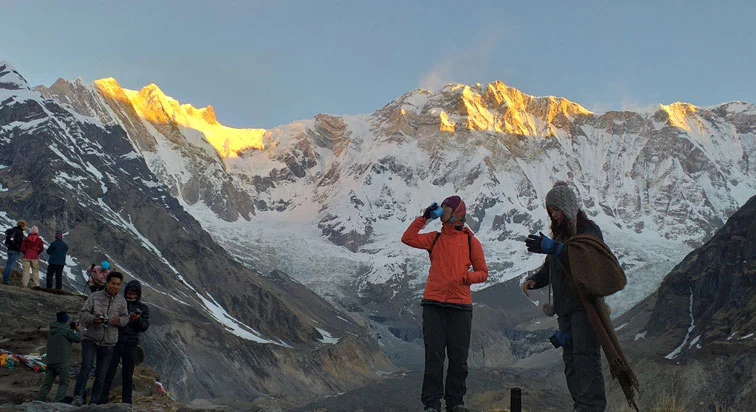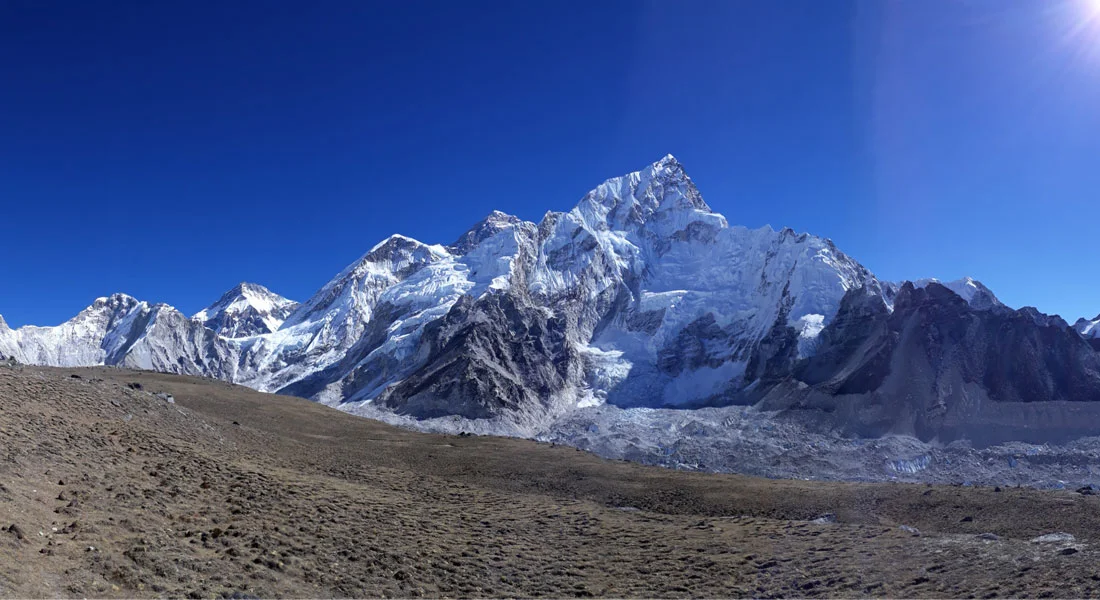
Mount Everest has two base camps-the Everest South Base Camp is in Nepal at an altitude of 5,364 metres, while North Everest Base Camp is in Tibet at 5,150 metres. The base camps are rudimentary campsites at the base of Mount Everest that are used by mountain climbers during their ascent and descent. They are also visited by hikers. Everest South Base Camp is used when climbing via the southeast ridge, while the North Everest Base Camp is used when climbing via the northeast ridge.
Supply to the South Base Camp is carried by porters, and the yaks. The North Base Camp is accessed by a paved road. Climbers typically rest at base camp for several days for acclimatization, to reduce the risk of altitude sickness.
Nepal Everest Base Camp
The Everest Base Camp trek on the south side, at an elevation of 5,364 m is one of the most popular trekking routes in the Himalayas. About 40,000 people per year make the trek there from Lukla Airport (2,846 m). Trekkers usually fly from Kathmandu to Lukla to save time and energy before beginning the trek to the base camp. However, trekking to Lukla is possible. There are no roads from Kathmandu to Lukla and as a result, the only method of transporting large and heavy goods is by plane.
Everest Base Camp Trek Route
From Lukla, climbers trek upward to the Sherpa capital of Namche Bazaar, 3,440 metres (11,290 ft.), following the valley of the Dudh Kosi river. It takes about two days to reach the village, which is the central hub of the area. Typically at this point, climbers allow a day of rest for acclimatization. They then trek for another two days to Dingboche, 4,260 metres (13,980 ft.) before resting for another day for further acclimatization.
Most trekkers use the traditional trail via Tengboche monastery, but recently, the high trail via Mong La and Phortse has gained popularity due to the impressive views it offers. Another two days takes them to Everest Base Camp via Gorakshep, the flat field below Kala Patthar, 5,545 metres (18,192 ft) and Mt. Pumori.
Everest Base Camp Height(Elevation)
Everest Base Camp on the South side (Nepal) is located at an altitude of 5,364 meters (17,598 feet) above sea level. This base camp is on the Khumbu Glacier, a constantly moving glacier that can cause the location of the base camp to shift slightly year on year.
The youngest person visited Everest Base Camp
Zara, a four-year-old girl from the Czech Republic has made history by becoming the youngest ever person to reach Mount Everest base camp. She managed to make the 170-mile journey to base camp at an elevation of 17,598 feet.
Permits and Paperwork
As well as arranging a guide, trekkers need to register for a Trekkers’ Information Management System (TIMS) card, administered by the Trekking Agencies’ Association of Nepal (TAAN), purchase a Khumbu Rural Municipality permit (available in Lukla), and pay the entry fees for Sagarmatha National Park (available in Monjo or at the Tourist Service Center at Bhrikutimandap in Kathmandu). We take care of all your paperwork for trekking to Everest Base Camp.
Health and safety
Acute Mountain Sickness (AMS) is a risk on any trek above 2500m (8202ft). To give your body time to adjust, acclimatization days are essential, and guides will build these stops into the schedule. Some people start to feel the effects of altitude above 3000m (9800ft), and by 4000m (13,100ft), almost everyone will have an elevated heart rate, faster breathing, and maybe a headache and difficulty sleeping.
Some people adjust quickly to altitude, but others don’t. While everybody responds to altitude differently and there’s no guarantee a fit traveler will withstand altitude better than their out-of-shape friend, the overall experience tends to be easier if you’re fit and healthy.
Medications such as Diamox (Acetazolamide) are available in Kathmandu (or at home) to help reduce mild symptoms as you adjust to the altitude, but it’s important to be alert for more serious warning signs of AMS and other high-altitude illnesses. If you feel unwell, descend immediately to a lower elevation – mountain sickness can be deadly.
Everest Base Camp Height/Altitude
The base camp is 17,600 ft or 5,380m. However, you will probably also trek to Kala Patthar, which looks over the base camp. Kala Patthar is 5,644m high.
Everest Base Camp Trek Distance
The distance from Lukla the first town to Everest Base Camp is 38.58 miles or 62 kilometers. Most people take 8-9 days trekking to Everest Base Camp and 3-4 days trekking back to Lukla. It took 8 days to trek to Base camp and two days to trek out.
Everest Base Camp Temperature
During June when I trekked it was sunny in the days and I actually wore shorts every day. However as I mentioned above about when the best time to be trekking to Everest Base Camp is, it can get very cold at high elevations during November to January (-20 to-30)
Meals/Food on Everest Base Camp Trek
Meals on the Everest Base Camp trek offer a mix of local Nepali dishes and some Western options. You can expect to find traditional Nepali staples like Dal Bhat, Momo, and various vegetable dishes. Additionally, teahouses often serve Western dishes like pizza, pasta, and sandwiches, providing familiar flavors for those seeking variety.
Dal Bhat-A staple of the region, Dal Bhat consists of lentil soup (dal), rice (bhat), and various vegetable dishes (Tarkari). Meal prices vary depending on the location and teahouse, but you can generally expect to pay between $10-$15 per dish, potentially more at higher altitudes.
Everest Base Camp Trek-Accommodations
Accommodation during the Everest Base Camp trek typically involves staying in teahouses or lodges, offering simple but comfortable rooms with beds and blankets. These basic accommodations provide a unique trekking experience and are often family-run, offering a warm and welcoming atmosphere.
Teahouses and Lodges
Basic but Comfortable-Rooms usually have two single beds with mattresses, pillows, and blankets. Some lodges may offer better facilities like en-suite bathrooms and hot showers.
Shared Bathrooms-Bathrooms are typically shared, and toilets are often squat-type.
Communal Dining-Teahouses have spacious dining rooms where trekkers can enjoy meals and socialize.
Electricity and Wi-Fi-Most teahouses have electricity and Wi-Fi, though internet speeds can vary.
Hot Showers-Hot showers are available at many teahouses, often heated with solar or gas.
Social Hubs-Teahouses are known for being social hubs where trekkers can meet and share stories.
Local Hospitality-Stays at teahouses allow trekkers to experience local culture and hospitality.
Luxury Options-Luxury lodges with better facilities are also available for those who prefer more comfort.
Additional Considerations
Sleeping Bag-While teahouses provide blankets, it’s recommended to bring a warm sleeping bag for added warmth, especially at higher altitudes.
Shared Spaces-Teahouses are shared spaces, so be prepared for some noise and potential for sharing rooms.
Wifi and Electricity Availability on Everest Base Camp
Wifi-Costs anywhere from $3 to $10 to use wifi at the guesthouses. Buy a Ncell Sim before you go. Ncell works at 50% of the guesthouses.
Electricity-You will have to pay anywhere from $2 at low elevation to $8 at high elevation to charge your power banks, cameras, and phones. The key is to get a fat power bank. Pay to charge that then charge everything from your power bank. My power bank lets me charge my phone and four camera batteries before it would be done.
Everest Base Camp Package
Everest Base Camp Package Cost ranges from $1400 to $2500, depending on trip days and the services. In the package price, it includes flight, guide, permits, meals and accommodations.
Everest Base Camp Packing List
Keep in mind you won’t be doing any washing. Clothes that dry quickly and are lightweight are key. Here is a packing list for Everest Base Camp. All of this should fit into a backpack no bigger than 50L and be less than 15kg.
Clothes
2 pairs of pants that rip off into shorts
2 long sleeve quick-dry material shirts
5 Pairs of Thermal North Face socks
1 Fleece pants and sweater.
1 Thermal Lycra long sleeve and pants
5-6 pairs of quick-dry underwear
1 huge waterproof down jacket
Beanie
Neck Buff
Gloves
Other gear
Headlamp
Water Purification pills and 1L bottle
Sunblock
Sunglasses
Hat
Watch
Camera gear and electronics (Not necessary but up to you. Obviously I carried a lot)
Power bank
Why trek to Everest Base Camp in Nepal?
Mt Everest straddles the Nepal-Tibet border, but when people talk about trekking to Everest Base Camp, they almost always mean the route in Nepal. As well as having excellent infrastructure for trekkers, Nepal is more open and accessible to tourists, and from this side, the only way to reach Base Camp is on foot (or by helicopter, if you’re short on time but flush with funds). A nicely paved road leads most of the way to the mountain on the Tibetan side.
While the unobstructed views of Everest are arguably better from the Tibetan side (take it from someone who’s seen both) there’s more to this trek than just the views of the mother mountain. You’ll enjoy an unforgettable cultural experience alongside the physical challenge of one of the world’s best trekking trails. If you’re a physically active, outdoors-loving, adventurous traveler, this trek ticks all the boxes!
How much does it cost to climb Everest Base Camp from Nepal?
If you are planning to climb Everest Base camp from Nepal, it costs from US$800 to US$ 5000, depending on services, and days of trekking to EBC. Everest Base Camp trek in 2025 cost ranges in between $1000 and $3000 for a 12 to 14-day trek, depending services and tour operators.
Is Free to visit Everest Base Camp?
Trek to visit Everest Base Camp is not free. The Khumbu Pasang Lhamu Rural Municipality Permit and the Sagarmatha National Park Entry Permit with cost USD 60, you have to pay to get permission to go to the Everest Base Camp. The food costs range from $30 to $40 per day, approximately $10 to $15 per meals, it depends on the food items you choose.
Is there a age limit for Everest Base Camp Trek?
There’s no upper age limit for this trek, but it would be wise to approach it extremely carefully if you’re over 70 years old. You can do it, of course, just visit your GP for a full medical and be honest with yourself about your stamina. In the past, people aged from 18 to 80 have trekked to Everest Base Camp.
A normal person can trek to Everest Base Camp (EBC). You don’t need to be an elite athlete, but a good level of fitness, preparation, and determination are essential. Many people with varying fitness levels and trekking experience have successfully completed the EBC trek. The beginners can go for the Everest Base Camp and enjoy the unforgettable journey to the lap of the highest peak in the world.
Can anyone visit Everest Base Camp?
While summiting Mount Everest itself obviously requires years of mountaineering experience and technique. Trekking to Everest Base Camp (EBC) requires no mountaineering experience and technique. A fact that makes it wonderfully open to many, including, most probably, you.
Is a sleeping bag needed for Everest Base Camp Trek?
A warm sleeping bag is nice to keeping warm and having a good nights sleep on an Everest Base Camp trek. The nights on your trek, especially in the high mountain regions, can get extremely cold. I strongly suggest a goose down sleeping bag if it’s within budget.
Is Everest Base Camp worth it ?
Trekking to Everest Base Camp is really a worth it for the stunning scenery, the sense of accomplishment, and the unique cultural experience it offers. While it’s a physically challenging trek, the rewards are numerous, making it a bucket-list experience for many adventurers.
Unforgettable Scenery-The trek takes you through breathtaking landscapes, including stunning mountain views, glacial plains, and vibrant valleys. The Majesty of Everest-you’ll have a chance to witness the sheer scale and beauty of Mount Everest from a close vantage point. Cultural Immersion-the trek provides an opportunity to experience Sherpa culture, interact with local guides and porters, and learn about their way of life.
Personal Growth-The trek can be a physically and mentally challenging experience, pushing individuals to their limits and fostering a sense of accomplishment. A Sense of Adventure-the Everest Base Camp Trek is a classic adventure, offering a unique and unforgettable experience.
However, it’s also important to be aware of potential challenges such as altitude Sickness-the trek involves significant elevation gains, and altitude sickness can be a serious concern.
physical demands-the trek requires a moderate level of fitness and can be physically demanding, especially at high altitudes.
Logistical Considerations-planning and booking the trek can require careful attention to detail.
potential crowding-The trek can be crowded, especially during peak season, which may impact the experience.
Which is good Kilimanjaro or Everest Base Camp?
The Everest Base Camp trek is generally considered harder than Kilimanjaro due to its longer duration (12-14 days) and sustained high altitude, which increases the risk of altitude sickness. However, Kilimanjaro’s summit is higher, and the final ascent is more physically demanding. Everest Base Camp trek is more challenging due to higher altitudes and longer days than the Annapurna Base Camp Trek.
When is the best time to trek to Everest Base Camp?
The peak seasons for trekking in Nepal are from October to November and March to May. These are the busiest times to trek to Everest Base Camp but also the best times to go for fine weather. The season for mountaineering ascents of Everest is the spring – while climbing and trekking are not the same thing, trails will be more crowded at this time as mountaineering groups also trek to Everest Base Camp.
During the monsoon season from June to September, trails can be slippery, visibility poor, and flights into and out of Lukla often delayed or canceled. Winter (December–February) is not necessarily a bad time to trek, but you’ll need to be well-prepared for the cold. Not all tour operators offer treks in winter and many businesses on the trail close, but those who hit the trails can enjoy an uncrowded experience.
How long does the Everest Base Camp trek take?
The most commonly trekked route starts in Lukla, a mountain village with a tiny airstrip served by regular turboprop flights from Kathmandu. The trail meanders through Sagarmatha National Park – Nepal’s highest national park – climbing steadily to Everest Base Camp before returning to Lukla. It’s an in-and-out route, rather than a circuit, and the trek typically takes 9 to 20 days. Here’s the most popular itineraries to Everest Base Camp.
Everest Base Camp Trek 9 days
Everest Base Camp Trek 10 days
Everest Base Camp Trek 11 days
Everest Base Camp Trek 12 days
Everest Base Camp Trek 13 days
Everest Base Camp Trek 14 days
Everest Base Camp Trek 15 days
Everest Base Camp Trek 16 days
Everest Base Camp Trek 17 days
How hard is the Everest Base Camp Trek?
The two-week trek to Everest Base Camp requires stamina but not superhuman powers. Many older kids manage it, for example, but you’ll find it easier if you’re reasonably fit and have some experience with multi-day mountain trekking. If you’ve never hiked in your life, you may struggle, but if you have a regular workout routine of some kind, you’ll probably do fine. Pre-trek gym-based or outdoor training is a good idea.
Lukla – the most common starting point for the trek – sits at 2860m (9383ft), and you’ll climb to 5364m (17,598ft) at base camp. The trek gets harder the higher you go because the air gets thinner and the temperatures colder, especially at night. The trail is steep in places, and some of the earlier days are relentlessly uphill, such as the climb from Phakding to Namche Bazaar at 3440m (11,286ft) on day two of the hike.
The best time to trek to Everest Base Camp
The peak seasons for trekking in Nepal are from October to November and March to May. These are the busiest times to trek to Everest Base Camp but also the best times to go for fine weather. The season for mountaineering ascents of Everest is the spring – while climbing and trekking are not the same thing, trails will be more crowded at this time as mountaineering groups also trek to Everest Base Camp.
During the monsoon season from June to September, trails can be slippery, visibility poor, and flights into and out of Lukla often delayed or canceled. Winter (December–February) is not necessarily a bad time to trek, but you’ll need to be well-prepared for the cold. Not all tour operators offer treks in winter and many businesses on the trail close, but those who hit the trails can enjoy an uncrowded experience.
Where is Everest Base Camp?
The Everest Base Camp Trek is one of the most iconic and well-known treks in the world. Mount Everest is the world’s highest mountain and part of the Nepalese Himalayas, standing at 8,848m above sea level. Everest Base Camp is either one of two base camps-South Base Camp is in Nepal and North Base Camp is in Tibet. These camps are primarily used by mountaineers to ascend and descend the World’s highest mountain. The Everest Base Camp Trek Nepal is one of the most popular trekking routes in the Himalayas.
What is trekking to Everest Base Camp?
Trekking to Everest Base Camp really is a once in a lifetime experience! Hiking through the foothills of the Nepalese Himalayas is an incredible experience; eight of the world’s fourteen highest peaks are located here – there really isn’t a mountain range quite like this anywhere else on Earth.
The trek starts in the picturesque village of Lukla, before trekking along the Dudh Koshi River, through rhododendron forests, along a glacial lake and up onto the Khumbu Glacier itself. We then reach the prayer flags of Everest Base Camp. An experience like no other!
Our Everest Base Camp Trek sees us spend the following day pushing on further to summit Kala Patthar – a mighty peak at 5,545m, overlooking Base Camp, with the most incredible view of Everest. Over the next couple of days, we retrace our steps (with a few diversions to experience new exciting views!), back to Lukla.
How hard is it to trek to Everest Base Camp?
Climbing to Everest Base Camp is a challenge – but an achievable one! You don’t need any specialist equipment or technical climbing skills. This is a trek – on mountain paths, gentle gradients and, of course, with some steep sections. No matter what your age, experience or fitness level, as long as you put in the correct training you will be able to conquer Everest Base Camp. It is a long trek at altitude, covering a distance of 120km. The days will be long and tough; tackling some significant climbs across varied terrain. However, our itinerary has been designed to maximize your chances of success – remember, this is not a race.
Meals/Food on Everest Base Camp Trek
Meals on the Everest Base Camp trek offer a mix of local Nepali dishes and some Western options. You can expect to find traditional Nepali staples like Dal Bhat, Momo, and various vegetable dishes. Additionally, teahouses often serve Western dishes like pizza, pasta, and sandwiches, providing familiar flavors for those seeking variety.
Dal Bhat-A staple of the region, Dal Bhat consists of lentil soup (dal), rice (bhat), and various vegetable dishes (tarkari). Meal prices vary depending on the location and teahouse, but you can generally expect to pay between $10-$15 per dish, potentially more at higher altitudes.
Everest Base Camp Trek-Accommodations
Accommodation during the Everest Base Camp trek typically involves staying in teahouses or lodges, offering simple but comfortable rooms with beds and blankets. These basic accommodations provide a unique trekking experience and are often family-run, offering a warm and welcoming atmosphere.
Teahouses and Lodges
Basic but Comfortable-Rooms usually have two single beds with mattresses, pillows, and blankets. Some lodges may offer better facilities like en-suite bathrooms and hot showers.
Shared Bathrooms-Bathrooms are typically shared, and toilets are often squat-type.
Communal Dining-Teahouses have spacious dining rooms where trekkers can enjoy meals and socialize.
Electricity and Wi-Fi-Most teahouses have electricity and Wi-Fi, though internet speeds can vary.
Hot Showers-Hot showers are available at many teahouses, often heated with solar or gas.
Social Hubs-Teahouses are known for being social hubs where trekkers can meet and share stories.
Local Hospitality-Stays at teahouses allow trekkers to experience local culture and hospitality.
Luxury Options-Luxury lodges with better facilities are also available for those who prefer more comfort.
Additional Considerations
Sleeping Bag-While teahouses provide blankets, it’s recommended to bring a warm sleeping bag for added warmth, especially at higher altitudes.
Shared Spaces-Teahouses are shared spaces, so be prepared for some noise and potential for sharing rooms.
Planning a Trip? Make an Inquiry
- Nepal Everest Base Camp
- Everest Base Camp Trek Route
- Everest Base Camp Height(Elevation)
- The youngest person visited Everest Base Camp
- Permits and Paperwork
- Health and safety
- Everest Base Camp Height/Altitude
- Everest Base Camp Trek Distance
- Everest Base Camp Temperature
- Meals/Food on Everest Base Camp Trek
- Everest Base Camp Trek-Accommodations
- Teahouses and Lodges
- Additional Considerations
- Wifi and Electricity Availability on Everest Base Camp
- Everest Base Camp Package
- Everest Base Camp Packing List
- Why trek to Everest Base Camp in Nepal?
- How much does it cost to climb Everest Base Camp from Nepal?
- Is Free to visit Everest Base Camp?
- Is there a age limit for Everest Base Camp Trek?
- Can anyone visit Everest Base Camp?
- Is a sleeping bag needed for Everest Base Camp Trek?
- Is Everest Base Camp worth it ?
- Which is good Kilimanjaro or Everest Base Camp?
- When is the best time to trek to Everest Base Camp?
- How long does the Everest Base Camp trek take?
- How hard is the Everest Base Camp Trek?
- The best time to trek to Everest Base Camp
- Where is Everest Base Camp?
- What is trekking to Everest Base Camp?
- How hard is it to trek to Everest Base Camp?
- Meals/Food on Everest Base Camp Trek
- Everest Base Camp Trek-Accommodations
- Additional Considerations
 Talk to Expert