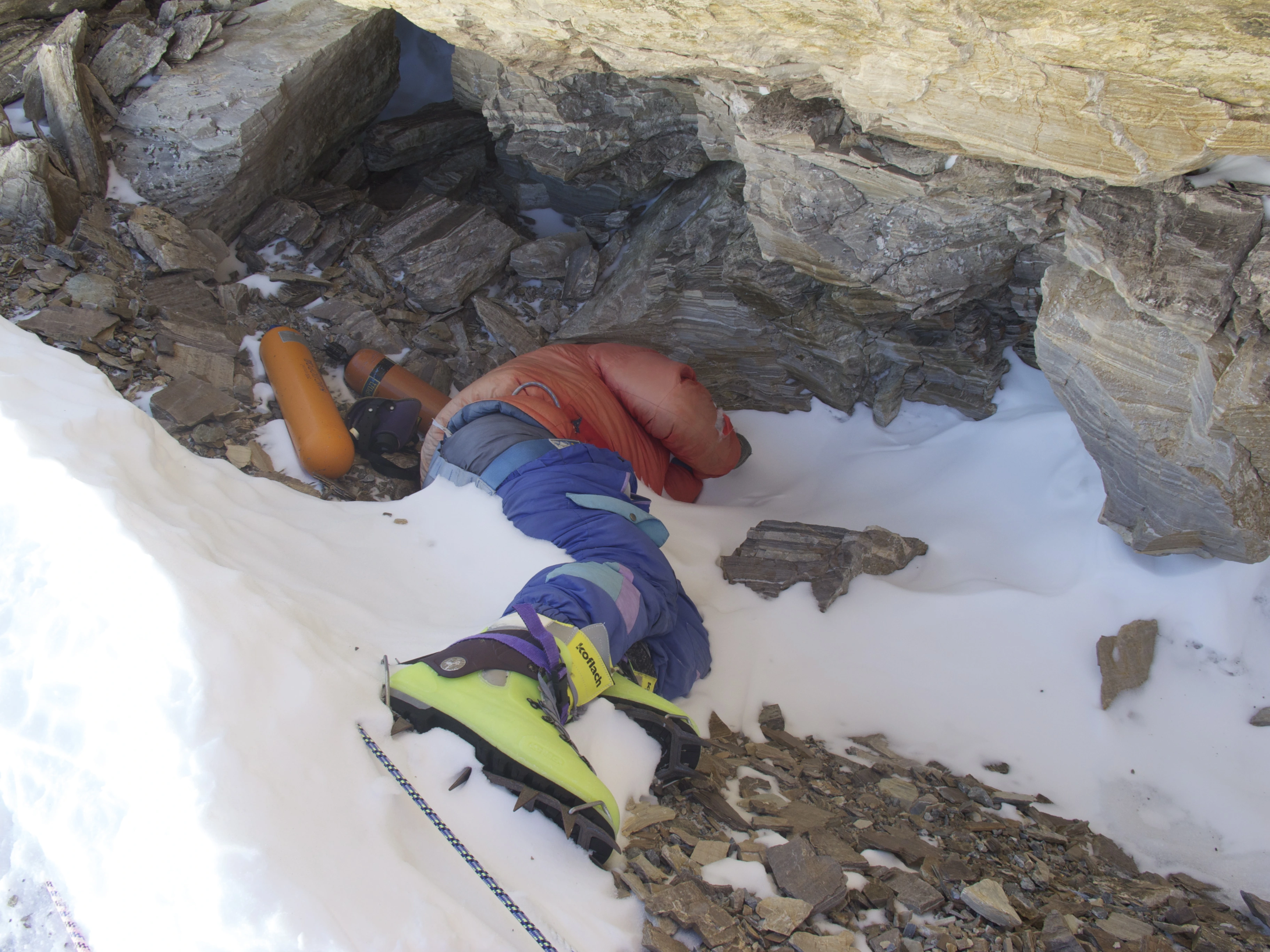
Green Boots Mt Everest is believed to be the body of Tsewang Paljor, an Indian climber who died on climbing Mount Everest disaster in 1996. The body is known as “Green Boots” because Paljor was wearing green Koflach mountaineering boots. The body of Tsewang Paljor, also known as “Green Boots on Mount Everest”, is still on Everest because it was moved to a snow burial site on the mountain’s slope.
Keynotes of about Green Boots Mt Everest
The body of Tsewang Paljor was found in a cave on the Northeast Ridge of Mount Everest in 1996. The body became a landmark for climbers on the Northeast Ridge route. In 2014, the body was moved to a snow burial site on the mountain’s slope. In 2017, mountaineers found the body again and covered it with snow. The body is still on Everest and is easily recognizable by climbers.
Green Boots Mt Everest Facts
Tsewang Paljor was an Indian member of the Indo-Tibetan Border Police expedition (ITBP). He died in the 1996 climbing disaster on Mount Everest. The 1996 Everest tragedy was one of the deadliest historical disasters with eight climbers dying. The tragedy led to a radical transformation in the way excursions are made at the world’s highest peak.
Green Boots Mt Everest is the body of an unknown climber, found on the north east ridge of Mount Everest. The green Koflach mountaineering boots on his feet are the term “Green Boots” first seen. Up until it was moved in 2014, all excursions from the north side discovered the body curled in the limestone alcove cave at 8,500 meters (27,900 feet). Nearly every climber who ascends the top encounters this enigmatic corpse known as Green Boots Everest.
A Tragic Story of Green Boots Mt Everest
British climber and filmmaker Matt Dickinson captured the first known video footage on Green Boots in May 1996. The video was used in the 1996 Brian blessed film Summit Fever. The unnamed climber is identified as being from Nepal by the film’s narrative. The body gained notoriety over time for its location on the north route as well as its connection to David Sharp’s passing. Members of a Chinese expedition moved Green Boots in 2014 to a less obvious site.
Years later, his body was discovered on the peak’s northern crest, or at least that is what the search team believed when they discovered it. In actuality, the body had been lying there eerily for so many years and had a pair of green boots on it. The body had been given the moniker Green Boots Everest because of the color of the boots. Many people still today hold that Paljor is the rightful owner of the body, while other beliefs contend that this is not the case.
Green Boots Mt Everest, Found in 2001
First time, Green Boots were found on Mount Everest in 2001. The Sherpas at the time thought that the body belonged to a Chinese mountaineer who had passed away around six months prior. Later, it was discovered that the body belonged to a person who had passed away in 1996, on the Everest disaster, an avalanche that killed the lives of eight climbers, climbing Mount Everest. It was rumored that Tsewang Paljor, who was a member of the first Indian expedition team, attempt to climb Everest, was in reality the Green Boots in Everest.
In 1996, an Indian climber by the name of Tsewang Paljor became disoriented while attempting to scale the Everest. The 28-year-old Tsewang Paljor, an Indo-Tibetan climber from Sakti, a small mountain town in North India. He had the confidence to realize his aim of becoming the first Indian to climb Mount Everest from the North Side because he was a border officer who had grown up in the Himalayas.
Due to his history in climbing and job as a border police in the high altitude of the border between India and China, Paljor was confident that Everest was not a serious problem. Along with reaching the summit, his goal was to become the first Indian to climb Everest from the North Side. Despite being informed that the weather is getting worse, Paljor and two of his co-workers decide to press on rather than give up.
Although several Indian teams had before scaled the mountain, the six-person Indian team was the first to try the ascent from the eastern ridge. The Indian Indo-Tibetan Border Police (ITBP) expedition sent the climbers on the northeast route. It was the first Indian ascent of Everest from the east side, and Commandant Mohinder Singh oversaw the trip. Harbhajan Singh, the sole survivor of the Indian mountaineering expedition, was unable to reach the peak of Mount Everest due to weather conditions, which he stated were worsening.
Green Boots Mt Everest Of Tsewang Paljor
Paljor died away at the age of 28. On May 10, 1996, just below the top, Subedar Tsewang Smanla, Lance Naik Dorje Morup, and Head Constable Tsewang Paljor were stuck in a blizzard. The storm appeared to be lethal, so three of the six people made the decision to head back. The other three, including Paljor, were more resilient and made the decision to press on and reach the summit however they could. Smanla, Morup, and Paljor made the decision to attempt the summit. The three climbers radio messaged their expedition leader at 15:45 Nepal time to let him know they had reached the summit.
They left a gift of khatas, pitons, and prayer flags. The leader Smanla made the decision to spend more time here for religious ceremonies and gave the other two instructions to descend. After that, there was no further radio contact. Team members who were still in the camps below noticed two head lights moving just above the second step, which is located at 8,570 meters (28,117 feet). None of the three were able to return to high camp, which is located at 8,300 meters (27,231 feet). The condition that led to their death is unknown due to the poor weather.
Later, there was debate over whether or not and a group of Japanese climbers from Fukuoka had seen the missing Indian climbers and maybe neglected to save them. At 06:15 Beijing time, the group left their camp at an elevation of 8,300 meters (27,231 feet), and they arrived at the summit at 15:07. They came across other climbers on the trail along the way.
They thought these others, all of whom had goggles and breathing masks under their hoods, were members of a climbing party from Taiwan, unaware of the missing Indians. They started their descent at 15:30 and claimed to have seen an unknown object above the Second Step. They did radio message to report spotting one person on a fixed rope below the first step.
Shigekawa, one of the climbers, then greeted an unidentified man who was standing close. They only had enough oxygen at that point to get back to C6. The Fukuoka party learned that three men were missing from an Indian in their group at 16:00. They proposed to assist with the rescue, but it was turned down. They had to wait until May 13 to send a second party to the summit due to severe weather. Although they came upon many bodies at the First Step, they kept going to the peak.
Regarding the acts of the Fukuoka team, there were first some misunderstandings and harsh words, which were subsequently rectified. The Indian team allegedly stated that the Japanese had promised to assist with the search but had instead moved forward with their summit attempt, according to Reuters.
The Indian-Tibetan Border Police accepted the Japanese team’s denial that they had abandoned and refused to assist the climbers who were near death while ascending. Captain Kohli, a representative of the Indian Mountaineering Federation, eventually withdrew his prior criticism of the Japanese and acknowledged that the Japanese had not met the Indians on May 10.
While it is generally accepted that Green Boots contains the remains of Head Constable Tsewang Paljor, a 1997 article titled “The Indian Ascent of Qomolangma by the North Ridge” written by the expedition’s deputy leader P. M. Das in the Himalayan Journal suggests that Lance Naik Dorje Morup, aka Dorje, might actually be the person buried there. At 19:30, two climbers were sighted descending by the light of their headlamps, according to Das, however they quickly disappeared from view.
The expedition’s second summit group’s leader radioed base camp the following day to report that they had seen Morup moving slowly between the First and Second Steps. Das stated that Morup “had refused to put on gloves over his frost-bitten hands” as well as “was finding difficulty in unclipping his safety carabineer at anchor points.” Das claims that the Japanese team helped him move to the following rope stretch. The body of Tsewang Smanla was later found by the Japanese team above the Second Step.
Morup was still making slow progress as the gang arrived back at their starting point. On May 11, in the late afternoon, Morup is thought to have passed away. According to Das, Paljor’s corpse was never discovered. Smanla and Morup’s bodies were also discovered by a second ITBP team while they were leaving the top. Morup was found by them “lying under the shelter of a boulder near their line of descent, close to Camp 6” with his bag by his side and all of his clothing in situ, according to Das.
By the beginning of the twenty-first century, Green Boots joined the group of about 200 bodies that were still on Everest. When the phrase “Green Boots” first appeared in Everest slang is unknown. As all the excursions from the north side ran into the climber’s body curled up in the limestone alcove cave over time, the phrase eventually spread. At a depth of 27,890 feet (8,500 meters), the cave is covered in empty oxygen tanks. It is down the way from the first step.
Francys Arsentiev, who perished in 1998 after attempting an unsuccessful descent from Everest after summiting, is another climber who has failed and earned the moniker “Sleeping Beauty”. She died where she fell, and her body was on display until 2007, when it was formally hidden.
In “Rainbow Valley,” a region below the summit where bodies covered in vividly colored mountaineering gear are scattered, there are further bodies. Hannelore Schmatz, known as “the German woman” because her prominent placement on the south path, is yet another identified corpse. She reached the summit in 1979 but passed away while descending at an altitude of 8,200 meters (27,000 feet). She stayed there for a long time before being blown further down the mountain.
Climber Mark Inglis and his group discovered British mountaineer David Sharp in a hypothermic condition in Green Boots’ Cave in 2006. After radioing for assistance in helping Sharp, which he was unable to give, Inglis continued his ascent. A few hours later, Sharp passed away from intense cold. On that day, some thirty other climbers would have passed the dying guy; it has been conjectured that those who saw him thought Sharp was Green Boots and gave him no mind.
Green Boots is starting to take on the unmistakable significance of Everest’s inherent dangers. For climbers who have their sights set on the highest peak in the world, the figure known as Green Boots serves as a somber reminder. The chilling sight of his ultimate resting place brings home to us the severe conditions of the mountain. He vividly described the possible repercussions of being unprepared.
For more than 25 years, Green Boots, who is thought to be Tsewang Paljor, has left his silent warning in the history of mountaineering. His experience is not unique; the mountain’s harsh terrain has claimed the lives of over 200 climbers. Their carcasses are uncannily preserved in the high-altitude “death zone.”
Many of these fallen climbers go unharmed because of the costly, risky, and challenging process of recovering them. They were unintentionally creating a high-altitude cemetery on Everest. Within the climbing community, this phenomena has sparked discussions. In essence, it discusses the validity of leaving these bodies where they are from an ethical standpoint. It has prompted demands for modifications in how Everest’s fallen are handled.
Despite the assertions made by several parties, it is impossible to point the precise identity of Green Boots in Everest. The corpse of Green Boots Everest was reported missing from its original location in the year 2014. They had begun to think that the body had most likely been buried beneath the snow. A body was later discovered hanging on the cliff in 2017. Many people believed that the body was Green Boots Everest, moved here from its original location on the ridge. But generally, it was difficult to be certain.
Further Answer and Questions(FAQS)
Is Green Boots still on Mount Everest?
Green Boots is among the roughly 200 corpses remaining on Everest by the early 21st century. It is unknown when the term “Green Boots” entered Everest parlance. Over the years, it became a common term, as all the expeditions from the north side encountered the climber’s body curled up in the limestone alcove cave. The body of “Green Boots, is still on Mount Everest in 2024. While there were reports in 2014 that the body was no longer visible, it was later confirmed to be present again in 2017, with more rocks surrounding it.
What is the identity of Green Boots Everest?
The Green Boots in Everest is the dead body of a climber on the Northeast Ridge route believed to be Tsewang Paljor. He was an Indian climber and Indo-Tibetan Border Police officer. The infamous name came from the green mountaineering boots he wore.
How cold is the death zone on Mount Everest?
Above 8000 meters, considered the death zone of Everest at the summit the temperature fall is recorded to be -60˚C. This temperature of Everest is resulted due to excessive high altitude and low air pressure making the air very thin to breathe properly.
What is Rainbow Valley Everest?
Rainbow Valley exists as a dark side of Everest despite being commonly known by its name. Rainbow Valley stands as a morbid memorial to all those who perished within the lethal area of the mountain. The frozen clothes of dead climbers stay in the area for a long time. This is why the place is called Rainbow Valley.
What is the death zone on Mount Everest?
The altitude above 8,000 meters (26,247 feet) consider the “death zone” on Mount Everest where the oxygen level is so low that humans cannot survive for extended periods without supplemental oxygen. This area is known for its extreme conditions and high mortality rate.
Characteristics of Death Zone on Mount Everest
Low Oxygen-At this altitude, the atmospheric pressure is significantly lower, resulting in a much reduced oxygen level.
Extreme Conditions-The death zone is characterized by frigid temperatures, strong winds, and the physical and psychological toll of the extreme altitude.
Physiological Challenges-The body struggles to adjust to the low oxygen levels, leading to conditions like high altitude pulmonary edema (HAPE) and high altitude cerebral edema (HACE).
Risk of Death-Prolonged exposure to the death zone without supplementary oxygen can result in death due to organ failure or other complications.
Consequences for Climbers
Physical Strain-The physical exertion of climbing in the death zone, combined with the low oxygen, puts a tremendous strain on the body.
Cognitive Impairment-Low oxygen levels can impair cognitive function, leading to poor decision-making and increased risk of accidents.
Psychological Effects-The isolation, stress, and fear of the death zone can take a toll on climbers’ mental state.
Limited Time to Acclimatize-While climbers can acclimatize to some degree, complete acclimatization to death-zone altitudes is impossible.
Summits in the Death Zone-The summit of Mount Everest, and other “eight-thousand” peaks, lie within the death zone.
Use of Supplemental Oxygen-Most climbers use supplemental oxygen above 8,000 meters to mitigate the effects of the low oxygen levels.
Strategic Timing-Climbing expeditions often plan their summit attempts during favorable weather windows to minimize exposure to the death zone.
Risk Mitigation-Climbers must take various precautions, including proper acclimatization, careful planning, and adherence to safety protocols, to reduce the risk of injury or death in the death zone.
 Talk to Expert