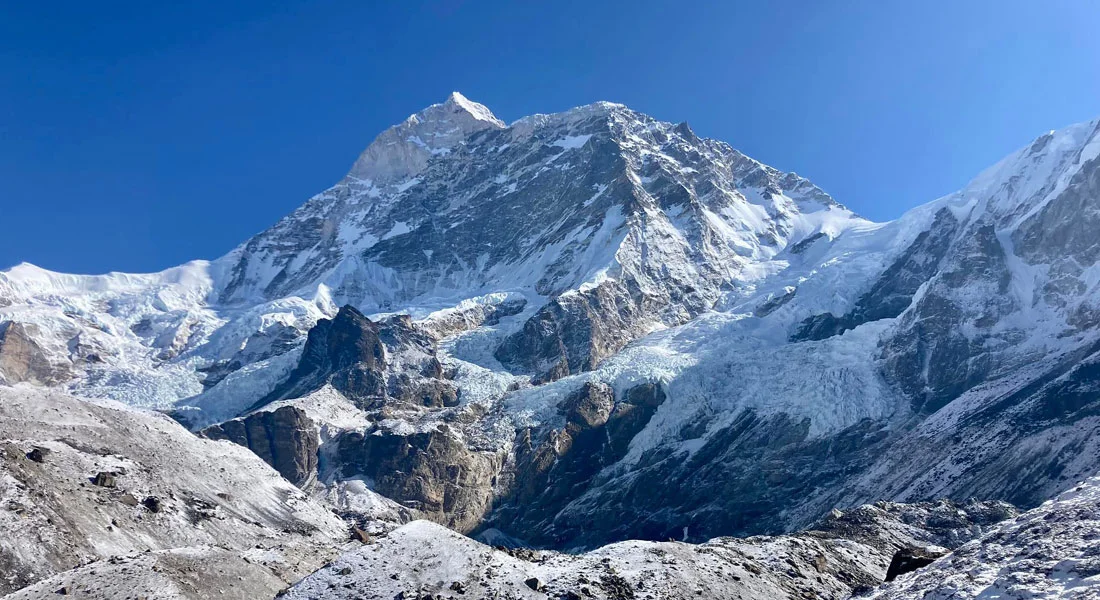
Mount Makalu Nepal is the fifth-highest peak on Earth, lying on the Nepal-Tibet border, famous for trekking and climbing in Nepal. Learn more about the towering beauty of Mt Makalu, including its first ascent, permits, routes, and the number of days of trekking and climbing.
Mount Makalu Nepal Facts
Height: 8,485 meters / 27,838 feet
First Ascent: May 15, 1955, by Lionel Terrey and Jean Couzy
Location: Nepal/Tibet border in Mahalangur Himalayas
Deaths: 35 (as of 2022)
Summit Success Rate: 34%
Key Notes of Mt Makalu Nepal
Distinctive Pyramid Summit
The Makalu summit is characterized by its pyramid shape, a distinctive feature that sets it apart from other peaks. The sharp angles of the Makalu summit create a captivating silhouette against the backdrop of the Himalayan sky.
Challenging Ascent
Makalu presents a formidable challenge to climbers, earning its reputation as one of the most technically demanding climbs in the world. The ascent involves navigating steep rock walls, ice slopes, and unpredictable weather conditions, testing the skills and resilience of even the most experienced mountaineers.
Makalu Climbing Routes
Makalu offers various climbing routes, each with its own challenges and rewards. The most popular route is the standard Southeast Ridge, known for its technical difficulty and breathtaking views. Other paths – the West Pillar and the Northeast Ridge, provide alternative options for seasoned climbers.
Stunning Panoramas
The summit of Makalu offers panoramic views of some of the world’s highest peaks, including Everest, Lhotse, and Kanchenjunga. The expansive vistas from Makalu’s peak are a visual feast, rewarding climbers with an unparalleled experience of the Himalayan landscape.
Untouched Wilderness
Makalu’s remote location and challenging terrain contribute to the preservation of its pristine wilderness. The surrounding Makalu Barun National Park, a biodiversity hotspot, is home to a diverse range of flora and fauna, making the region a haven for nature lovers and conservation enthusiasts.
History of Makalu Ascents
For centuries, Makalu remained an unknown peak shrouded in clouds and mystery. It was only identified as the world’s fifth highest in the 1850s. After an expedition in 1954, a French team made the first ascent in 1955, two years after the first ascent of Everest (the highest mountain in the world).
The technical difficulty and isolation of Makalu and political restrictions meant few attempts in the early years. By 1970, there were only six successful summits. A legendary American team in 1970 finally conquered the southwest Makalu face.
In the modern era, easier access and routes have enabled more expeditions. But the summit success rate still hovers around 34%, making Makalu among the hardest 8000ers to climb. Storms, avalanches, and technical rock sections regularly turn back teams each season.
Mount Makalu Climbing Permits Costs
Makalu-Barun National Park Entry Permit
Nepal Government royalty fees
Makalu permit (Peak climbing permit) per person, issued by Nepal Mountaineering Association (NMA)
Liaison officer expenses (Mandatory for teams)
Visa costs for Nepal
Flights to/from Kathmandu
Insurance, food, supplies, oxygen, etc.
We suggest you contact an experienced operator to make the complex logistical and permitting process smoother. You should prepare for the permits 4-6 months in advance of your climb.
Best time to climb Mount Makalu
The best time to climb Makalu is either spring or autumn. Spring is the most favorable due to the right temperature and the clear skies. In spring, April, March, and May months are popular. You can also climb Makalu during autumn in September, October, and November.
Climbing Makalu
The first step for a Makalu climb is securing a permit. It is an essential step for mountaineers undertaking this challenging expedition. The permit, issued by the Nepalese government, ensures that climbers adhere to regulations designed to preserve the environment and promote responsible mountaineering.
Acclimatization
The climbing journey typically begins with an acclimatization process, allowing climbers to adapt to the high-altitude conditions. The trek to Makalu Base Camp, situated at approximately 4,800 meters, serves for acclimatization and preparation for the ascent.
Routes on Mount Makalu
Southeast Ridge: This is the original and most common route, first climbed in 1955. It follows the long Southeast ridge, joining the main summit ridge. However, this route is highly prone to rockfall and avalanches, yet this route is not as technical as the northeast ridge.
Northeast Ridge: A direct route first climbed in 1971 involving steep snow, ice, and mixed terrain. It joins the southeast ridge higher up. This path is steeper and harsher to climb than the southeast ridge.
West Pillar – This is a technical route first climbed in 1971 that meets the southern ridge just below the summit. The route is exposed, and the strong winds are frequent.
West Face – Among other routes, this is the most challenging route as it passes through avalanche-prone areas with huge serac barriers. This route was first summited in 1997.
All routes require expertise in rock, snow, and ice climbing. Southeast Ridge is the most commonly taken route.
Southeast ridge of Mt. Makalu
Southeast ridge is the most frequented route to Makalu Peak. Here are the climbing details through this route.
Makalu Base Camp (5600M): Reaching Makalu Base Camp is the first step for a Makalu Expedition. This base camp serves as the preparation and an acclimatization point for the Makalu expedition.
Makalu Camp 1 (6400m): Once prepared at the Base Camp, you will head to Camp 1. The path passes through rock slabs and moraine before reaching a glacier. It will take around three to four hours to reach the first Camp. The first Camp consists of two sections – lower and upper.
Makalu Camp 2 (6800m): The path from Makalu Camp 1 and Makalu Camp 2 is intermediate in terms of climbing complexity. You will have to cross several steep ice areas. Though you do not need a ladder to complete this section, you must take support from ropes. The average time to reach Camp 1 to Camp 2 is around three hours.
Makalu Camp 3 (7450m): This is the longest section between the camps. You will have to cross a few crevasses and follow the ropes placed by Sherpas. It will take around four hours to reach Camp 3 from Camp 2.
Makalu Camp 4 (7900m): The distance between Camp 3 to Camp 4 is short, but due to altitude and the rough terrain, the climb gets progressively harder as you get closer to the death zone. Due to low oxygen levels, you must push yourself. It will take around 3 hours to reach Camp 4 from Camp 3 as you conquer the route that averages around 50 percent.
Makalu Summit (8485m): After setting up a series of camps along the mountain for acclimatization, the summit push begins from Makalu Camp 4 before midnight to reach the summit at daylight. You must brave 50-60-degree snow slopes using fixed ropes to negotiate steep rock bands and ice cliffs while fighting exhaustion, oxygen deprivation, and bitter cold (-40 C). This 12-18 hour push requires every ounce of strength and stamina. Teamwork is crucial to getting through complex sections. The summit rewards those who endure but comes at a heavy price.
The Challenges of climbing Mount Makalu
Makalu is extremely dangerous, and underestimating the mountain can be fatal. You must be ready to face the challenges like
Altitude sickness, edema, exhaustion
Sudden blizzards and whiteouts
Massive avalanches and ice/rock falls
Deep hidden crevasses
Cornices and exposed knife-edge ridges
Technical climbing errors and accidents
You must stay within your limits, plan carefully, trust Sherpa’s judgment, and turn back in time to survive this peak. Makalu continues to claim lives each year.
Is Makalu Right for You?
Before embarking on a Makalu expedition, you must honestly assess the skills and experience required. Ask the following questions. Makalu is not to be underestimated. Come prepared for the challenge of a lifetime with humility, caution, and respect for the mountain. The rewards of standing atop this iconic Himalayan pyramid are immense but earned only through determination, suffering, and accepting real risk. Few peaks transform climbers like Makalu.
About Makalu Trekking
Makalu Trek takes you to Makalu Base Camp is in the heart of Makalu-Barun National Park in the Eastern Nepal. Makalu Base Camp Hike is ideal for an experienced trekkers to explore wilderness and stunning natural scenery of Makalu region. Mt Makalu is the 5th highest peak in the world and famous for its outstanding diversity of flora and fauna.
Introduction of Makalu Base Camp Trek
Makalu, an off-the-beaten-path trek in the Himalayas of Nepal presents an intense physical challenge compared to other treks in Nepal. Makalu Trek takes most trekkers at least 8 days to reach Makalu Base Camp (5,050 m). Trekkers then need to retrace their steps on 5 to 6-day journey back out the same way they came in.
At the base camp of Makalu offers a clear view of the mountain. Each morning, you can watch the sunrise over the summit of the fifth tallest mountain in the world. A short walk up the slopes from basecamp reveals incredible views of Everest and Lhotse. The Makalu Base Camp Trek is perfect for adventurers who are looking to avoid the crowded trekking routes of Nepal to experience an authentic experience of trekking amongst the giants of the Himalayas.
Highlights of Makalu Trek
View points
Makalu is derived from the Sanskrit, Maha Kala, which is a name for the Hindu God Shiva. When you stand at base camp and stare up at Makalu you could feel as if you’re in the presence of the gods.
Local life
The villages and trails of Makalu region are a mish-mash of peoples, cultures and religions. In the higher villages live the Buddhist Sherpas, originally from eastern Tibet, while the Rai people, many of whom still follow the ancient Kranti religion, live at lower levels. Whatever their background the welcome is always a warm one.
Bio-diversity
Makalu forms the heart of the Makalu-Barun National Park, a super diverse 2,330sq-km protected area with an 8,000m vertical spread of elevation, ranging from tropical river valleys to the frozen summits of some of the world’s biggest mountains. Not surprisingly, there’s a huge diversity of life and growing species of flowering plants. There’s also the full spectrum of wildlife, from snow leopards to red pandas; black bears to sunbirds.
Exploration possibilities
Almost all of the people who trek Makalu take a simple up and down route along the same path. For those with plenty of time and stamina, and who are very well-equipped with a full, experienced expedition-style support team, there are wildly exciting treks to Kanchenjunga or even Everest.
The Mount Makalu Trek Routes
A. Makalu Base Camp
There’s only one standard route to Makalu base camp and it’s a simple there and back along the same trail. But this is a real wilderness trek and there are only permanent villages for the first and last couple of days. Most of the time the only other people you’ll meet are herders with their yaks. One of the highlights of this trek is camping in gorgeous spring flower meadows well away from other people and waking to soaring mountain views.
Once you clear the villages the route climbs steeply through forests, crosses the high and often snowy Shipton Pass (4,127m; named after Eric Shipton who followed this route with Sir Edmund Hillary during the 1952 Everest reconnaissance expedition) and then goes along the Barun Valley past rapids and waterfalls. Eventually, after crossing scree fields and landslide debris, the valley opens out and you arrive at base camp.
The view at base camp will send shivers of wonder down your spine, but climb up to the nearby ridge on Peak 3 for even more stunning Makalu views as well as side views of Lhotse, Lhotse Sar and Everest. You’ll probably be the only person up there.
B. Fact of Makalu Base Camp Trek
Difficulty: Difficult.
Lots of steep up and down and the fast elevation gain means the risk of altitude sickness is high.
Trek Duration: 14 days
Max Elevation: 4,870m
Accommodation: Camping; very basic herders’ tea houses.
Start/End Point: Num
Makalu Circuit Trek(Makalu to Everest)
One of the most challenging treks, the Makalu to Everest traverses via the very high passes of Sherpani (6,135m), West Col (6,143m), Baruntse Base Camp (5,700m) and Amphu Laptsa (5,850m) before descending into the Everest region at Pangboche. You should allow a minimum of three weeks for this trek and a lot more if you want to explore the Everest region in depth. You will need full expedition equipment, an experienced team, mountaineering experience and to be prepared for many nights’ camping above 4,500m.
Facts Of Makalu Circuit Trek
Difficulty: Very strenuous. Borderline mountaineering.
Trek Duration: Minimum 21 days
Max. Elevation: 6,143m
Accommodation: Camping; very basic herders’ tea houses, trekking lodges.
Start/End Point: Num/Lukla
Makalu to Kanchenjunga Trek
In recent years a few daring groups have launched expedition-style treks that link Makalu with Kanchenjunga via the 5,160m Sumba Lumba pass. It takes almost four weeks and a lot of determination, but for most people it’s a slightly more realistic proposition than the Makalu to Everest trek mentioned above. Like that trek, you need to approach it as a full expedition and have experience at high altitude and basic mountaineering skills.
Fact of Makalu to Kanchenjunga
Difficulty: Very strenuous/borderline mountaineering.
Trek duration: 25 days
Max elevation: 5,160m
Accommodation: Camping/basic tea houses
Start/end point: Num/Taplejung
Attractions of Makalu Circuit Trek
Makalu Circuit Trek is a challenging trek that takes you through breathtaking landscapes, remote villages, and high altitudes, offering stunning views of the Himalayas. The trek typically takes about 14-25 days to complete, depending on the itinerary and the trekker’s pace. It is compulsory for all international trekkers to have a licensed guide for hiking. It is nice to organize a guide through a good trekking company. It is an easier option because they will arrange a guide for you and plan your entire trip. Just make sure you will have a reliable guide with the license.
Makalu Trek Difficulty
The Makalu Base Camp Trek is slightly more difficult than Everest Base Camp or the Annapurna Circuit due to the incline, remoteness, and rugged nature of the trails. You will reach an altitude of 5000m, which will challenge many. Altitude sickness can be common. The route has lots of undulation with several days purely walking upstairs on stairs. These days of ascent are tiring and also require the body to adjust quickly.
Makalu Circuit Trek Permits
You will need a Makalu Barun National Park Conservation Area permit (USD $30 per person and a Trekkers’ Information Management Systems (TIMS) card (USD $20 per person) to do Makalu Trek.
Best Seasons for Makalu Trek
The peak season for the Makalu Base Camp Trek is March to April and October to November. The time to avoid this trek is during the rainy season from June to August. During the winter from December to February, this region gets very cold and there will be snow cover in the higher parts of the trek. Many of the guesthouses actually close up for the winter and re-open in late February to March. However, it is possible to hike the Makalu Base Camp Trek on the fringe of the season in late February/early March and it can be quite beautiful with snow cover.
Hike to Makalu Base Camp Trek in late April/early May and it will be warm during the day and got pretty cold at night. The Shipton La had good snow cover but other than that the paths were clear. We did not need crampons.
Is guide necessary for trekking to Makalu?
A guide is necessary. However, the guide manages all of the logistics, distances, directions, and tea houses for your group. If it’s your first-time trekking in Nepal, I would suggest having a guide.
Makalu Trek-Accommodation
There are basic homestay style tea houses and lodges throughout the route. Fancy lodging and dining facilities are not available. Most tea houses have basic rooms with twin beds, hard mattresses, and blankets. Carrying sleeping bag, mattress and travel liner will keep you warm, on cold nights.
No Camping required as the basic tea houses are available along the way to Base Camp. There are three tea houses at most of the camps including at Makalu Base Camp. But, Mambuk has only one tea house. One lodge can accommodate only six to eight persons per day.
For larger groups, you either have to split between the tea houses or go camping. When you are staying at the tea houses, the rooms are basic with shared toilets and bathrooms. The toilets have Nepali style commodes. For bathing, tea houses can arrange you a bucket of hot water.
Packing Lists for Makalu Trek
Please pack pretty light and manage to wash most of your clothes each afternoon/night for the first half of the trip. In the latter stages of the trip, it is pretty cold and wear warm gear basically nonstop while at the teahouses. There will be no real need for multiple outfits. This is just a guide and it works quite well. You need a sleeping bag as there are not blankets in each guesthouse and when gets cold you also need a good down jacket.
1 pair of pants that maybe convert to shorts
1 pair of shorts
1 Warm or thicker pair of hiking pants
1 Long sleeve quick-dry shirt
1 Long-sleeve thermal shirt
2 Short-sleeve t-shirts
1 Thermal long underwear
4 pairs of quick-dry underwear
1 Lightweight down jacket
1 Heavy-duty summit down jacket
1 Beanie
1 Cap
1 Sunglasses
1 Neck Buff
1 Gloves
Hiking boots
Micro spikes
Headtorch
1 pair Gaiter
1 pair of warm summit socks
2 pairs of regular socks
1 Sunscreen
1 Trekking poles
1 Water filter
1 Power bank
What size of backpack you need to bring trek to Makalu?
All of this should fit into a backpack no bigger than 50L and should be less than 14kg.
How is WIFI Connection during Makalu Circuit Trek?
Unlike many treks in Nepal there is almost no Wi-Fi on this route. NTC sim card work for the first day and a half on the trek but once we reached Tashigaun, the connection is over.
Be prepare not to have electricity, hot water, or wi-fi on the trek even if a place has all the facilities. Often something doesn’t work and there is no power in the village, it is a cloudy day and a solar panel couldn’t warm water in the shower, they ran out of Internet cards, there is no running water because pipes are frozen. I’d recommend asking if everything works fine before checking in.
What is the situation of Electricity?
This was the least power I have experienced on a trek in Nepal so far. Once we left Tashigaun, most places ran off solar and didn’t have places to charge items for the clients. It was possible but not something offered for a fee like in other teahouses around Nepal.
Makalu Circuit Trek Cost
The Makalu Circuit Trek cost ranges from USD 1850 to USD 3550, it depends on the length of trek and the services. Basically, the price covers your transport, accommodation, food, guide fees, porter and trekking permit fees. Any kind of drinks such as beer, snacks, hot showers, recharging your phone or camera, tipping the guide and porter are not included in the package price.
Meals on Makalu Trek.
The meals are quite diverse and usually includes Nepalese, Chinese, Indian, and Western food. The typical dishes on the Makalu Circuit are pasta, noodles, rice with vegetable/chicken/cheese and tomato sauce, omelet, and fried, boiled, or scrambled eggs with potato/cheese/vegetable. Dal Bat (rice, roasted vegetable, chapati, and lentil soup) is the most typical local food. Momos (local dumplings), all sorts of soups (chicken, vegetable, garlic, tomato, noodle, etc.), pizzas, pancakes, different types of bread (chapati, Tibetan bread, toast), porridge, muesli, etc. There is a variety of hot beverages of different teas such as lemon, ginger, Masala, milk, mint, instant coffee.
As you can see there are really many options. You don’t have to eat the same food, you can try something different every day. If you’re vegetarian, vegan, or follow a certain diet you’ll be able to find suitable food. The problem is a lack of fresh fruit and vegetables, especially at higher altitudes. The best value-for-money food on the Makalu Circuit trek is local Dal Bhat. We really like local soups they’re always good. To make a meal more filling you can order Tibetan bread or chapati with it. For breakfast, we usually are omelet, fried eggs, or porridge.
Is travel insurance necessary for Makalu Trek
Nepal can be a dangerous place for trekking or hiking because the high altitude can lead to many illnesses, weakness in trekkers, and misjudgments. There is also a risk on trails for falls, avalanches and other mishaps. Your regular travel insurance probably won’t cover you at high altitudes and won’t cover a helicopter evacuation. There is a solution though.
Travel insurance is necessary for Makalu Trek. It is nice to provide the name and the phone number of your insurance company. You are required to provide your own insurance coverage from your home country. This should be valid for high altitude trekking and helicopter rescue. It’s actually required when applying for the TIMS card hiking permit to have insurance. Getting injured or sick at isolated locations, especially at altitude evacuation can be very complicated and expensive. Travel insurance with coverage for emergency medical, lost luggage, trip cancellation and helicopter rescue/evacuation.
Tips to guide and porter
The guide and porter will expect a tip. This can reflect your overall satisfaction but it should be in the region of USD 150 for a guide, USD 100 for a porter. This amount is shared between the trekkers in your group.
Safety
You have already done the groundwork regarding the safety record of the trekking company, and you have bought your insurance. The guide will be carrying a first aid kit. But we recommend you also carry your own, particularly if there are special medicines you require. Probably the most common injury on a trek is a sprained ankle or sunburn. But you should also take into consideration altitude sickness.
Altitude Sickness
This is not something we can predict. It is not known why some people suffer while others do not. It has nothing to do with age or fitness level. Pushing ahead too quickly, climbing too high too fast can result in problems. AMS or Acute Mountain Sickness occurs when we ascend too quickly. Normally at altitudes 3,000m/ 9,840ft or over.
What does it feel like?
Headache, shortness of breath and light-headedness. These are also related to being dehydrated. Stay hydrated and your body will most likely adjust to the altitude itself.
What if it gets worse?
If the symptoms continue, tell your guide. Especially if you are suffering from:
Difficulty in sleeping.
Need an unusual amount of sleep.
Loss of appetite.
Vivid dreams.
The need to rest/ catch your breath frequently, especially above 3,500m/ 11,483ft.
Runny nose.
Need to pee more.
Dizziness.
Altitude sickness can vary between mild symptoms and more serious stuff. Mild symptoms should clear up themselves with drinking lots of water, walking slowly and taking rest. More severe symptoms are a sign you must descend immediately.
Makalu Circuit Trek Add-on Treks.
It is possible to combine Makalu Base Camp Trek with other treks such as Kanchenjunga and Everest Base Camp via Amphu Laptse (Serpani Col).
Conclusion:
Makalu Base Camp Trek is a hidden gem, obscured from the crowd. The stunning beauty the region makes it worth to hike the arduous trail. If you are looking for a challenging trek into the remote wilderness of Nepal and experience the culture untouched by the westernization, trek to Makalu Base Camp is a good options.
 Talk to Expert