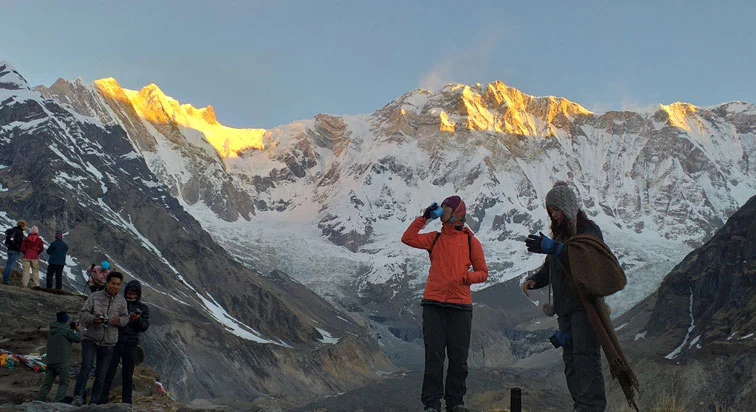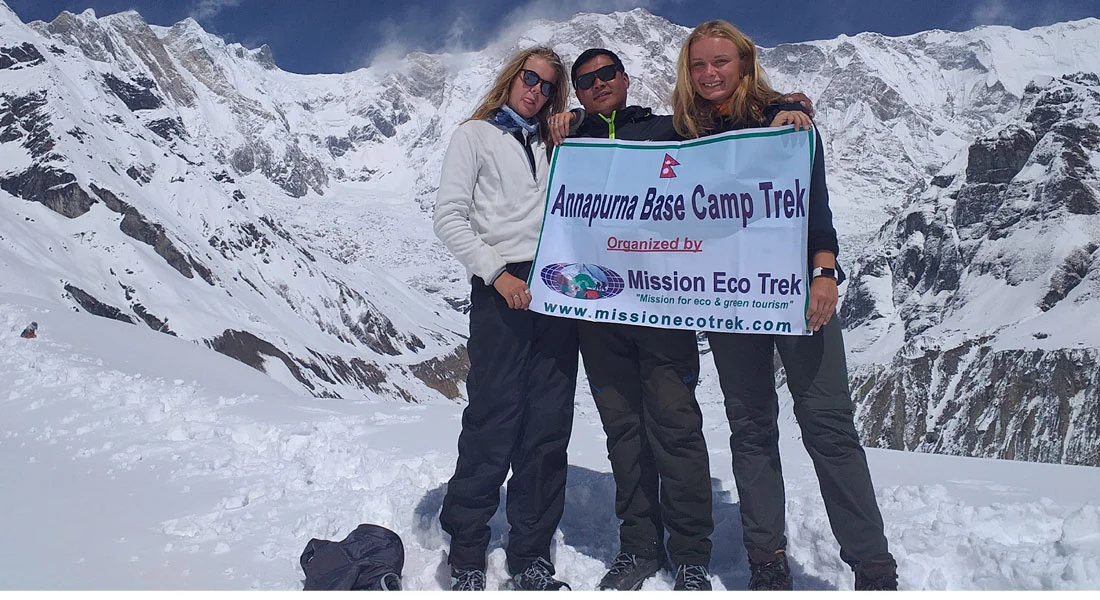
Annapurna Base Camp is a high glacial basin lying 40 km directly north of Pokhara. ABC, an oval-shaped plateau sits at an altitude of over 4000 metres, and is surrounded by a ring of mountains, the Annapurna ranges over 7000 metres. You will walk in a narrow valley between the peaks of Hiunchuli and Machapuchare to reach MBC and ABC.
Because of the high mountains on all sides, the Annapurna Sanctuary receives only seven hours of sunlight a day at the height of summer. The south-facing slopes are covered in dense tropical jungles of rhododendron and bamboo, while the north-facing slopes, in the rain shadow, have a drier colder climate similar to that of the near-by Tibetan Plateau.
The entire Annapurna sanctuary is a sacred land to the Gurung people, one of the many native people to inhabit the area. They believed it is the repository of gold and various treasures left by the Nāgas, the serpent-gods. The sanctuary is believed to be the home of several deities of Hinduism and Buddhism as well as older animistic gods.
The beautiful peak of Machapuchare is believed to be the home of the god Shiva, and the daily plumes of snow is thought to be the smoke of his divine incense. Until recently, the local Gurung people forbidden anyone from bringing eggs and meat into the Annapurna Sanctuary, and women and untouchables is prohibited from going the Annapurna Base Camp as well.
The Annapurna Sanctuary is closed for tourists until 1956 when Colonel Jimmy Roberts, who was reconnoitering the approach to Machapuchare in preparation for an attempt on the peak the following year, reached the area enclosed by the various peaks of the Annapurnas, Machapuchare and Hiunchuli. He had spent three days climbing through the gorge of the Modi Khola ‘most of the way by dismal bamboo slogging’ after leaving the village of Chhomrong. The area was first described as the Sanctuary in the book which was written about the Machapuchare expedition.
The Annapurna Sanctuary is now part of the Annapurna Conservation Area Project, which places restrictions on number of outside travelers, gathering of firewood, and domestic animal grazing. Here are some trek options to reach the Annapurna Base Camp(ABC)
When to Trek Annapurna Base Camp
The best time to trek the Annapurna Base Camp is during the peak seasons of either March – May in Spring or September – November in Autumn. This time is considered to be pre-monsoon and before winter respectively. The weather is mildly hot during the day while hiking and cold at night, depending on the altitude. There is also a lesser chance of rain during this time, and you will like to get clear days consecutively, which is perfect for hiking.
How to Get from Kathmandu to Pokhara?
There are several domestic airlines (Buddha Air, Yeti Airline, and Simrik Airline) that fly from Kathmandu to Pokhara on a daily basis. The price should be around 100 – 150 USD one way and it should take around 30 minutes. If you have time and want to save costs, you can take a tourist bus from Kathmandu at 7-8 AM for around 12-25 USD, depending on the comfort level of the bus, and that should take you 6-8 hours.
Budget for Annapurna Base Camp
Here is an approximate breakdown budget cost for the things you will have to pay on the trail.
Accommodation: USD 8 to 10 USD per night.
Food: USD 35 to 40 USD for a day, and gets more expensive the higher you go.
Water: Free tap water, USD 2 per liter of purified water.
Permits: The TIMS permit costs 20 USD and the ACAP permit costs 30 USD, totaling 50 USD.
Nepal Visa: $15 for a 15-day and USD 45 for a 30-day entry visa.
Transfer: USD 60 to USD 90(Pokhara to Pokhara from trekking starting and ending point.
Flights to Pokhara and Back: USD 200 to 300 round-trip.
Guide: USD 30 to 40 a day and porter-USD 25 to 30 USD includes all their expenses such as meals, salary, transfer, accommodation and insurance.
From the breakdown above, you can expect to spend around 40 USD (4500 NPR) per day on the trail, including food and accommodation. Adding it all up, expect to carry a minimum of 60,000 NPR in cash when you are on the trail. Your last chance of getting money from an ATM is in Pokhara, so prepare accordingly. The best way is to have more cash than you need for a smoother experience in the mountains.
Annapurna Base Camp Distance
Annapurna base camp trek distance is approximately 60km to 90km depending on the trek route and the beginning and ending point of the trek. The trip is moderate-difficult with some very steep areas and high altitude but good paths most of the way. The Annapurna Base Camp Trek beginning from a base in Pokhara is a great beginner multi-day trek for reasonably fit travelers. It is challenging but completely manageable and so worth it to go for Annapurna Base Camp.
Permits for Annapurna Base Camp Trek
In order to trek in most parts of Nepal you will need a TIMs card and permit. It costs USD 60 for both permits. For issuing permit, needs 4 passport photos and passport copy.
Need a guide for the Annapurna Base Camp Trek?
It is nice to trek with guide and porter to Annapurna Base Camp, though it is not necessary. A guide cost will be USD 35 to USD 40 a day and porter will carry your luggage, it costs USD 25 to USD 30 a day.
Temperatures on the Annapurna Base Camp
During the day temperatures are mostly pleasant and after warming up a t-shirt is fine for trekking with a warmer layer to put on when you stop. At night the temperature drops sometimes quite dramatically and you will need a couple of warmer layers. Expect it to get below zero at the base camp at night and below 10 degree Celsius further down.
Accommodation on the Annapurna base camp trek
Accommodation along the route is in the form of tea houses. At the start of the trek they are in villages where locals live and work, and further up these huts have been specifically built for trekkers. The standards are basic but comfortable mostly. Rooms have anywhere from 2 beds to a dorm of 7 or 8. Expect a thin mattress, pillow and warm blanket. The sheets are varying levels of clean and it is nice to use your sleeping bag.
Hot water is available throughout most of the trek but cost an extra fee, usually around 150 NPR per litre. There is cellphone signal as far as Sinuwa, past there almost everywhere, including the base camp, have WiFi for an additional fee.
Food on the Annapurna base camp trek
Almost all the huts serve the same menu which is regulated by the authorities and prices are set. The menu is surprisingly good and prices are increasing slightly as you get higher up. Dal baht is a standard option it provides great sustenance for trekking, it’s one of the more expensive options on offer but you get unlimited refills so it’s worth it. There are also a range of pasta meals, noodles, rice and egg and toast combinations for breakfast. Expect to pay NPR 1200-1800 NPR for a meal and around 100-200 for a tea or coffee.
Drinking Water on Annapurna Base Camp
Plastic bottles are banned after a certain point so make sure you bring a refillable bottle. Tea houses sell 1L of safe drinking water for between 150-200 NPR. It is nice to bring your own sterilizing method such as Steripen (UV sterilizer) and water purification tablets.
Packing List for the Annapurna Base Camp Trek
Trekking in Nepal requires decent gear. Especially the basics like an 80-90 L backpack and quality trekking socks. Please kindly bring below equipment with you.
Document
Passport
Travel insurance
Boarding passes for flights
2 passport photos
Driving license (if applicable)
Dollars in cash
Credit card (make sure you have $500 available on your card in case evacuation by helicopter is required)
Sleep
Sleeping bag
Sleeping bag liner
Footwear
Mountain Boots: B1 / B2 waterproof
Slippers or sandals for the city
Aircraft shoes (optional)
Clothing
Make sure you have non-cotton clothing for during the trek
2 t-shirts with underlayer (e.g. running t-shirts)
Fleece / softshell jacket
Waterproof jacket (breathable)
Down jacket for warmth
Travel and city wear
Underwear
Trousers for underlayer (optional)
Waterproof pants
Trekking pants
Trekking shorts (optional)
2 thick trekking socks
Lightweight and breathable trekking socks
Gloves and woolen hat
Accessories
One backpack: 35 liters
A duffel bag or backpack (80-100L) with straps to go over your back (max. 12kg weight for the porters to carry)
Drybag or waterproof cover for your backpack
Water bottle/thermos: at least 2 liters
Sunglasses
Sunscreen
Personal medication (Inhaler, blister plasters…)
Inhaler, blister plasters, etc.
General toiletries, contact lenses, spectacles (if necessary)
Towel
Electronics
Headlight, travel adapter, phone & charger
Lip balm
Book
MP3/Music and headphones
Hand disinfectant, biodegradable wet wipes
The Annapurna Base Camp Trek Difficulty
Most of the mountain adventures that you do is trekking, except for our Island Peak and Mera Peak climb. Trekking is hard, but in most cases the technical difficulty is fairly low. Walking paths are clear and the terrain itself is safe. What makes trekking in Nepal often hard is the altitude. To get closer to the high mountains you will have to go up.
The Annapurna Base Camp height is fairly modest compared to the likes of Everest Base Camp. At just over 4000 meters, and with a gradual approach in terms of elevation difference, the hike to Annapurna Base Camp is not extreme by any means. It would make a great first time Himalayan trek.
Annapurna trekking versus Everest trekking
Travel to and from-All treks in the Everest region start in Lukla and require a flight by either a small airplane or a helicopter. The trekking routes in the Annapurnas can be reached by vehicle, although flights (to Pokhara) are optional.
The mountains-The Everest region has the highest mountain in the world, Mount Everest. However, trekking in either area gives you the chance to see three or four 8000 meter peaks. It’s basically Everest, Lhotse, Cho Oyu and Makalu versus Annapurna l, Manaslu and Dhaulagiri. Apples and oranges, all phenomenal mountains to look at.
The length of trekking routes-Both areas have short and long trekking routes. Generally, treks around Everest are longer, and you need to commit at least 10 days to complete a route. There are more options for shorter hikes in the Annapurna region, such as Mardi Himal and the Ghorepani Poon Hill trek. These can all be done in 8 days or less.
The altitude-The main reason that you need more time in the Everest region is the altitude. If you want to avoid doing a return hike, you need to scale passes that are over 5000 meters in order to do a loop. The Annapurnas have options. You can go high on the Annapurna Circuit. But it’s possible to trek below the 4000 meter mark and still have incredible views. It lowers the bar for people with less time, or those who don’t want to reach extreme altitudes.
The people-It is a common misconception that all the mountain people in Nepal are Sherpa. The Sherpa people live and work primarily in the Solu-Khumbu Valley, the main inhabited area in the Everest region. The Annapurna region has two main ethnic groups: the Gurung and Magar people.
Our View-Both areas are world-class trekking destinations. If you don’t have a lot of time, you want to avoid flying or you trekking to very high elevations is not what you’re after, then the Annapurna region is probably a better choice. If you crave high altitude adventures, away from the crowds and possibly scaling a 6000-er then the Everest region may be up your street. In either case, we will make sure your Nepal trek will be unforgettable.
Annapurna Base Camp versus Annapurna Circuit
These treks are in the same area, yet they are quite different in character. One of the main differences is the altitude. On the Annapurna Circuit, you have to scale the 5,416 meter high Thorung La, if you want to finish the trek. The Annapurna Base Camp elevation at 4,130 meters is much lower, and if things don’t go well, there is no absolute necessity to make it up there.
Most itineraries on the full Circuit are more than two weeks. ABC can be done in 9 days, ideal for trekkers with less time on their hands. Finally, the Annapurna Circuit has seen lots of road development, forcing trekkers to walk on the road. That won’t happen to the Annapurna Base Camp hike , as the route to the Sanctuary is a dead-end. So, take your pick, both treks are excellent.
How difficult is Annapurna Base Camp?
The Annapurna Base Camp trek is generally considered a moderate-to-challenging trek, suitable for individuals with a reasonable level of fitness and experience. While it’s not technically difficult in terms of mountaineering, it does present challenges related to altitude, terrain, and weather.
A breakdown of the difficulty of Annapurna Base Camp
Altitude-The trek reaches altitudes of over 4,000 meters, where altitude sickness can be a concern.
Terrain-The trail includes steep ascents, descents, and sections with stairs, requiring good stamina and leg strength.
Weather-The Himalayan weather can be unpredictable, with potential for snow, rain, and strong winds.
Physical Endurance-Daily treks of 4-6.5 hours, including uphill climbs and descents, require a reasonable level of fitness.
Acclimatization-Proper acclimatization is crucial to minimize the risk of altitude sickness, as the trek begins at lower altitudes and gradually ascends.
How hard is it to climb to Annapurna Base Camp?
In summary, while accessible to both beginners and experienced trekkers with adequate preparation, the Annapurna Base Camp trek requires a good level of physical fitness, awareness of altitude sickness, and an ability to handle challenging terrain and weather conditions.
Is Annapurna harder than Everest Base Camp?
Generally, Everest Base Camp is considered slightly harder than Annapurna Base Camp, primarily due to higher average altitude and more challenging terrain. While Annapurna offers a more manageable elevation, Everest Base Camp takes trekkers to higher altitudes, increasing the risk of altitude sickness.
Comparison between Annapurna Base Camp and Everest Base Camp
Everest Base Camp
Higher altitude-Reaches 5,300 meters (17,598 feet).
More challenging terrain-Includes steeper sections and longer treks with higher altitude.
Remote location-More remote and less developed than Annapurna.
More demanding-Often considered more challenging due to the higher altitude and terrain.
Annapurna Base Camp
Lower altitude-Reaches 4,130 meters (13,550 feet).
More accessible-Easier to reach with a bus ride from Pokhara.
More varied terrain-Offers diverse landscapes, including villages with traditional life.
Shorter duration-The trek can be completed in a shorter timeframe.
Altitude sickness-Everest Base Camp presents a higher risk of altitude sickness due to the higher altitude.
Acclimatization-Both treks allow for acclimatization days to help the body adjust to the altitude.
Experience level-Annapurna Base Camp can be a good option for first-time high-altitude trekkers due to its lower altitude and manageable terrain.
In conclusion, while both treks offer incredible views and challenges, Everest Base Camp is generally considered slightly more difficult due to its higher altitude and more demanding terrain.
How many days does it take for Annapurna Base Camp?
The Annapurna Base Camp trek typically takes between 5 and 12 days, depending on the chosen route and the starting point. A shorter, more intense trek can be completed in 5 days, while longer, more leisurely treks can extend to 12 days or more.
Shortest routes-The shortest 5-day Annapurna base camp itineraries is suitable for fit and experienced trekkers.
Annapurna Base Camp Trek 5 days
Annapurna Base Camp Trek 6 days
Annapurna Base Camp Trek 7 days
Most common routes-Many trekkers choose 7-10 day itineraries that include a visit to Poon Hill, which provides acclimatization and scenic views.
Annapurna Base Camp Trek 8 days
Annapurna Base Camp Trek 9 days
Annapurna Base Camp Trek 10 days
Longer routes-Itineraries can be extended to 12 days or more, allowing for more time to acclimatize, explore surrounding villages, and enjoy the trek at a slower pace. The chosen route, the pace of the trek, and acclimatization time all influence the overall duration.
Annapurna Base Camp Trek 11 days
Annapurna Base Camp Trek 12 days
Annapurna Base Camp Trek 13 days
Annapurna Base Camp Trek 14 days
Annapurna Base Camp Trek 15 days
Why is Annapurna Base Camp famous?
Annapurna Base Camp is famous for its breathtaking views of the Annapurna massif, particularly Annapurna I, and its rich cultural experiences along the trek. It’s a popular destination for trekkers due to its accessible nature and the opportunity to experience diverse landscapes, including villages, waterfalls, and forests. The region also offers a chance to see unique wildlife and enjoy local cuisine, making it a rewarding and memorable adventure.
Here is why Annapurna Base Camp is so popular.
Iconic Landscapes-The trek offers stunning views of the Annapurna range, including the iconic Annapurna I (8,091m), the tenth highest peak in the world.
Diverse Cultural Experiences-The trail passes through picturesque villages inhabited by ethnic communities, allowing trekkers to experience their unique culture.
Accessible Trek-While it’s a challenging trek, it’s considered relatively accessible for those with moderate fitness levels, making it a popular choice for both experienced and beginner trekkers.
Variety of Scenery-The trek traverses various landscapes, including lush forests, cascading waterfalls, and snow-capped mountains, providing a diverse and visually appealing experience.
Wildlife Viewing-The region is home to a variety of wildlife, including the rare red panda, Himalayan griffon vulture, and Himalayan pheasant.
Local Cuisine-Trekkers can enjoy delicious local dishes like Dal Bhat (Nepal’s national dish) and Yak butter tea, offering a taste of Nepalese cuisine.
What is the mortality rate at Annapurna Base Camp?
The mortality rate for climbers attempting to summit Annapurna I is high, around 38%, making it a particularly dangerous mountain. The mortality rate for trekkers in the Annapurna Base Camp trek is significantly lower, normally below 1%.
Annapurna I (the main peak)-Annapurna I, a member of the Annapurna range, has a high fatality-to-summit ratio, with approximately 38% of climbers dying during their attempts to summit. This is the highest fatality rate among all eight-thousand mountains, meaning it’s statistically the most dangerous to climb.
Annapurna Base Camp (ABC)-The trek to Annapurna Base Camp is generally considered safe, with a very low mortality rate, typically less than 1%. This is because the trek does not involve the same high-altitude climbing challenges and risks as attempting to summit the mountain.
Why the difference-The high mortality rate on Annapurna I is primarily due to the extreme altitude, treacherous terrain, and the potential for dangerous weather conditions. The trek to ABC, while challenging in its own right, avoids these more extreme risks.
Planning a Trip? Make an Inquiry
- When to Trek Annapurna Base Camp
- How to Get from Kathmandu to Pokhara?
- Budget for Annapurna Base Camp
- Annapurna Base Camp Distance
- Permits for Annapurna Base Camp Trek
- Need a guide for the Annapurna Base Camp Trek?
- Temperatures on the Annapurna Base Camp
- Accommodation on the Annapurna base camp trek
- Food on the Annapurna base camp trek
- Drinking Water on Annapurna Base Camp
- Packing List for the Annapurna Base Camp Trek
- The Annapurna Base Camp Trek Difficulty
- Annapurna trekking versus Everest trekking
- Annapurna Base Camp versus Annapurna Circuit
- How difficult is Annapurna Base Camp?
- A breakdown of the difficulty of Annapurna Base Camp
- How hard is it to climb to Annapurna Base Camp?
- Is Annapurna harder than Everest Base Camp?
- Comparison between Annapurna Base Camp and Everest Base Camp
- Why is Annapurna Base Camp famous?
- Here is why Annapurna Base Camp is so popular.
- What is the mortality rate at Annapurna Base Camp?
 Talk to Expert